

Richmond Times-Dispatch · Sep 4, 1921
DECORATED FOR WORK BY FOREIGN NATIONS
Achievements of “Prime Minister of Navigation” Save Millions of Dollars Annually to Commerce — Made Possible Laying of Atlantic Cable.
By John Goolrick, Jr.
Of all the famous men who went from old Fredericksburg to take large parts in the radily moving history of America, or in the important work of the world, Commodore Maury added most to the store of knowledge and the progress of science. Not only did he create knowledge, but he created wealth by the immense savIng he effected to shipping through charting shorter ocean routes. He is buried in Hollywood Cemetery in Richmond under a simple shaft which bears the name, “Matthew Fontaine Maury.” The great “pathfinder of the seas” was born in Spotsylvania County, January, 1806, and died at Lexington in 1873.
Like they of “Spoon River Anthology,” in every old cemetery sleep men and women whose lives were strange patterns of romance and sorrow, tragedy and sacrifice, adventure duty. Buried with each is a greater book than was ever written, but save for one now and then who “made his name,” they lie dreamlessly there, unknown to later generations
Decorated by European Monarchs.
There is nothing to show at Maury’s grave in Hollywood that he wore the most-prized decorations the monarchs of Europe could give him; that he founded the most valuable natural science known. and that he was reckoned a transcendent genius of him.
Mellin Chamberlain, Librarian of Congress, said, with calm consideration: “I do not suppose there is the least doubt that Maury was the greatest man America ever produced.”
Alexander Humboldt said that Maury created a new science. He plunged into the unknown: he charted the seas and mapped unseen currents and winds. He was the first to tell the world that winds and currents were not of chance, but of fixed and immutable laws, and that even cyclones were well governed, so that in the Northern Hemisphere these wild winds always revolved “with the hands of the clock,” while in the Southern Hemisphere they revolved “against the hands of the clock.” He knew why a certain coast was dry and another rainy, and he could, on being informed of the latitude and longitude of a place, tell what was the prevailing weather and winds.
Maury went to sea as a midshipman in the American navy in 1825, and in 1831, at 24 years of age, he became master of the sloop Falmouth, with orders to go to Pacific waters but though he sought diligently, he found no chart of a track for his vessel, no record of currents or winds, to guide him. The sea was a trackless wilderness of water, and the winds were things of vagrant caprice. And he began then to grapple with those problems which were to immortalize him.
Married an Old Sweetheart.
He came back from ocean wanderings in a few years and married an old sweetheart, Miss Ann Herndon of Fredericksburg, and in that town he lived for a time ashore, on Charlotte Street, between Princess Anne and Prince Edward, and wrote his first book, “A Treatise on Navigation.” From his pen came a series of newspaper and magazine articles that startled the world of scientific thought. For the man had discovered new and unsuspected natural laws!
Misfortune—that vastly helped him— came in 1839, when his leg was injured through the overturning of a stage coach, but the government put him in charge of a new “Bureau of Charts and Instruments,” at Washington, and out of his work here grew the Naval Observatory, the Signal Service and the first Weather Bureau ever established on earth! Every other science was old, if undeveloped. His science was utterly new, a field untouched,
But he found, in a rubbish room, a mass of log books of American war-ships, and over these he pondered nigging out corroborative facts. He sent hundreds of bottles and buoys to be dropped into the seven seas by fighting craft and merchantment.
These were picked up now and again and came back to him, and from the information sent to him with them. and soundings in thousands of places, added to what he had gleaned in earlier years, he prepared his greatest work. It took ultimate form in a series of six “charts” and eight large volume of “sailing directions,” and these comprehended all the waters and winds. in all climes, and on every sea where white sails bend and steamer smoke drifts.
Paths Marked Out on Ocean.
The charts exhibit, with wonderful accuracy, the winds and currents, their force and direction at different seasons, winds, the calm belts, the trade the rains and storms. The gulf stream, the Japan current-all the great ocean movements. And the sailing directions, treasure chests for seamen, effected a revolution in navigation: Paths were marked out on the ocean, and a practical result was that one of the most difficult sea voyages-from New York to San Francisco, around the Horne-was shortened by forty days, for sailing ships and for steamships is made safer and easier, and it has been estimated that by shortening the time of many sea voyages, Commander Maury has effected a saving to the world’s commerce of not less than forty million dollars each year.
Of his own work, Maury wrote:
“So to shape the course on voyages at sea as to make the most of winds and currents, is the perfection of the navigator’s art. How the winds blow or the currents flow along this route or that is no longer a matter of speculation of opinion. The wind and weather, daily encountered by hundreds who sailed before him, have been tabulated for the mariner: nay, the path has been blazed for him on the sea; mile posts have been set upon the waves and time tables furnished for the trackless waste.”
Brought on Brussels Conference.
It was this work that, reaching over Europe and Asia, brought on the Brussels conference in 1853, to which Maury, founder of the science of hydrography and meteorology, went as America’s representative, and here he covered himself with honors. He came back to write his “Physical Geography of the Sea and Its Meteorology.”
This is the essence. of his life work. the poetry and the romance of his science, that passed through twenty editions and was known in every school until the book’s greatest intered was killed by the removal of the poetic strain that made it beautiful, but it is still the greatest work of its kind and is translated in many languages, language, for mariners from Gloucester to Shanghai. In it is the story of the sea, its tides and winds, its shore lines and its myriads of lite: its deep and barren bottoms. For Maury also charted the ocean floors, and it was his work in this line that caused Cyrus Field to say of the laying of the Atlantic cable:
“Maury furnished the brains, England furnished the money and I did the work.”
No other American ever was honored by Emperors and Kings as was Matthew Fontaine Maury. He was given orders of knighthood by Czar of Russia, the King of Denmark, King of Spain, King of Portugal, King of Belgium and Emperor of France, while Russia, Austria, Sweden, Holland, Sardenia, Bremen, Turkey and France struck gold medals in his honor. The Pope of Rome sent him a full set of all the medals struck during his pontificate. Maxmillian decorated him with “The Cross of the Order of Guadaloupe,” while Germany bestowed on him the “Cosmos Medal.” struck in honor of Von Humholdt, and the only duplicate of that medal in existence.
Joined State In Confederacy.
The current of the Civil War swept Maury away from Washington, and he declined offers from France, Germany and Russia, deeming it his duty to join with his native State in the Confederacy. He introduced the submarine torpedo, and rendered the South other service before the final wreck, which left him stranded and penniless. He went to Mexico, now, to join his fortunes with those of the unhappy Maxmillian, and when the Emperor met his tragic end he found himself again resourceless-and crippled. In 1868 when general amnesty rumored his political die-abilities, he came back to be given the first professorship of meteorology at the Virginia Military Institute. In October, 1672, he became Ill and died in February of the next year.
And this man, who had from Kings and Emperors more decorations than any American has ever received, and for whom Europe had every ready the highest honors and greatest praise, was ignored by his own government, to which he gave his life’s work.
No word of thanks, no tribute of esteem, no reward, was ever given him. A bill to erect a monument to him lies now rotting in some pigeonhole in Congress.
It is because they feel that America owes it to herself no less than Maury. that some of those who appreciate his work are now asking Congress to pay him the tardy tribute of erecting a shaft at his grave. Strangers who come, often from foreign countries, cannot understand his country’s failure to recognize his work. They cannot see that the Civil War blurred his fame, and that it was because he joined those men in gray. Thousands of whom sleep under the rows of small marble tombstones, close to his last resting place, that he lies beneath such a simple shaft in the great cemetery at Richmond.
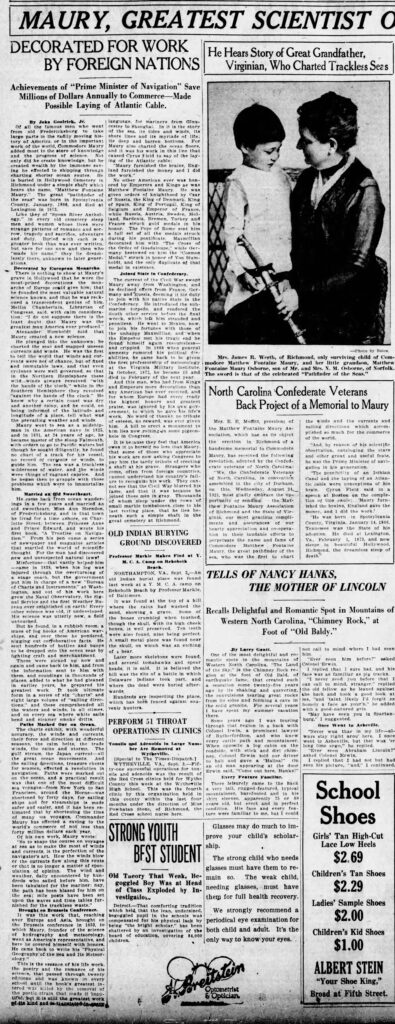
He Hears Story of Great Grandfather, Virginian, Who Charted Trackless Seas
Mrs. James R. Werth, of Richmond, only surviving child of Commodore Matthew Fontaine Maury, and her little grandson, Matthew Fontaine Maury Osborne, son of Mr. and Mrs. N. M. Osborne, of Norfolk. The sword is that of the celebrated “Pathfinder of the Seas.”
North Carolina Confederate Veterans Back Project of a Memorial to Maury
Mrs. E. E, Moffitt, president of the Matthew Fontaine Maury Association, which has as its object the erection in Richmond of a handsome memorial to Commodore Maury, has received the following resolution, adopted by the Confederate veterans of North Carolina:
“We, the Confederate Veterans of North Carolina, in convention assembled in the city of Durham, on this, Wednesday, August 24. 1921, most gladly embrace the opportunity of sending n the. Matthew Fontaine Maury Association of Richmond and the State of Virginia, our most gracious compliments and assurances of our hearty appreciation and cooperation in their laudable efforts to perpetuate the name and fame of Commodore Matthew Fontaine Maury, the great pathfinder of the sea, who was the first to chart the winds and the currents and sailing directions which accomplished so much for the commerce of the world.
“And, by reason of his scientific observation, cataloging the stars and other great and useful feats, he was the Prime Minister of navigation in his generation.
“The possibility of an Isthian Canal and the laying of an Atlantic cable were conceptions of his brain. Cyrus Field said in a speech at Boston on the completion of this cable: Maury furnished the brains, England gave the money, and I did the work.
“He was born in Spotsylvania County, Virginia, January 14, 1806. Tennessee was the State of his adoption. He died at Lexington, Va., February 1, 1873, and now Sleeps in beautiful Hollywood, Richmond, the dreamless sleep of death.