

Birth of a Nation
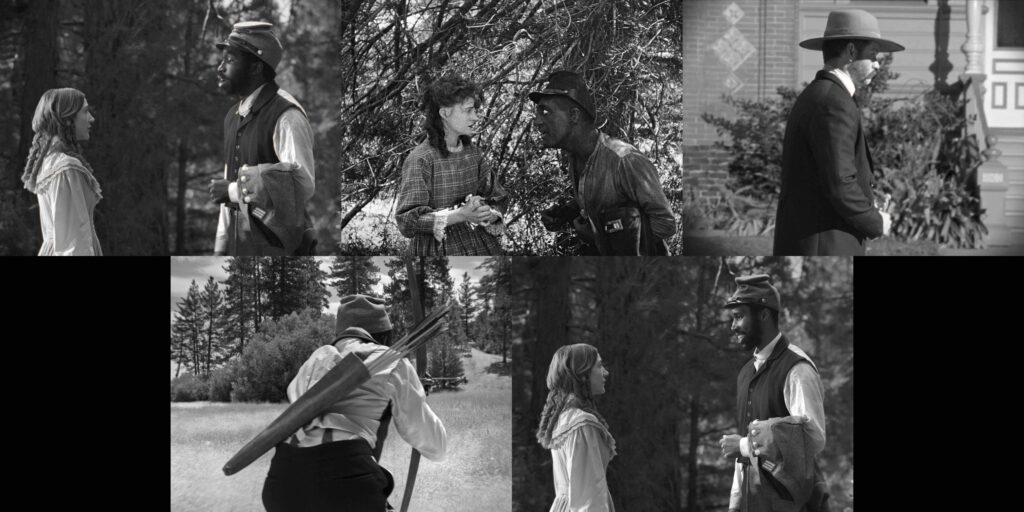
Birth of a Nation, 2025
Five channel video installation (color; silent
13:20 minutes
Commissioned by the Hartwig Foundation with The Brick
Courtesy of the artist, Victoria Miro, and David Zwirner
Filed Under:
Stan Douglas
(b. 1960, Vancouver; lives in Vancouver)
Filmmaker Stan Douglas often works at the crossroads of popular media and historical events, deploying cases of mistaken identity and doppelgängers to tell alternative narratives. On the occasion of MONUMENTS, he reimagines a pivotal scene from D. W. Griffith’s landmark 1915 film The Birth of a Nation, which is perhaps the most impactful monument to the Confederacy.
Released fifty years after the end of the Civil War and made by the son of a Confederate veteran, The Birth of a Nation presents a crystallized version of the Lost Cause, framing an imagined past as historical fact. By the time the film had premiered, the Lost Cause had firmly taken hold, permeating historical memory across the nation. The United Daughters of the Confederacy had erected hundreds of Confederate monuments across the Southern landscape, Jim Crow segregation laws were fully in effect, Reconstruction had been deemed a failure, and sectional strife between white Northerners and Southerners had been greatly alleviated, in no small part due to their joint service in the Spanish American War.
Based on Thomas Dixon’s 1905 novel The Clansman, the film follows two white families—one Southern, one Northern—through the Civil War and Reconstruction. The film was a widespread sensation; it grossed $50-$100 million, the highest box office (adjusted for inflation) until Gone With the Wind was released in 1939. The Birth of a Nation was also among the first films screened at the White House, by then-president Woodrow Wilson, who is quoted in the opening title cards. Despite its success, the film was not without controversy, spawning protests from the NAACP for the depiction of Black people as well as from white Northern audiences denouncing the historical distortion of the war. Griffith’s film has not only influenced the popular view of the Confederacy and Reconstruction, it also inspired the rebirth of the Ku Klux Klan.
One of the film’s most memorable scenes is the lynching of Gus. The series of events that sets this in motion begins with Flora, a young Southern white woman, going into the forest to fetch water. She is lecherously stalked by Gus, a Black Union veteran played by a white actor in blackface. Once alone, Gus proposes marriage to Flora, who rebuffs him and flees in fear. Gus chases after Flora, ostensibly to force himself upon her. Finding herself at the edge of a cliff, she threatens to jump if Gus comes any closer. Gus advances, and Flora, a paragon of chaste Southern womanhood, jumps. Flora’s brother Ben finds her body at the base of the cliff and wipes the blood from her mouth with a Confederate flag. In retaliation for her death, he leads a party of costumed Ku Klux Klan members to lynch Gus. Throughout the film, racial terror perpetrated by the Klan is presented as valiant and righteous.
Black actors appear throughout the film, including in the immediately preceding scene in which Black legislators legalize miscegenation while looking directly at the white women standing on the balcony of the statehouse. But Griffith notably chose to use white actors in blackface to portray the main characters in the film so as to have “no black blood amongst the principals.” Direct interaction between a white and Black actor in the scene between Gus and Flora would have violated the racial norms of the time. This casting decision underscores the unreality of the Flora-Gus scene. The fact that a real Black man and white woman could not have acted together in such intimacy is, in and of itself, telling of the extent to which Gus’s proposal would have been unthinkable and therefore the product of a white imaginary fueled by fears of miscegenation.
Douglas uses this fifteen-minute portion of Griffith’s film as source material for a new five-channel installation in which he reenvisions the lynching and its preceding events. However, Douglas introduces additional protagonists, Tom and Sam, two Black Union veterans who do not appear in the original film. Upending the conceit that one Black man is all Black men, Douglas shows that the one Black man upon whom all others are based is a caricature stemming from irrational fears that are psychosexual in nature. In Douglas’s Birth of a Nation, the original film plays alongside the events from the perspectives of Ben, Flora, Tom, and Sam. Portrayed by a white actor in blackface, Gus’s character is a figment of the imagination, ungrounded in any reality. This is latent in the original, while in Douglas’s version the introduction of two Black characters portrayed by Black actors makes this manifest. Whenever we are provided with Ben and Flora’s perspective, we see only Gus. Sam and Tom can’t be seen, only Gus, who is exposed as a racist amalgam of Ben and Flora’s fantasies.
For the interactions between Flora and Gus, Douglas chose to stick with Griffith’s “movie logic,” in which Sam, played by a Black actor, asks Flora, a white woman, to marry him, flouting deeply entrenched mores of the time. She rejects him in disgust, and when he grabs her hand, she slaps him. Feeling embarrassed and dejected, Sam returns home and drinks whiskey in solitude. Flora continues walking through the woods, looking over her shoulder, worried that she is being pursued. Tom, who is hunting nearby, sees Flora atop an outcropping of rocks and urges her to be careful. To Flora, Tom appears to be the same man whom she had just left in the woods. She venomously tells him to get away from her before falling to her death. Though he has done nothing wrong, he realizes he is in the wrong place at the wrong time. Tom flees the scene just as Ben discovers Flora’s body.
Unlike Griffith, Douglas cast a Black actor to play Gus, using CGI to digitally replace both Sam and Tom’s face with this third actor’s face in the white characters’ channels. Here, Douglas emphasizes that Gus does not have a corporeal body but is a projection by Ben and Flora, who are incapable of seeing Sam or Tom as individuals. Gus was never real to begin with. In that regard, the actors portraying Sam and Tom cannot be free of projection. In contrast, Sam and Tom are emotionally complex characters who experience sadness, compassion, and fear.
Following Flora’s death, Ben rouses the Ku Klux Klan to find and lynch Sam for the transgression of making romantic advances toward a white woman. They go looking for him at the local bar and in a brief moment of levity, Douglas explains Griffith’s bar-fight scene, in which one white man singlehandedly defeats a crowd of Black men, as a fantasy. In Douglas’s version, this man is knocked unconscious and dreams the outcome, a manifestation of his belief in the superiority of the white race.
The final moments of Douglas’s piece consist of three distinct scenes. After avenging Flora’s death, Ben mourns with family. This scene follows Griffith’s original and plays out over three adjacent channels. The other two scenes, however, are devised wholly by Douglas. On one channel, Sam packs his belongings and leaves home. Though he stops to put on his Union soldier cap, he ultimately leaves it and the rest of the uniform behind, recognizing that having served the country will not improve his lot in life. Sam exits into the light; while his fate is unknown to him, it is known to us at a sociohistoric level. The space between 1865 and the present is a century-long struggle for civil rights.
Finally, whether mistaking one Black man for another or caring more about extrajudicial violence than vigilante justice, Klansmen capture Tom and lynch him. In stark contrast with Griffith’s original film, Douglas’s version frames the lynching not as an act of heroism but rather a violent act of terrorism aimed at maintaining white supremacy and racial social control. Here, Douglas introduces a stark cut to color reminiscent of The Wizard of Oz. Tom is shown hanging with his feet dangling, surrounded by Klansmen, the forest background replaced by a blue screen. Tom is mechanically lowered to the ground and the camera pans left, revealing the soundstage on which the film is being made. A production assistant in contemporary clothing leads the horse in Klan regalia outside, mirroring Sam’s open door, exposing the artifice behind everything the viewer has just seen.
Unlike Oz, where Technicolor represents fantasy, Douglas’s use of color draws attention to the pastness of Griffith’s black-and-white fiction as distinct from our current reality. This begs the question—in what ways is this present accountable to the legacies of slavery? Further, the 1915 film cannot be discounted due to its significance to both film history and popular understandings of historical narrative. All in all, Douglas signifies the subjectivity of filmmaking, in direct opposition to Woodrow Wilson’s reported statement about the original Birth of a Nation that “It’s like writing history with lightning.”
Stan Douglas
Since the 1980s, Stan Douglas (b. 1960) has created films, photographs, and other multidisciplinary projects that investigate the parameters of their respective mediums. His ongoing inquiry into technology’s role in image making, and how those mediations infiltrate and shape collective memory, has resulted in works that are at once specific in their historical and cultural references and broadly accessible.
Douglas was born in Vancouver and studied at Emily Carr College of Art in Vancouver in the early 1980s. He was one of the earliest artists to be represented by David Zwirner, where he had his first American solo exhibition in 1993—the second show in the gallery’s history.
In 2022, the artist represented his native Canada at the Venice Biennale, where he debuted a major video installation, ISDN (2022)—now in the collection of the National Gallery of Canada, San Francisco Museum of Modern Art, and The Museum of Modern Art, New York—and a related body of photographs. A solo exhibition featuring this body of work, Stan Douglas: 2011 ≠ 1848, traveled around Canada with stops at The Polygon Gallery, Vancouver (fall 2022); Remai Modern, Saskatoon (February–April 2023); and the National Gallery of Canada, Ottawa (September 2023–October 2024). A solo exhibition also titled 2011 ≠ 1848 was subsequently staged in 2023 at De Pont Museum, Tilburg, the Netherlands. This body of work inaugurated David Zwirner’s Los Angeles location in 2023 and was on view at the Parque de Serralves in Porto, Portugal, in 2024.
The artist’s permanent public commission Penn Station’s Half Century was unveiled in Moynihan Train Hall, Penn Station, New York, in 2021. This body of work, commissioned by Empire State Development in partnership with Public Art Fund on the occasion of the dedication of New York City’s new Moynihan Train Hall, is composed of nine vignettes arranged into four thematic panels that explore the rich history of Penn Station.
Douglas’s work has been the subject of solo exhibitions at prominent institutions worldwide since the 1980s. A major solo exhibition, Stan Douglas: Ghostlight, is currently on view at the Hessel Museum of Art, Bard College, Annandale-on-Hudson, New York, marking the first institutional survey of the artist’s work in the United States in over 20 years. The accompanying monograph was published in conjunction with the Kemper Museum of Contemporary Art, Kansas City, Missouri, where another solo exhibition of Douglas’s work was recently on view. Previous solo presentations of the artist’s work have been held at DAS MINSK Kunsthaus, Potsdam, Germany (2022); Phi Foundation, Montreal (2022); Art Gallery of Nova Scotia, Halifax (2022); Bourse de Commerce, Pinault Collection, Paris (2021); Toledo Museum of Art, Ohio (2021); Julia Stoschek Collection, Berlin (2019–2020); Musée d’Art Moderne Grand-Duc Jean (MUDAM), Luxembourg (2018); Pérez Art Museum Miami (2016); Salzburger Kunstverein, Salzburg, Austria (2016); Hasselblad Center, Gothenburg, Sweden (2016); WIELS Centre d’Art Contemporain, Brussels (2015); and Museu Coleção Berardo, Lisbon (2015).
In 2013, a major survey of the artist’s work, Stan Douglas: Photographs 2008–2013, was presented at Carré d’Art – Musée d’Art Contemporain in Nîmes, France. It traveled as Stan Douglas: Mise en scène to Haus der Kunst, Munich; Nikolaj Kunsthal, Copenhagen; and Irish Museum of Modern Art, Dublin through 2015. Additional solo exhibitions include the Fruitmarket Gallery, Edinburgh (2014); Minneapolis Institute of Arts (2012); Staatsgalerie Stuttgart and Württembergischer Kunstverein, Stuttgart (2007); The Studio Museum in Harlem, New York (2005); Serpentine Gallery, London (2002); Centre Pompidou, Paris (1994); and Art Gallery of Ontario, Toronto (1987).
Douglas’s work has been featured in the Venice Biennale in 1990, 2001, 2005, 2019, and 2022, and in documenta in 1992, 1997, and 2002. Douglas’s first multimedia theater production, Helen Lawrence, debuted at The Arts Club Theatre Company, Vancouver, in March 2014 and has subsequently been hosted by the Münchner Kammerspiele, Munich; Edinburgh International Festival; Canadian Stage, Toronto; Brooklyn Academy of Music, New York; De Singel, Antwerp; and Center for the Art of Performance, University of California, Los Angeles (co-organized by Los Angeles County Museum of Art).
Douglas has been the recipient of notable awards, including the Audain Prize for Visual Art (2019); the Hasselblad Foundation International Award in Photography (2016); the third annual Scotiabank Photography Award (2013); and the Infinity Award from the International Center of Photography, New York (2012). In 2021, Douglas was knighted as a Chevalier of the Ordre des Arts et des Lettres by the French Minister of Culture, and in 2023 he was awarded an honorary doctorate by Simon Fraser University, Greater Vancouver. Douglas was appointed as an Officer of the Order of Canada in 2024.
Work by the artist is held in major museum collections worldwide, including the Art Gallery of Ontario, Toronto; Centre Pompidou, Paris; Los Angeles County Museum of Art; Museum of Contemporary Art Chicago; The Museum of Modern Art, New York; National Gallery of Canada, Ottawa; Pérez Art Museum Miami; San Francisco Museum of Modern Art; Solomon R. Guggenheim Museum, New York; Tate, United Kingdom; Vancouver Art Gallery; and Walker Art Center, Minneapolis. Douglas lives and works in Vancouver.

Birth of a Nation, 2025
Five channel video installation (color; silent
13:20 minutes
Commissioned by the Hartwig Foundation with The Brick
Courtesy of the artist, Victoria Miro, and David Zwirner 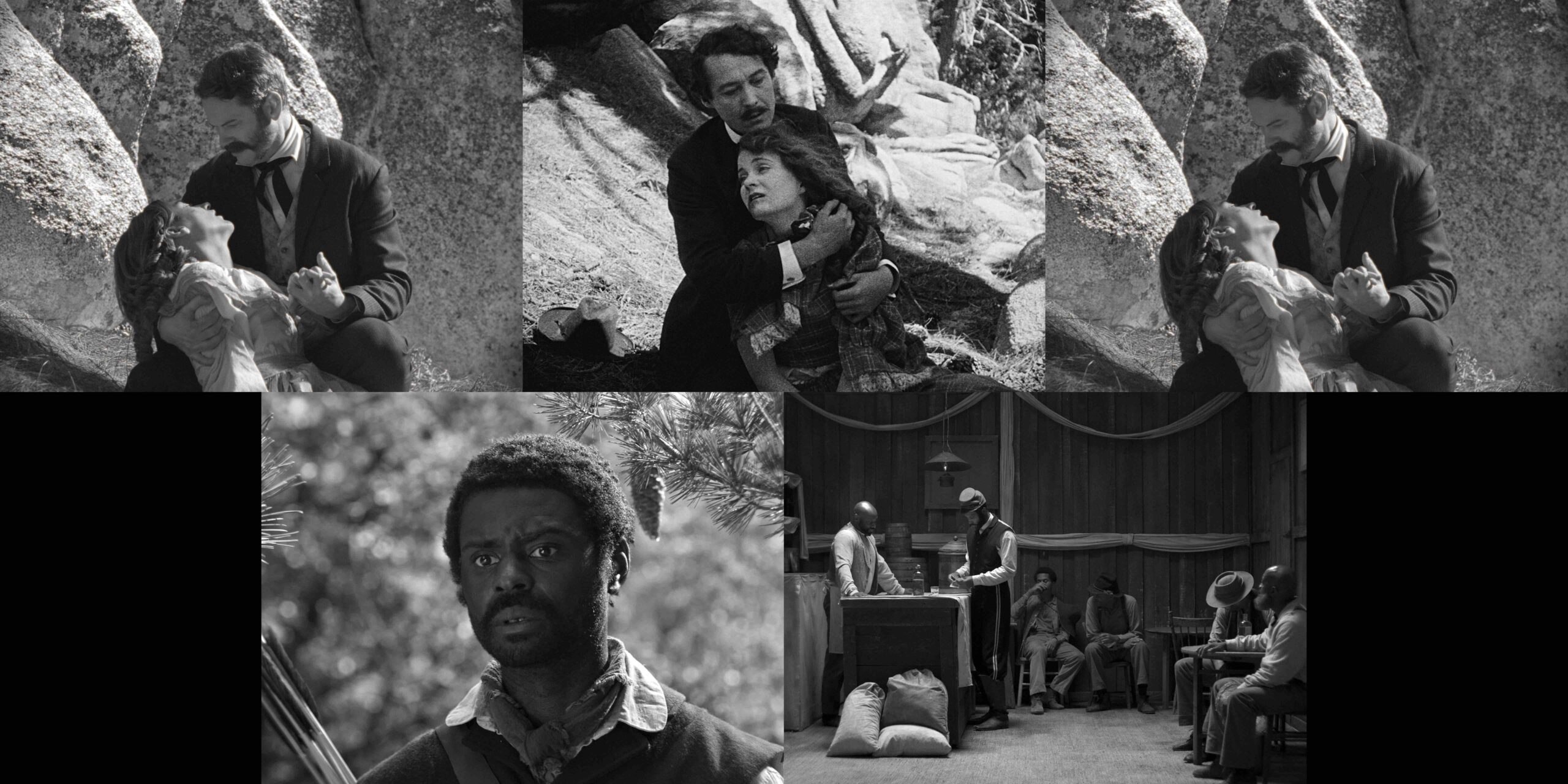
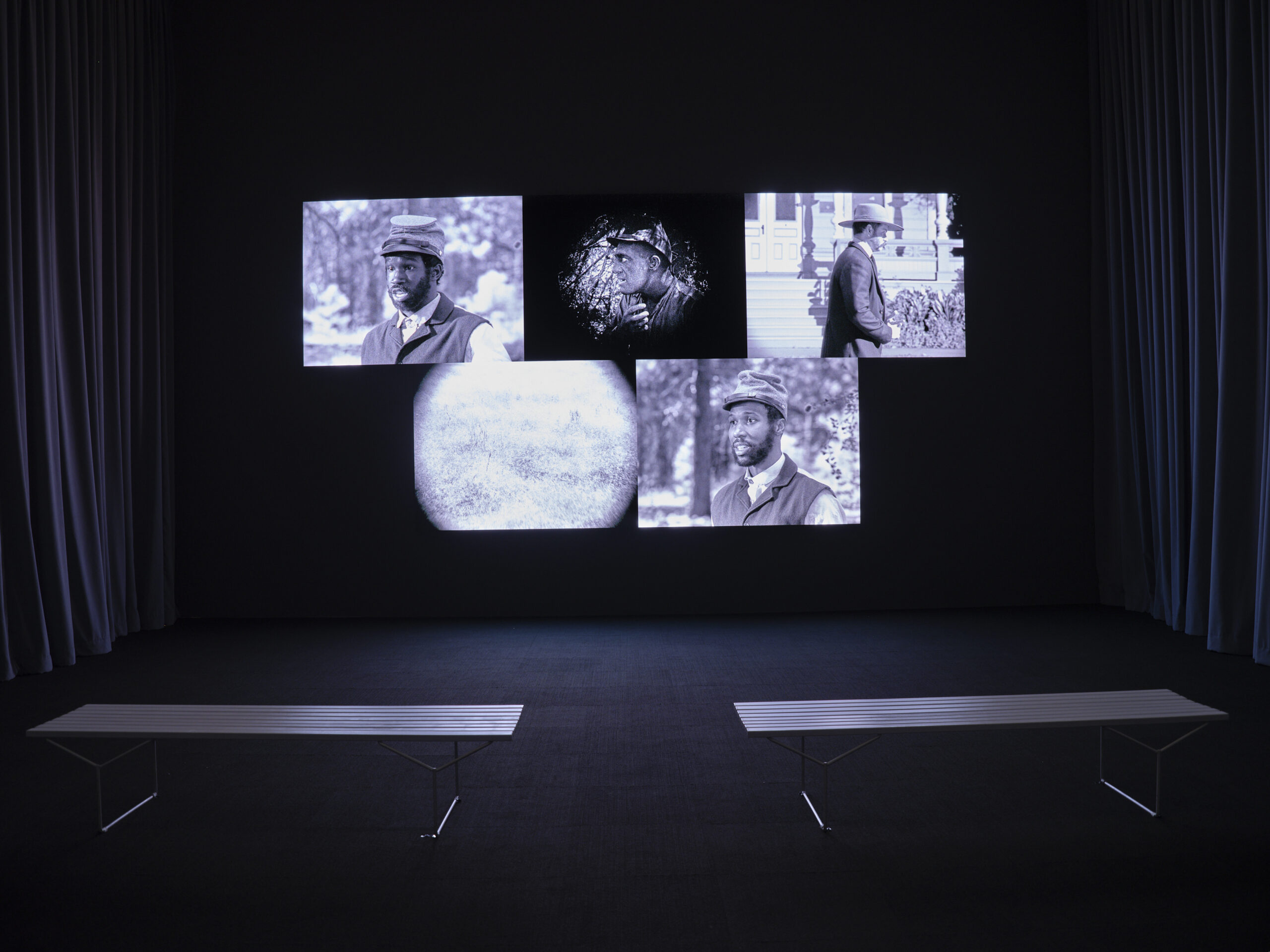
Birth of a Nation (installation view)
Photo by Frederik Nilsen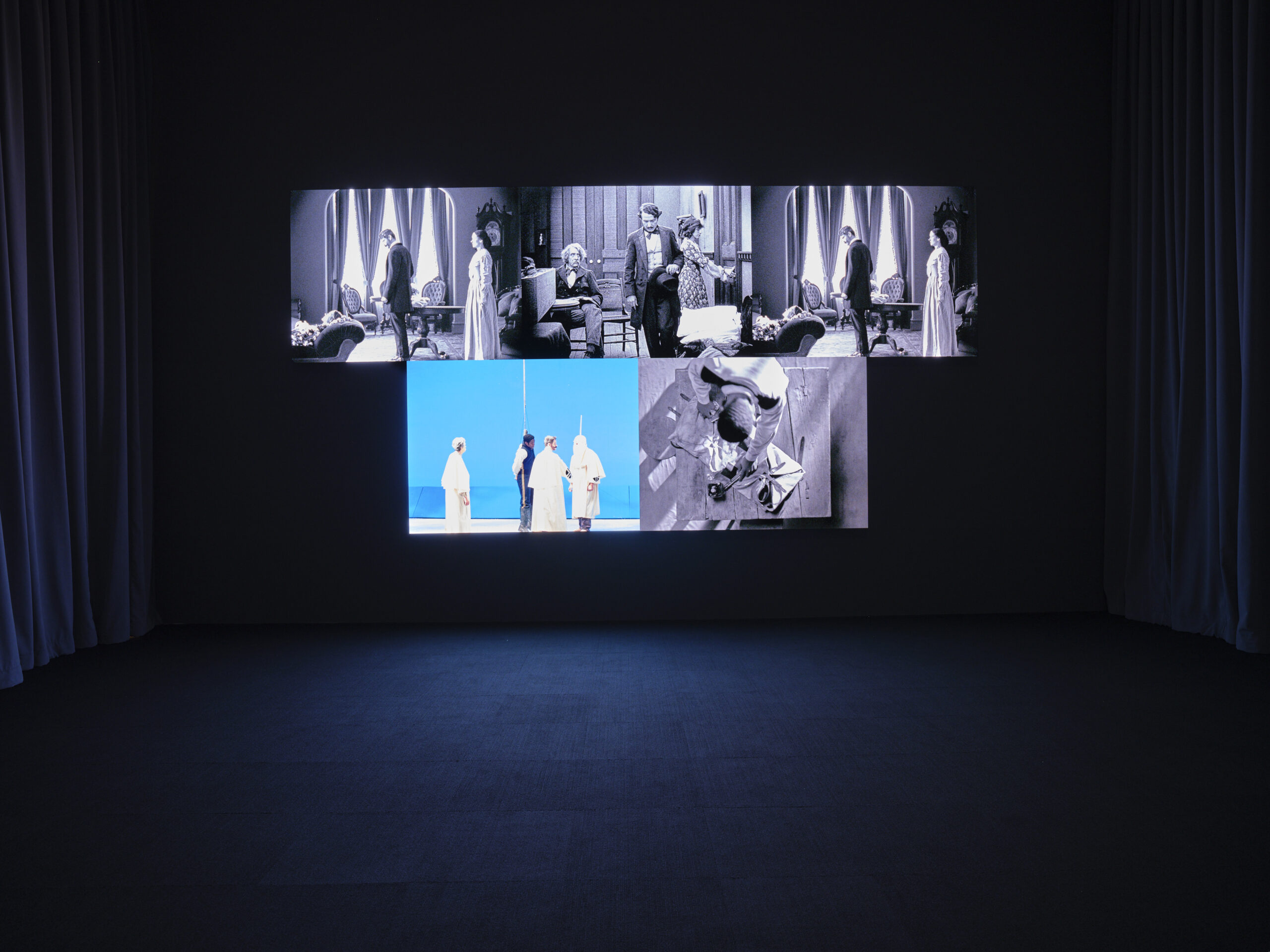
Birth of a Nation (installation view)
Photo by Frederik Nilsen