

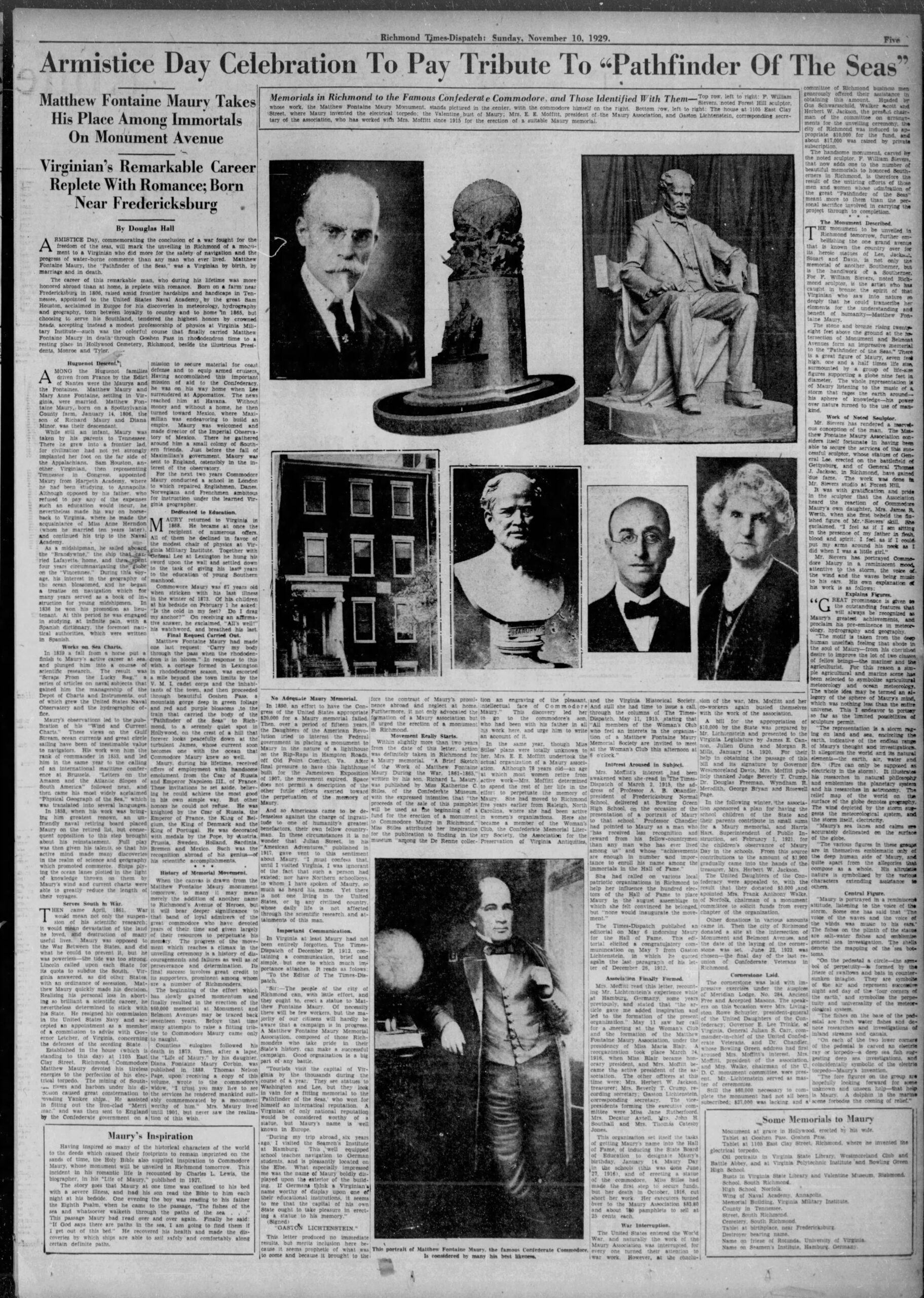
Richmond Times-Dispatch · Nov 10, 1929
Armistice Day Celebration To Pay Tribute To “Pathfinder Of The Seas”
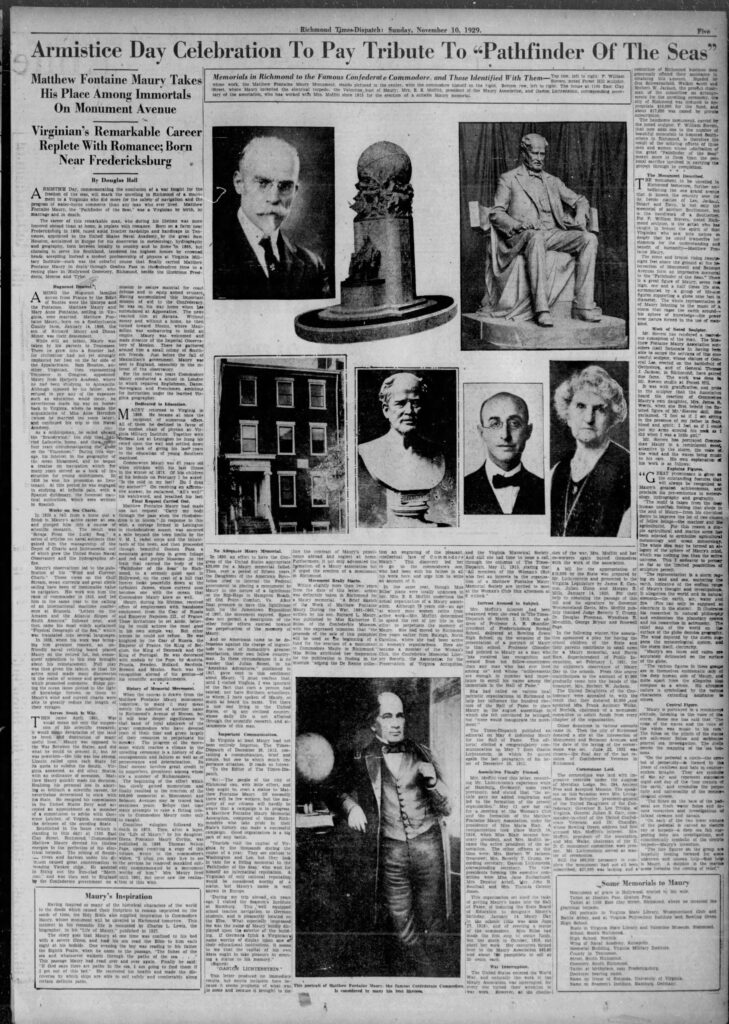
Memorials in Richmond to the Famous Confederate Commodore, and Those Identified With Them—Top row, left to right: F. Willam Sievers, noted Forest Hill sculptor, whose work, the Matthew Fontaine Maury Monument, stands pictured in the center, with the commodore himself on the right. Bottom row, left to right: The house at 1105 East Clay Street, where Maury invented the electrical torpedo; the Valentine bust of Maury; Mrs. E. E. Moffitt, president of the Maury Association, and Gaston Lichtenstein, corresponding secret since 1915 for the erection of a suitable Maury memorial
Matthew Fontaine Maury Takes His Place Among Immortals On Monument Avenue
Virginian’s Remarkable Career Replete With Romance; Born Near Fredericksburg
By Douglas Hall
ARMISTICE Day, commemorating the conclusion of a war fought for the freedom of the seas, will mark the unveiling in Richmond of a monument to a Virginian who did more for the safety of navigation and the progress of water-borne commerce than any man who ever lived. Matthew Fontaine Maury, the “Pathfinder of the Seas,” was a Virginian by birth, by marriage and in death.
The career of this remarkable man, who during his lifetime was more honored abroad than at home, is replete with romance. Born on a farm near Fredericksburg in 1806, raised amid frontier hardships and handicaps in Tennessee, appointed to the United States Naval Academy by the great Sam Houston, acclaimed in Europe for his discoveries in meteorology, hydrography and geography, torn between loyalty to country and to home in 1865, but choosing to serve his Southland, tendered the highest honors by crowned heads, accepting Instead a modest professorship of physics at Virginia Military Institute-such was the colorful course that finally carried Matthew Fontaine Maury in death through Goshen Pass in rhododendron time to a resting place in Hollywood Cemetery, Richmond, beside the illustrious Presidents, Monroe and Tyler.
Huguenot Descent.
AMONG the Huguenot families driven from France by the Edict of Nantes were the Maurys and the Fontaines. Matthew Maury and Mary Anne Fontaine, settling in Virginia,
were married. Matthew Fontaine Maury, born on a Spottsylvania County farm, January 14, 1806, the son of the Richard Maury and Diana Minor, was their descendant.
While still an infant, Maury was taken by his parents to Tennessee There he grew into into a frontier lad, civilization had not yet strongly implanted her toot on the far side of the Appalachians. other Virginian, Sam Houston, another Virginian, then representing Tennessee in Congress, appointed Maury from Harpeth Academy, where he had been studying, to Annapolis Although opposed by his father. refused to pay any of the expenses such an education would incur, he nevertheless made his way on horseback to Virginia, where he made the acquaintance Miss Anne Herndon (whom he married ten years later), and continued his trip to the Naval Academy.
As a midshipman, he sailed aboard the “Brandywine the ship that carried Lafayette home, and then spent four years circumnavigating the, globe on the “Vincennes.” During this voyage, his interest in the the ocean blossomed, geography of and he began a treatise on navigation which for many years served as a book of instruction for young midshipmen. In 1836 he won his promotion as lieutenant. At this period he was engaged in studying, at infinite pain, with a Spanish dictionary, the foremost nautical authorities, which were written in Spanish.
Works on Sea Charts.
In 1839 a fall from a horse put a finish to Maury’s active career at sea, and plunged him into course of scientific research. The result was “Scraps From the Lucky Bag,” series of articles on naval subjects that gained him the managership of the Depot of Charts and Instruments, out of which grew the United States Naval Observatory and the hydrographic office.
Maury’s observations led to the publIcation of his “Wind and Current Charts.” These views on the Gull Stream, ocean currents and great circle sailing have been of inestimable value to navigators. His work won him “the rank of commander in 1833, and led him in the same year to the calling of an International maritime conference at
Brussels. “Letters On Amazon and the the Atlantic Slopes of South America” then followed next, and came his most widely acclaimed “Physical Geography of the Sea,” translated which was translated into several languages.
In 1853, when his work was bringing him greatest renown, friendly naval an un-friendly retiring board placed Maury on the retired list, placed but consequent opposition to this
step brought about his reinstatement. Full play was then given his talents, so that his active mind made many discoveries in the realm of science and geography which promoted commerce. Ships plying the ocean lanes plotted in the light of knowledge thrown on them by Maury’s wind and current charts were able to greatly reduce the length of their voyages.
Serves South in War.
THEN came April, 1861. War would mean not only the suspension of his scientific research: it would mean devastation of the land he loved, and destruction of many useful lives. Maury was opposed to the War Between the States, and did what he could to prevent it, but he was powerless-the tide was too strong. Lincoln called upon each State for its quota to subdue the South. Virginia answered, as did other States, with an ordinance of secession. Matthew Maury quickly made his decision. Realizing his personal loss in aborting so brilliant a scientific career, he nevertheless determined to stick with his State. He resigned his commission in the United States Navy and accepted an appointment as a member of a commission to advise with Governor Letcher of Virginia, concerning the defenses of the seceding State.
Established in the house (which is standing to this day) at 1105 East Clay Street, Richmond. Commodore Matthew Maury devoted his tireless energies to the perfection of his electrical torpedo. The mining of Southern rivers and harbors under his discretion caused great consternation to invading Yankee ships. He assisted in fitting out the iron-clad “Merrimac,” and was then sent to England by the Confederate government on a mission to secure material for coast defense and to equip armed cruisers, Having accomplished this important mission of aid to the Confederacy, he was on his way home when Lee surrendered at Appomattox. The news reached him at Havana. Without money and without a home, he then turned toward Mexico, where Maximilian was endeavoring to build an empire. Maury was welcomed and made director of the Imperial Observatory of Mexico. There he gathered around him a small colony of Southern friends. Just before the fall of Maximilian’s government, Maury was sent to England, ostensibly in the interest of the observatory.
For the next two years Commodore Maury conducted a school in London to which repaired Englishmen, Danes, Norwegians and Frenchmen ambitious for instruction under the learned Virginia geographer.
Dedicated to Education.
MAURY returned to Virginia in 1868. He became at once the recipient of numerous offers. All of them he declined in favor of the modest chair of physics at the Virginia Military Institute. Together with General Lee at Lexington he hung his sword upon the wall and settled down to the task of giving his last “years to the education” of young Southern manhood.
Commodore Maury was 67 years old when stricken with his last illness in the winter of 1873. Of his children at his bedside on February 1 he asked: “Is the cold in my feet? Do I drag my anchor?” On receiving an affirmative answer, he exclaimed, “All’s well!” his watchword, and breathed his last.
Final Request Carried Out.
Matthew Fontaine Maury had made one last request: “Carry my body through the pass when the rhododendron is in bloom.” In response to this wish, a cortege formed in Lexington in rhododendron season, was escorted a mile beyond the town limits by the V.M.I. cadet corps and the inhabitants of the town, and then proceeded through beautiful Goshen Pass, a mountain gorge deep in green foliage and red and purple blossoms, to the train that carried the body of the “Pathfinder of the Seas” to Richmond, to a serenely quiet spot in Hollywood, on the crest of a hill that peacefully forever looks down at the turbulent James, whose current soon becomes one with the ocean that Commodore Maury knew so well.
Maury, during his lifetime, received offers of employment with handsome emolument
from the Czar of Russia and Emperor Napoleon III of France. These invitations he set
aside, believing he could achieve the most good in his own simple way. But other honors he could not refuse. He was knighted by the Czar of Russia, Emperor of France, the King of Belgium, the King of Denmark and the King of Portugal. He was decorated with medals by the Pope, by Austria Prussia, Sweden, Holland. Sardinia, Bremen and Mexico. Such was the recognition abroad of his genius —of his scientific accomplishments.
History of Memorial Movement,
When the canvas is drawn from the Matthew Fontaine Maury monument tomorrow, to many it may mean merely the addition of another name to Richmond’s Avenue of Heroes, but it will bear deeper significance to that band of loyal admirers of the great commodore who have devoted years of their of their time and given largely resources to perpetuate his memory. The progress of the movement which reaches a climax in the unveiling ceremony is a history of discouragements and failures as well as of perseverance and determination. Its final success involves great credit to Its supporters, prominent among whom are a number of Richmonders.
The beginning of the effort which has slowly gained momentum and finally resulted in the erection of the $60,000 memorial at Monument and Belmont Avenues may be traced back seventeen years. Before that time many attempts to raise a fitting tribute to Commodore Maury came only to naught.
Countless eulogizes followed his death in 1878. Then, after a lapse, the “Life of Maury.” by his daughter, Diana Fontaine Maury Corbin, was published in 1888. Thomas Nelson Page, upon receiving a copy of this volume, wrote to the commodore’s widow, “I trust you may live to see the services he rendered mankind suitably commemorated by a monument worthy of him.” Mrs. Maury lived until 1901, but never saw the realization of this wish.
Maury’s Inspiration
Having inspired so many of the historical characters of the world to the deeds which caused their footprints to remain imprinted on the sands of time, the Holy Bible also supplied inspiration to Commodore Maury, whose monument will be unveiled in Richmond tomorrow. This incident in his romantic life is recounted by Charles L, Lewis, the biographer, in his “Life of Maury,” published in 1927.
The story goes that Maury at one time was confined to his bed with a severe illness, and had his son read the Bible to him each night at his bedside. One evening the boy was reading to his father the Eighth Psalm, when he came to the passage, sea and whatsoever walketh through the paths of the sea “The fishes of the this passage Maury had read over and over again. Finally he said: “If God says there are paths in the sea, I am going to find them it I get out of this bed.” He recovered his health and made the discoveries by which ships are able to sail safely and comfortably along certain definite paths.
No Adequate Maury Memorial.
In 1890, an effort to have the Congress of the United States appropriate $20.000 for a Maury memorial failed. Then, over a period of fifteen years, the Daughters of the American Revolution tried to interest the Federal government in placing a monument to Maury in the nature of a lighthouse on the Rip-Raps in Hampton Roads off Old Point Comfort, Va. After final pressure to have this lighthouse built for the Jamestown Exposition by 1907, the movement expired. Space does not permit description of the other futile efforts exerted toward the perpetuation of the memory of Maury.
And so Americans came to be defenseless against the charge of ingratitude to one of humanity’s greatest benefactors, their own fellow countryman. In these circumstances it is no wonder that Julian Street in his “American Adventures,” published in 1917, gave vent to this sentiment about Maury. “I must confess that, until I visited Virginia, I was ignorant of the fact that such a person had existed: nor have Northern schoolboys,
to whom I have spoken of Maury, so much as heard his name. Yet there is not one living in the United States, or in any civilized country whose daily life is not affected through the scientific research, and attainments of this man.
Important Communication.
In Virginia at least Maury had not been entirely forgotten. The Times-Dispatch of December 26, 1912, containing a communication, brief and simple, but one to which much importance attaches. It reads as folows:
“To the Editor of The Times-Dispatch,
“Sir:–The people of the city of Richmond can, with little effort, and they ought to, erect a statue to Matthew Fontaine Maury. Of necessity there will be few workers, but the majority of our citizens will hardly be aware that a campaign is in progress. A Matthew Fontaine Maury Memorial Association, composed of those Richmonders who take pride in their State’s history, can make a successful campaign. Good organization is a big part of any battle.
“Tourists visit the capital of Virginia by the thousands during the course of a year. They see statues to Washington and Lee, in vain for a fitting memorial to the ‘Pathfinder of the Seas,’ who won for himself an international reputation. A Virginian of only national reputation would be considered worthy of a statue, but Maury’s name is well known in Europe.
“During my trip abroad, six years ago, I visited the Seamen’s Institute at Hamburg. This well equipped school teaches navigation to German students and is pleasantly located on the Elbe. What especially impressed me was the name of Maury boldly displayed
upon the exterior of the building. It Germans think a Virginian’s name worthy of display upon one of their educational institutions, it seems to me that the capital of his own State ought to take pleasure in erecting a statue to his memory.” (Signed)
“GASTON LICHTENSTEIN.”
This letter produced no immediate results, but merits inclusion here because it seems prophetic of what was to come and because it brought to the fore the contrast of Maury’s prominence abroad and neglect at home. Furthermore, it not only advocated the formation of a Maury association but it urged the erection of a monument in Richmond.
Movement Really Starts.
Within slightly more than two years from the date of this letter, action was definitely taken in Richmond for a Maury memorial. “A Brief Sketch of the Work of Matthew Fontaine Maury During the War, 1861-1865,” written by his son, Richard L.. Maury, was published by Miss Katherine C. Stiles, of the Confederate Museum with the expressed intention that “the proceeds of the sale of this pamphlet will be used as the beginning of a fund for the erection of a monument to Commodore Maury in Richmond.” Miss Stiles attributed her inspiration for the publication to finding in the museum among the De Renne collection of an engraving of the pleasant intellectual face of Commodore Maury.” This discovery led her to go to the commodore’s son who had been with his father in all his work here, and urge him to write an account of it.
In the same year, though Miss Stiles’ plans were totally unknown to her, Mrs. E.E. Moffitt undertook the actual organization of a Maury association. Although 78 years old — an age at which most women retire from active work — Mrs. Moffitt determined to spend the rest of her life in the effort to perpetuate the memory of Maury. She had moved to Richmond five years earlier from Raleigh, North Carolina, where she had been active in women’s organizations. Here she became a member of the Woman’s Club, the Confederate Memorial Literary Society, the Association for the Preservation of Virginia Antiquities, and the Virginia Historical Society. And still she had time to issue a call, through the columns of The Times-Dispatch, May 11, 1915, stating that “All members of the Woman’s Club who feel an interest in the organization of a Matthew Fontaine Maury Memorial Society are invited to meet at the Woman’s Club this afternoon at 6 o’clock.”
Interest Aroused in Subject.
Mrs. Moftitt’s interest had been awakened when she read in The Times-Dispatch of March 2, 1915, the address of Professor A. B. Chandler, president of Fredericksburg Normal School, delivered at Bowling Green High School, on the occasion of the presentation of a portrait of Maury to that school. Professor Chandler had pointed to Maury as a man who
“has received less recognition and reward from his fellow-countrymen than any man
who has ever lived among us” and whose “achievements are enough in number and importance to enroll his name among the immortals in the Hall of Fame.”
She had called on various local patriotic organization in Richmond to help her influence the hundred electors of the Hall of Fame to place Maury int he august assemblage to which she felt convinced he belonged, but “none would inaugurate the movement.”
The Times-Dispatch published an editorial on May 6 endorsing Maury for the Hall of Fame. This editorial elicited a congratulatory communication on May 7 from Gaston Lichtenstein, in which he quoted again the last paragraph of his letter of December 26, 1912.
Association Finally Formed.
Mrs. Moffitt read this letter, recounting Mr. Lichtenstein’s experience while at Hamburg, Germany, some years previously, and stated that “the article gave me added inspiration and led to the formation of the present organization.” May 11 saw her call for a meeting at the Woman’s Club and the formation of the Matthew Fontaine Maury Association, under the presidency of Miss Maria Blair. A reorganization took place March 24, 1916, when Miss Blair became honorary president , and Mrs. Moffitt became the active president of the assocation. The other officers at this time were: Mrs. Herbert W. Jackson, treasurere; Mrs. Beverly T. Crump, recording secretary; Gaston Lichtenstein, corresponding secretary. The vice-presidents forming the executive committee were Miss Jane Rutherfoord. Mrs. Decatur Axtell, Mrs. John H. Southall and Mrs. Thomas Catesby Jones.
This organization set itself the tasks of getting Maury’s name into the Hall of Fame, of inducing the State Board of Education to designate Maury’s birthday, January 14, Maury Day in the schools (this was done June 27, 1916), and of erecting a statue of the commodore. Miss Stiles had made the first step to secure funds, but her death in the October, 1916, cut short her work. Her executors turned over to the Maury Association $83.80 and about 780 pamphlets to sell at 25 cents each.
War Interruption.
The United States entered the World War, and naturally the work of the Maury Association was interrupted for every one turned their attention to war work. However, at the conclusion of the war, Mrs. Moffitt and her co-workers again busied themselves with the work of the association.
A bill for the appropriation of $10,000 by the State was prepared by Mr. Lichtenstein and presented to the Virginia Legislature by James E. Cannon, Julien Gunn and Morgan R. Mills, January 14, 1920. For their help in obtaining the passage of this bill and its signature by Governor Westmoreland Davis, Mrs. Moffitt publicly thanked Judge Beverly T. Crump, DXr. Douglas Freeman, Wyndham R. Meredith, George Bryan and Rosewell Page.
In the following winter, the association sponsored a plan for having the school children of the State and their parents contribute in small sums for a Maury memorial, and Harris Hart, Superintendent of Public Instruction, set February 1, 1921, for the children’s observance of Maury Day in the chools. From the source contributions to the amount of $1,900 gradually came into the hands of treasurer, Mrs. Herbert W. Jackson.
The United Daughters of the Confederacy were appealed to with the result that they donated to, with eh result that they donated $5,000, and appointed Mrs. Frank Anthony Walke of Norfolk, chairman of a monument committee to solicit funds from every chapter of the organization.
Other donations in various amounts came in. Then the city of Richmond donated a site at the intersection of Monument and Belmont Avenues and the date of the laying of the cornerstone was set, June 22, 1922, was chosen — the final day of the last reunion of the Confederate Veterans in Richmond.
Cornerstone Laid.
The cornerstone was laid with impressive exercises under the auspices of Meridian Lodge No. 284, Ancient Free Masons. The speakers on this occasion were Mrs. Livingston Rowe Schuyler, president-general of the United Daughters of the Confederacy; Governor E. Lee Trickle of Virginia, General Julian S. Carr, commander-in-chief of the United Confederate Veterans, and Dr. Chandler whose Bowling Green address had first aroused Mrs. Moffitt’s interest. Mrs. Moffitt, president of the association and Mrs. Walke, Chairman of the U.D.C. monument committee were present. Mr. Lichtenstein served as master of ceremonies.
Still the $50,000 necessary to complete the monument had not all been subscribed; $27,000 was lacking and a committee of Richmond business men generously offered their assistance in obtaining this amount. Headed bye Gus Schwarschild Walker Scott and Herbert W. Jackson, the president chairman of the committee on arrangements for the unveiling ceremony, the city of Richmond was induced to appropriate $10,000 for the fund, and about $17,000 was raised by private subscription.
The handsome monument, carved by the noted sculptor, F. William Sievers, that now adds one of the number of beautiful memorials to honored Southerners in Richmond, is therefore the result of the untiring efforts of those men and women whose admiration of the great “Pathfinder of the Seas” meant more to them than the personal sacrifice involved in carrying the project through to completion.
The Monument Described.
The monument to be unveiled in Richmond tomorrow, further embellishing the one grand avenue that is known the country over for its heroic statues of Lee, Jackson, Stuart and Davis, is not only the memorial of another Southerner, but is the handiwork of a Southerner. For F. William Sievers, noted Richmond sculptor, is the artist who has caught in bronze the spirit of that Virginian who saw into nature so deeply that he could transcribe her elements for the understanding and benefit of humanity — Matthew Fontaine Maury.
The stone and bronze rising twenty eight feet above the ground at the intersection of Monument and Belmont Avenues from an impressive memorial to the “Pathfinder of the Seas.” There is a great figure of Maury, seven feet high, one and a half times life size figures supporting a globe nine feet in diameter. The whole representation is of Maury listening to the music of a storm that rages the earth around — his sphere of knowledge — his power over nature turned to the use of mankind.
Work of Noted Sculptor.
Mr. Sievers has rendered a marvelous conception of the man. The Matthew Fontaine Maury Association considers itself fortunate in having been able to secure the services of this successful sculptor, whose statues of General Lee, erected on the battlefield of Gettysburg, and of General Thomas J. Jackson in Richmond, have gained due fame. The work was done in Mr. Sievers studio at Forest Hill.
Its as with gratification and pride in the sculptor that the Association heard the reaction of Commodore Maury’s own daughter, Mrs. James R. Werth, when she first beheld the finished figure of Mr. Sievers’ skill. She exclaimed, “I feel as if I am sitting in the presence of my father in flesh, blood and spirit; I feel as if I could put my arms around his neck as I did when I was a little girl.”
Mr. Sievers has portrayed Commodore Maury in a reminiscent mood, attentive to the storm, the voice of the wind and the waves being music to his ears. His own explanation of his work is as follows;
Explains Figures.
“Great prominence is given so the outstanding features that will always be recognized as Maury’s greatest achievements, and proclaim his pre-eminence in meteorology, hydrography, and geography.
“The motif is taken from the deep human unselfish feeling that abode in the soul of Maury — from his cherished desire to improve the lot of two classes of fellow beings — the mariner and the agriculturists. For this reason, a simple agricultural and marine scene has been selected to symbolize agricultural meteorology and ocean meteorology. The whole idea may be termed an allegory of the sphere of Maury’s mind, which was nothing less than the entire universe. This I endeavor to portray so far as the limited possibilities of sculpture permit.
“The representation is a storm raging on land and sea, encircling the earth, indicative of the endless range of Maury’s thought and investigations. It allegorizes the world, and its natural elements — the earth, air, water and fire. (Fire can only be supposed as electricity in the storm). It illustrates his researches in natural philosophy and emblemizes the planetary system and his researches in astronomy. The relief map of the world on the surface of the globe denotes geography. The wind depicted by the storm suggests the meteorological system and the storm itself, electricity.
“Maury’s sea lanes and calms were accurately delineated on the surface of the globe.
“The various figures in these groups are in themselves emblematic only of the deep human side of Maury, and quite apart from the allegories that compose as a whole. His altrulate nature is symbolized by the various characters extending assistance so others.
Central Figure.
“Maury is portrayed in a reminiscent attitude, listening to the voice of the storm. Some one has said that ‘The voice of the waves and the voice of the winds was music to his ears.’ The fishes on the plinth of the statue are salt-water fishes and emblemizes general sea investigation. The shells denote the mapping of the sea bottoms.
“On the pedestal a circle —symbol of perpetuity — formed by the frieze of swallow sand bats in countersunk intaglio. They are symbols of the air and represent successive night and days of the ‘four corners of the earth,’ and symbolize the perpetuity and universality of the meteorological system.
“The fishes on the base of the pedestal are fresh water fishes and denote researches and investigations of inland streams and canals.
“On each of the two lower corners of the pedestal is carved an electric ray or torpedo — a deep sea fish suggesting deep sea investigations, and coincidentally symbolic of the electric torpedo — Maury’s invention.
“The fore figures on the group are hopefully looking forward for some unknown and unseen help— that help is Maury. A dolphin in the marine scene forbids the coming of relief.”
Some Memorials to Maury
- Monument at grave In Hollywood, erected by his wife.
- Tablet at Goshen Pass. Goshen Pass
- Tablet at 1105 East Clay Street, Richmond, where he invented the electrical torpedo.
- Oil portraits in Virginia State Library. Westmoreland Club and Battle Abbey, and at Virginia Polytechnic Institute and Bowling Green High School.
- Busts in Virginia State Library and Valentine Museum, Richmond.
- School, South Richmond.
- High School, Norfolk.
- Wing of Naval Academy, Annapolis.
- Memorial Building, Virginia Military Institute.
- County in Tennessee.
- Street, South Richmond.
- Cemetery, South. Richmond.
- Tablet at birthplace, near Fredericksburg.
- Destroyer, bearing name.
- Name on frieze of Rotunda, University of Virginia
- Name on Seamen’s Institute, Hamburg, Germany.