

Richmond Times-Dispatch · Oct 18, 2020
PAID OPINION ADVERTISEMENT
Who was Matthew Fontaine Maury?
The Pathfinder of the Seas
Maury’s Accomplishments:
- Internationally famous for his scientific ideas.
- Pondered ways to relieve human suffering.
- Humanitarian with humble faith.
- Investigated the sea and mapped the oceans.
- Endeavored through science to improve the condition of all mankind.
- Ocean maps still carry the phrase, “Founded upon the research made in the early part of the nineteenth century by Matthew Fontaine Maury.”
- Studied universal nature of weather patterns.
- Wrote the first textbook of modern oceanography: Physical Geography of the trans-Atlantic cable and the the Sea (1855).
- His research enabled the laying of the trans-Atlantic cable and the development of the submarine.
Biography:
- Born Jan 14th, 1806, in Spotsylvania County, Virginia.
- Husband, father, teacher who was renown.
- Became a midshipman in the U.S. Navy and circumnavigated the globe from 1826-1830.
- Recognized in Europe for his contributions to Science.
- Endured a stagecoach accident in 1839 which left him with a handicapped leg.
- Dreamed fo going to sea as a boy. His brother served as a naval officer in the War of 1812.
A Beautiful Work Of Art!
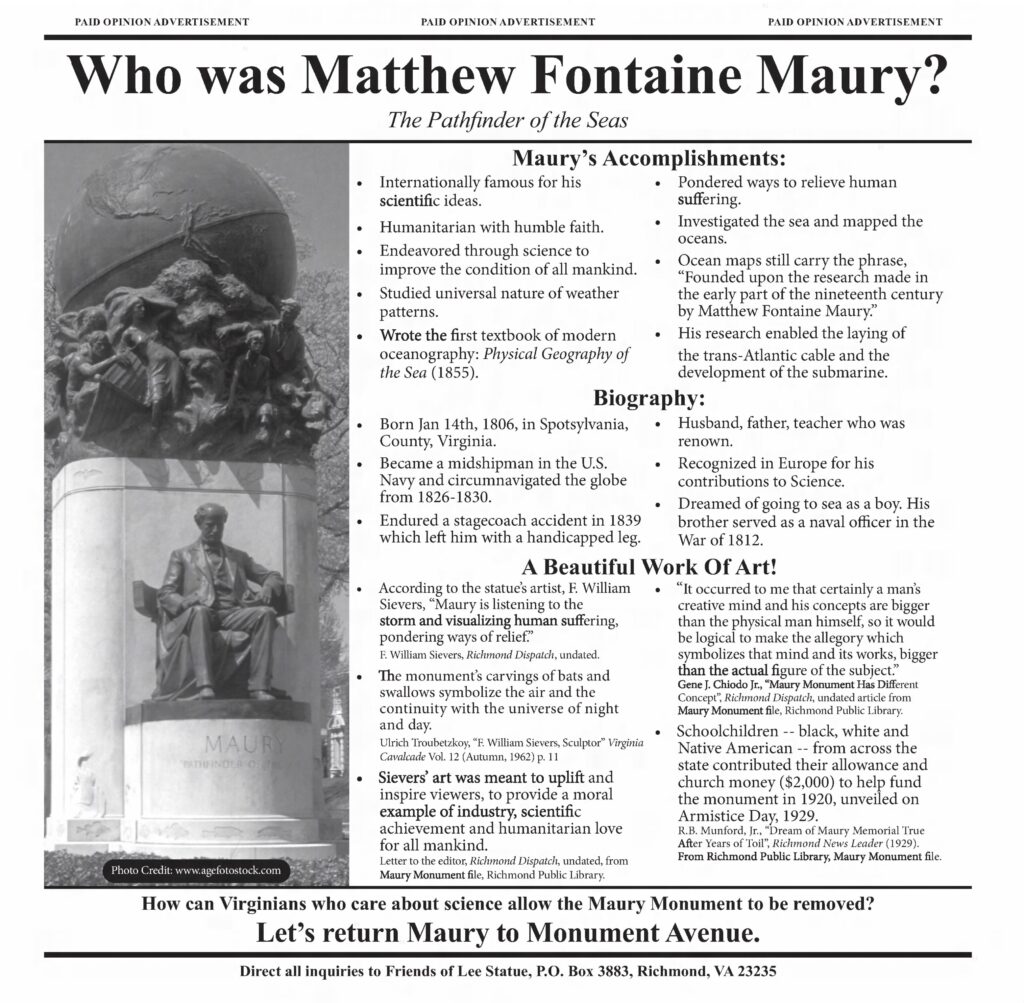
- According to the statues artist, F. William Sievers, “Maury is listening to the storm and visualizing human suffering, pondering ways of relief.” F. William Sievers, Richmond Dispatch, undated.
- “It occurred to me that certainly a man’s creative mind and his concepts are bigger than the physical man himself, so it would be logical to make the allegory which symbolizes that mind and its works, bigger than the actual figure of the subject.” Gene J. Chiodo Jr., “Maury Monument Has Different Concept, Richmond Dispatch, undated article from Maury Monument file, Richmond Public Library.
- The monument’s carvings of bats and swallows symbolize the air and the continuity with the universe of night and day. Ulrich Troubetzkoy, “F. William Sievers, Sculptor” Virginia Cavalcade Vol. 12 (Autumn, 1962) p. 11
- Schoolchildren — black, white and Native American — from across the state contributed their allowance and church money ($2,000) to help fund the monument in 1920, unveiled on Armistice Day, 1929. R.B. Munford, Jr., “Dream of Maury Memorial True After Years of Toil”, Richmond News Leader (1929). From Richmond Public Library, Maury Monument file.
- Sievers’ art was meant to uplift and inspire viewers, to provide a moral example of industry, scientific achievement and humanitarian love for all mankind. Letter to the editor, Richmond Dispatch, undated, from Maury Monument file, Richmond Public Library.
How can Virginians who care about science allow the Maury Monument to be removed?
Let’s return Maury to Monument Avenue.