

Richmond Times-Dispatch · Mar 30, 2008
HISTORIC RICHMOND
Who’s the Guy With the Globe On Monument Avenue?
Editor’s note: On Saturday more than 30,000 runners and walkers will converge on Monument Avenue for a 10K race under the watchful personages of some of the South’s most famous military and political leaders. Yet one is more obscure than the others. We asked John Coski, of the Museum of the Confederacy, to answer a question that occurs to many as they pass down this famous street: Who is “Maury – Pathfinder of the Seas”?
Richmond’s most famous street, Monument Avenue, was for more than a century a showcase exclusively for statues of Confederate heroes. In 1996, to the delight of some and the consternation of others, a statue of Richmond-born tennis legend and humanitarian Arthur Ashe joined those of generals Robert E. Lee, J.E.B. Stu-
art, and Stonewall Jackson and President Jefferson Davis.
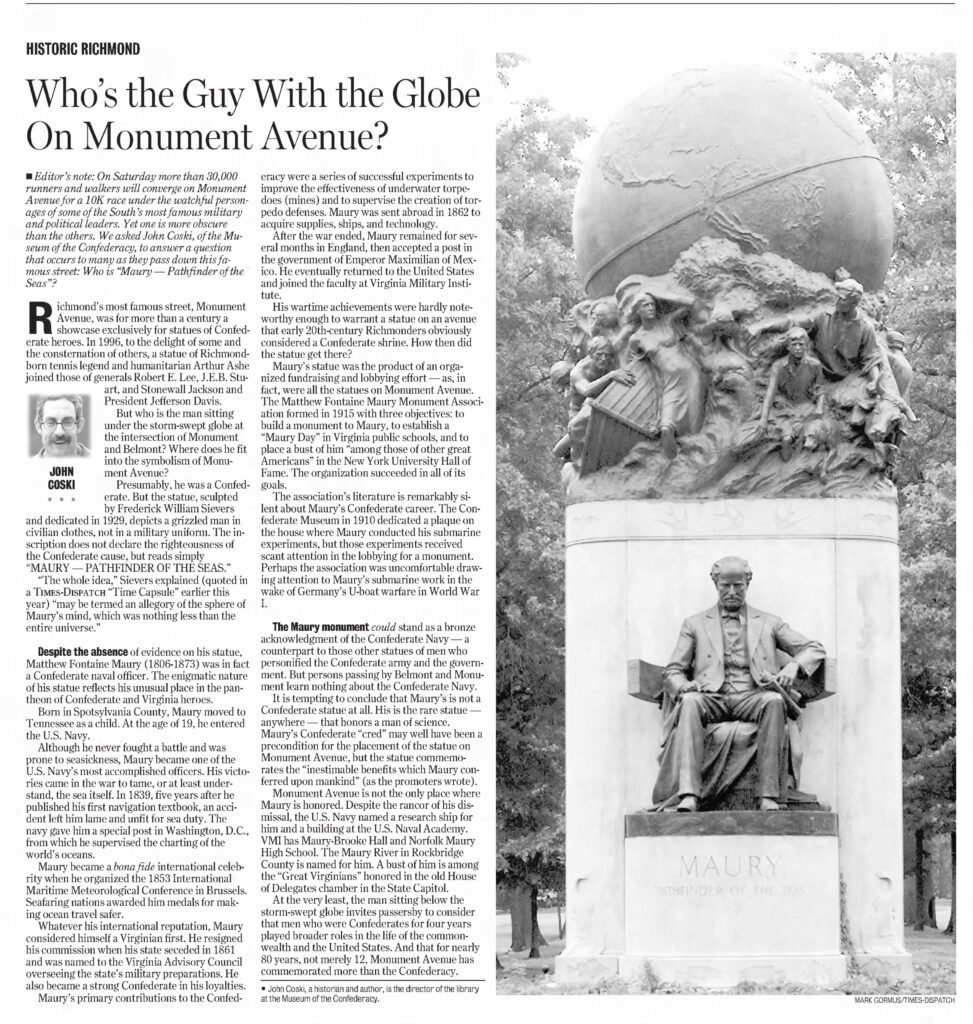
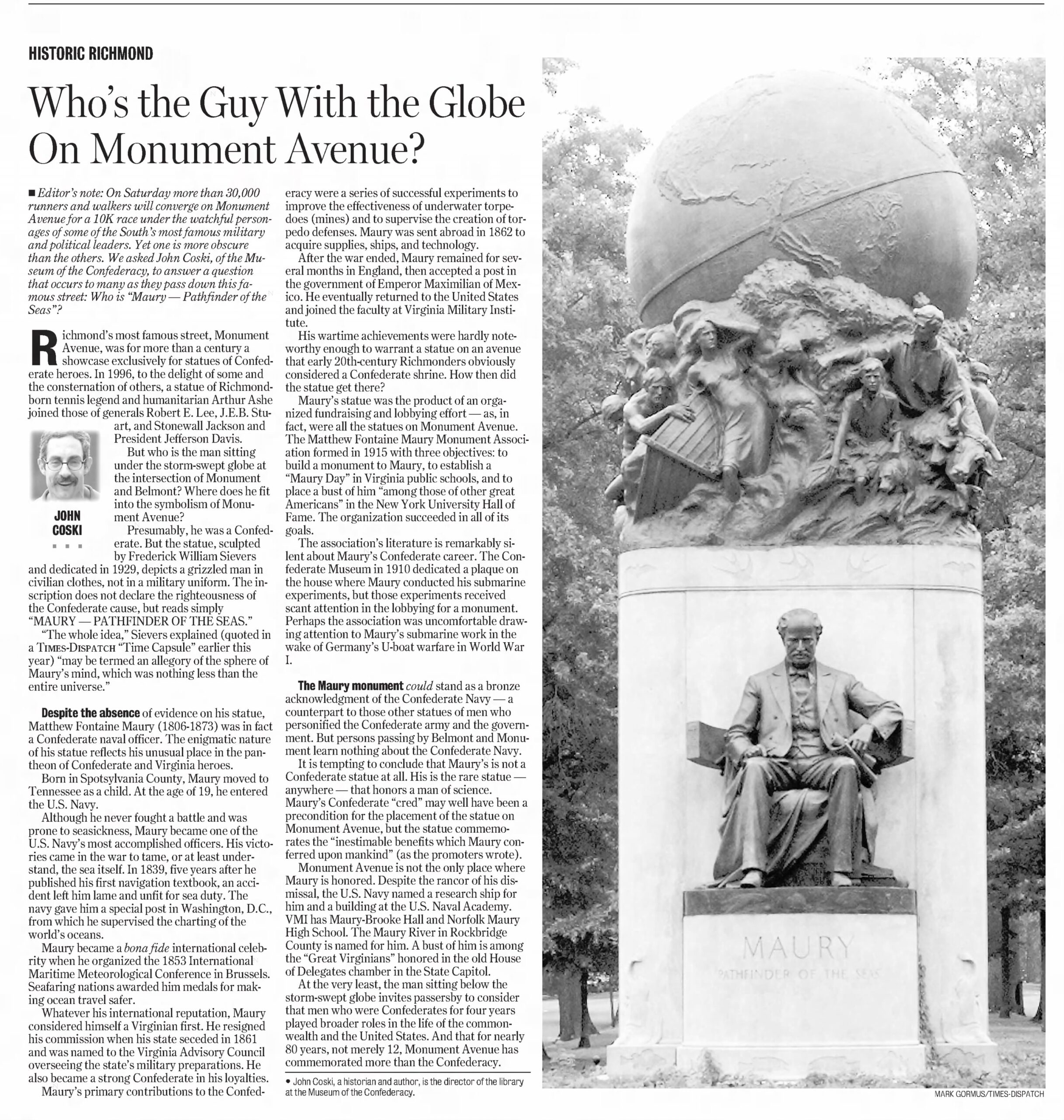
But who is the man sitting under the storm-swept globe at the intersection of Monument and Belmont? Where does he fit into the symbolism of Monument Avenue?
Presumably, he was a Confederate. But the statue, sculpted by Frederick William Sievers and dedicated in 1929, depicts a grizzled man in civilian clothes, not in a military uniform. The inscription does not declare the righteousness of the Confederate cause, but reads simply “MAURY — PATHFINDER OF THE SEAS.”
“The whole idea,” Sievers explained (quoted in a TIMES-DISPATCH “Time Capsule” earlier this year) “may be termed an allegory of the sphere of Maury’s mind, which was nothing less than the entire universe.”
Despite the absence of evidence on his statue, Matthew Fontaine Maury (1806-1873) was in fact a Confederate naval officer. The enigmatic nature of his statue reflects his unusual place in the pantheon of Confederate and Virginia heroes. Born in Spotsylvania County, Maury moved to Tennessee as a child. At the age of 19, he entered the U.S. Navy.
Although he never fought a battle and was prone to seasickness, Maury became one of the U.S. Navy’s most accomplished officers. His victories came in the war to tame, or at least under-stand, the sea itself. In 1839, five years after he published his first navigation textbook, an accident left him lame and unfit for sea duty. The navy gave him a special post in Washington, D.C., from which he supervised the charting of the world’s oceans.
Maury became a bona fide international celebrity when he organized the 1853 International Maritime Meteorological Conference in Brussels. Seafaring nations awarded him medals for making ocean travel safer.
Whatever his international reputation, Maury considered himself a Virginian first. He resigned his commission when his state seceded in 1861 and was named to the Virginia Advisory Council overseeing the state’s military preparations. He also became a strong Confederate in his loyalties.
Maury’s primary contributions to the Confederacy were a series of successful experiments to improve the effectiveness of underwater torpedoes (mines) and to supervise the creation of torpedo defenses. Maury was sent abroad in 1862 to acquire supplies, ships, and technology.
After the war ended, Maury remained for several months in England, then accepted a post in the government of Emperor Maximilian of Mexico. He eventually returned to the United States and joined the faculty at Virginia Military Institute.
His wartime achievements were hardly noteworthy enough to warrant a statue on an avenue that early 20th-century Richmonders obviously considered a Confederate shrine. How then did the statue get there?
Maury’s statue was the product of an organized fundraising and lobbying effort — as, in fact, were all the statues on Monument Avenue. The Matthew Fontaine Maury Monument Association formed in 1915 with three objectives: to build a monument to Maury, to establish a “Maury Day” in Virginia public schools, and to place a bust of him “among those of other great Americans” in the New York University Hall of Fame. The organization succeeded in all of its goals.
The association’s literature is remarkably silent about Maury’s Confederate career. The Confederate Museum in 1910 dedicated a plaque on the house where Maury conducted his submarine experiments, but those experiments received scant attention in the lobbying for a monument. Perhaps the association was uncomfortable drawing attention to Maury’s submarine work in the wake of Germany’s U-boat warfare in World War 1.
The Maury monument could stand as a bronze acknowledgment of the Confederate Navy — a counterpart to those other statues of men who personified the Confederate army and the government. But persons passing by Belmont and Monument learn nothing about the Confederate Navy.
It is tempting to conclude that Maury’s is not a Confederate statue at all. His is the rare statue — anywhere – that honors a man of science. Maury’s Confederate “cred” may well have been a precondition for the placement of the statue on Monument Avenue, but the statue commemorates the “inestimable benefits which Maury conferred upon mankind” (as the promoters wrote).
Monument Avenue is not the only place where Maury is honored. Despite the rancor of his dismissal, the U.S. Navy named a research ship for him and a building at the U.S. Naval Academy. VMI has Maury-Brooke Hall and Norfolk Maury High School. The Maury River in Rockbridge County is named for him. A bust of him is among the “Great Virginians” honored in the old House of Delegates chamber in the State Capitol.
At the very least, the man sitting below the storm-swept globe invites passersby to consider that men who were Confederates for four years played broader roles in the life of the commonwealth and the United States. And that for nearly 80 years, not merely 12, Monument Avenue has commemorated more than the Confederacy.
- John Coski, a historian and author, is the director of the library at the Museum of the Confederacy.