

Richmond Times-Dispatch · Aug 16, 2006
TIME CAPSULES – larry hall
Allegorical Maury statue was a monumental task
In 1938, The Times-Dispatch asked several local art connoisseurs to give their opinions of Richmond’s public statuary.
When the discussion turned to statues along historic Monument Avenue, the critics divided evenly over the Matthew Fontaine Maury Monument at the Belmont Avenue intersection. One dismissed it as lacking dignity. “It’s too fussy,” he said.
Thomas C. Colt, director of the Virginia Museum of Fine Arts, praised the work for its imaginative qualities. “This bronze of the Pathfinder of the Seas’ in its conception is unlike anything else in Richmond,” Colt said.
The sculptor shared Colt’s opinion. Frederick William Sievers, the Richmond artist who created the Maury and Thomas J. “Stonewall” Jackson monuments on Monument Avenue, often said the Maury Monument was his favorite of all his sculptures.
Sievers, an Indiana native who settled in Richmond in 1910, was chosen by the Maury Association to sculpt the monument in 1926. Sievers submitted his design after he heard about fundraising for a statue honoring Maury, a man noted more for achievements in oceanography, meteorology and hydrography than for his Confederate wartime role.
During the Civil War, Maury was in charge of all coastal, harbor and river defenses for the Confederacy.
The association awarded Sievers the commission without holding an open competition.
Sievers explained the inspiration for his design and its intent to The Times-Dispatch in 1929, shortly before the monument’s dedication.
“The whole idea may be termed an allegory of the sphere of Maury’s mind, which was nothing less than the entire universe,” Sievers told The Times-Dispatch.
The artist said the design was inspired by a line in a pamphlet published to help raise funds for a statue of Maury: “The voice of the wind and the voice of the waters were music to his ears.”
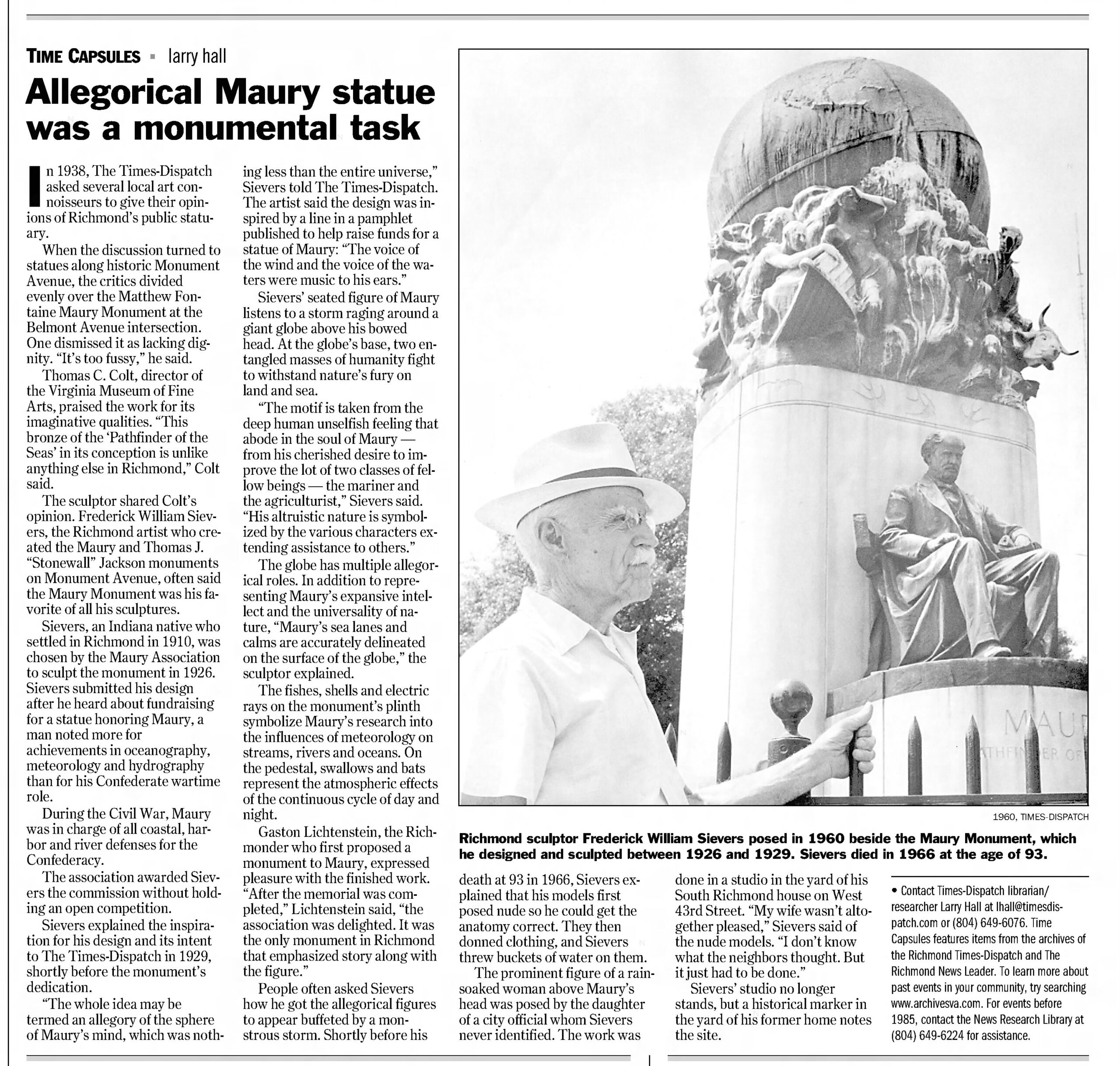
Sievers’ seated figure of Maury listens to a storm raging around a giant globe above his bowed head. At the globe’s base, two entangled masses of humanity fight to withstand nature’s fury on land and sea.
“The motif is taken from the deep human unselfish feeling that abode in the soul of Maury from his cherished desire to improve the lot of two classes of fellow beings — the mariner and the agriculturist,” Sievers said. “His altruistic nature is symbolized by the various characters extending assistance to others.”
The globe has multiple allegorical roles. In addition to representing Maury’s expansive intellect and the universality of nature, “Maury’s sea lanes and calms are accurately delineated on the surface of the globe,” the sculptor explained.
The fishes, shells and electric rays on the monument’s plinth symbolize Maury’s research into the influences of meteorology on streams, rivers and oceans. On the pedestal, swallows and bats represent the atmospheric effects of the continuous cycle of day and night.
Gaston Lichtenstein, the Richmonder who first proposed a monument to Maury, expressed pleasure with the finished work. “After the memorial was completed,” Lichtenstein said, “the association was delighted. It was the only monument in Richmond that emphasized story along with the figure.”
People often asked Sievers how he got the allegorical figures to appear buffeted by a monstrous storm. Shortly before his death at 93 in 1966, Sievers explained that his models first posed nude so he could get the anatomy correct. They then donned clothing, and Sievers threw buckets of water on them. The prominent figure of a rain-soaked woman above Maury’s head was posed by the daughter of a city official whom Sievers never identified. The work was the site.
done in a studio in the yard of his South Richmond house on West 43rd Street. “My wife wasn’t altogether pleased,” Sievers said of the nude models. “I don’t know what the neighbors thought. But it just had to be done.” Sievers’ studio no longer stands, but a historical marker in the yard of his former home notes
Richmond sculptor Frederick William Sievers posed in 1960 beside the Maury Monument, which he designed and sculpted between 1926 and 1929. Sievers died in 1966 at the age of 93.