

Richmond News Leader · Mar 9, 1929
Richmond News Leader · Mar 9, 1929
Sievers Finishes His Final Model for Maury Monument
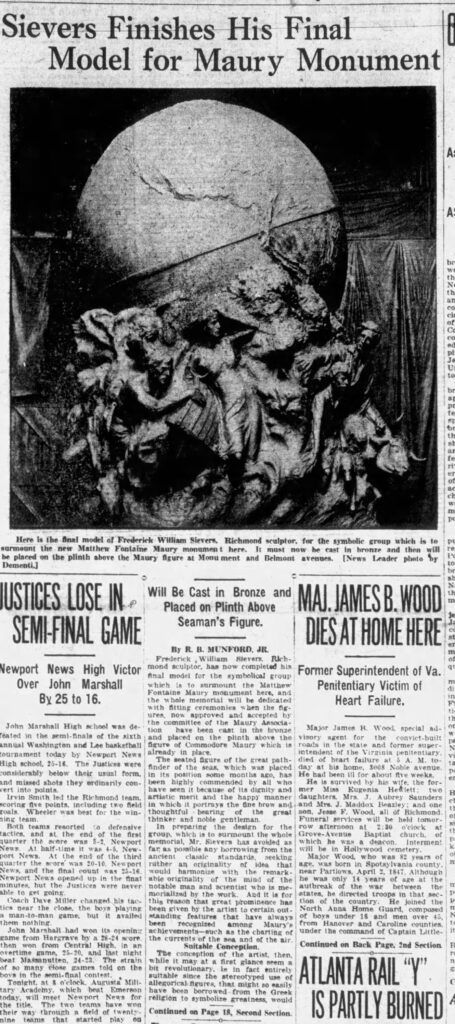
Here is the final model of Frederick William Sievers, Richmond sculptor, for the symbolic group which is to surmount the new Matthew Fontaine Maury monument here. It must now be cast in bronze and then will be placed on the plinth above the Maury figure at Monument and Belmont avenues. [News Leader photo by Dementi.]
Will Be Cast in Bronze and Placed on Plinth Above Seaman’s Figure.
By R. B. MUNFORD, JR.
Frederick, William Sievers, Richmond sculptor, has now completed his Anal model for the symbolical group which is to surmount the Matthew Fontaine Maury monument here, and the whole memorial will be dedicated with fitting ceremonies when the figures, now approved and accepted by the committee of the Maury Association have been cast in the bronze and placed on the plinth above the figure of Commodore Maury which is already in place.
The seated figure of the great pathfinder of the seas, which was placed in its position some months ago, has been highly commended by all who have seen it because of its dignity and artistic merit and the happy manner in which it portrays the one brow and thoughtful – bearing of the great thinker and noble gentleman.
In preparing the design for the group, which is to surmount the whole memorial, Mr. Sievers has avoided as far as possible any borrowing from the ancient classic standards, seeking rather an originality of idea that would harmonize with the remarkable originality of the mind of the notable man and scientist who is memorialized by the work. And it is for this reason that great prominence has been given by the artist to certain out – standing features that have always been recognized among Maury’s achievements-such as the charting of the currents of the sea and of the air.
Suitable Conception.
The conception of the artist, then, while it may at a first glance seem a bit revolutionary, is in fact entirely suitable since the stereotyped use of allegorical figures, that might so easily have been borrowed from the Greek religion to symbolize greatness, would hardly have aptly expressed the versatility of genius that was Matthew Fontaine Maury’s.
Commodore Maury was of a widely different era and was a man set apart among
the greatest thinkers of the nineteenth century-his field of investigation ranging from the lowest sea anemone to the motions of the planets.
Broadly speaking, the great group now completed by Mr. Sievers is a symbolization of the universe—indicative of the almost endless range of Commodore Maury’s labor.
The groups which surround and support the great terrestrial globe represent a storm on land and on sea, and, together with the globe, symbolize and portray the world and its natural elements. These two scenes undertake to emphasize, in symbolical fashion, Maury’s outstanding achievements in meteorology and hydrography.
Mr. Sievers has selected the storm—a meteorological disturbance—as the most pronounced symbolism possible for those researches in which Maury was pre-eminent. Hydrography easily connoted in the marine scene in which is portrayed a capsized lifeboat with a mass of struggling humanity, while the land scene portrays a farmer’s household fleeing from the overwhelming wind and symbolizes, in particular, agricultural meteorology.
A touch of humanity and altruism is observable throughout the two scenes in the faces both of the young and the old, and in this the artist would reflect the kind, unselfish nature that abode deep in the soul of Maury.
Gleam of Hope.
The mere terror of the storm has been by the artist intentionally reduced to a minimum and while various human emotions are noticeable, there is a gleam of hope expressed in the countenance as they peer through the confusion and look for help to come.
And the artist has injected into the scene this element of hope because of the fact that Maury had appeared on the horizon to guide the way to a lessening of disasters.
The figures in the foreground of the group, looking out into the distance, are searching for this unseen but expected help.
On the great globe above all, the sea lanes are accurately delineated-thus indicating “the paths of the sea,” while the relief map on the surface of the globe is the emblem of geography and the globe itself brings to mind – the planetary system Maury’s researches in astronomy.
The large fishes carved on either side of the pedestal are of the “electric ray” species also known as the “torpedo,” and these symbolize Maury’s invention of the electric torpedo and his deep sea investigations.
The fresh water fish, around the base of the pedestal, suggest the inland streams, while the swallows and bats that alternate on the capstone are emblematic of day and of night. They form a circle—the symbol of perpetuity—around the earth. Finally,
oceanography is suggested by the jelly fish on the arms of the chair in which Commodore Maury is seated, and by the other sea fish and shells around the plinth of the monument.