

The Evening Sun · Mar 22, 1941
They’ll Take Their Stand
On A $50,000 Pedestal In 1942 (Maybe)
By OUR PARKS CORRESPONDENT
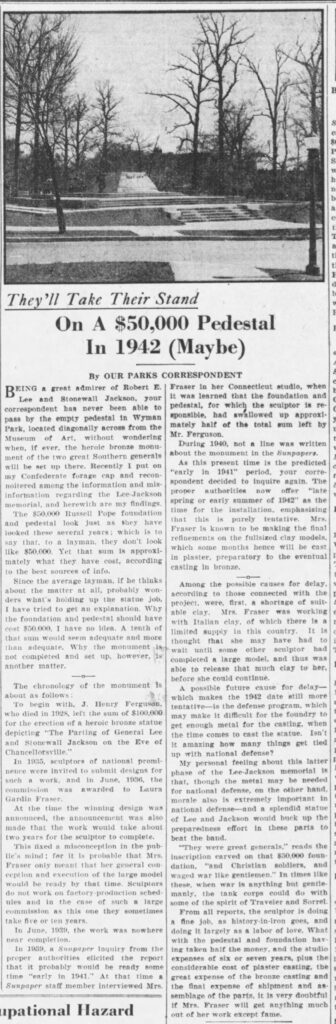
BEING a great admirer of Robert E. Lee and Stonewall Jackson, your correspondent has never been able to pass by the empty pedestal in Wyman Park, located diagonally across from the Museum of Art, without wondering when, if ever, the heroic bronze monument of the two great Southern generals will be set up there. Recently I put on my Confederate forage cap and reconnoitered among the information and misinformation regarding the Lee-Jackson memorial, and herewith are my findings.
The $50,000 Russell Pope foundation and pedestal look just as they have looked these several years; which is to say that, to a layman, they don’t look like $50,000. Yet that sum is approximately what they have cost, according to the best sources of info.
Since the average layman, if he thinks about the matter at all, probably wonders what’s holding up the statue job, I have tried to get an explanation. Why the foundation and pedestal should have cost $50,000, I have no idea. A tenth of that sum would seem adequate and more than adequate. Why the monument is not completed and set up, however, is another matter.
The chronology of the monument is about as follows:
To begin with, J. Henry Ferguson, who died in 1928, left the sum of $100,000 for the erection of a heroic bronze statue depicting “The Parting of General Lee and Stonewall Jackson on the Eve of Chancellorsville.”
In 1935, sculptors of national prominence were invited to submit designs for such a work, and in June, 1936, the commission was awarded to Laura Gardin Fraser.
At the time the winning design was announced, the announcement was also made that the work would take about two years for the sculptor to complete.
This fixed a misconception in the pub-lie’s mind; for it is probable that Mrs.
Fraser only meant that her general conception and execution of the large model would be ready by that time. Sculptors do not work on factory-production schedules and in the case of such a large commission as this one they sometimes take five or ten years.
In June, 1939, the work was nowhere near completion.
In 1939, a Sunpaper inquiry from the proper authorities elicited the report that it probably would be ready some time “early in 1941.” At that time a Sunpaper staff member interviewed Mrs.Fraser in her Connecticut studio, when it was learned that the foundation and pedestal, for which the sculptor is responsible, had swallowed up approximately half of the total sum left by Mr. Ferguson.
During 1940, not a line was written about the monument in the Sunpapers.
As this present time is the predicted “early in 1941” period, your correspondent decided to inquire again. The proper authorities now offer “late spring or early summer of 1942” as the time for the installation, emphasizing that this is purely tentative. Mrs.
Fraser is known to be making the final refinements on the full sized clay models, which some months hence will be cast in plaster, preparatory to the eventual casting in bronze.
Among the possible causes for delay, according to those connected with the project, were, first, a shortage of suitable clay. Mrs. Fraser was working with Italian clay, of which there is a limited supply in this country. It is thought that she may hare had to wait until some other sculptor had completed a large model, and thus was able to release that much clay to her, before she could continue.
A possible future cause for delay—which makes the 1942 date still more tentative-is the defense program, which may make it difficult for the foundry to get enough metal for the casting, when the time comes to cast the statue. Isn’t it amazing how many things get tied up with national defense?
My personal feeling about this latter phase of the Lee-Jackson memorial is that, though the metal may be needed for national defense, on the other hand, morale also is extremely Important in national defense-and a splendid statue of Lee and Jackson would buck up the preparedness effort in these parts to beat the band.
“They were great generals,” reads the inscription carved on that $50,000 foundation, “and Christian soldiers, and waged war like gentlemen.” In times like these, when war is anything but gentle-manly, the tank corps could do with some of the spirit of Traveler and Sorrel.
From all reports, the sculptor is doing a fine job, as history-in-iron goes, and doing it largely as a labor of love. What with the pedestal and foundation har-ing taken half the money, and the studio expenses of six or seven years, plus the considerable cost of plaster casting, the great expense of the bronze casting and the final expense of shipment and assemblage of the parts, it is very doubtful If Mrs. Fraser will get anything much out of her work except fame.