

The Baltimore Sun · Oct 13, 1946
The Baltimore Sun · Oct 13, 1946
The Statue That Isn’t There
_ By Harold A. Williams
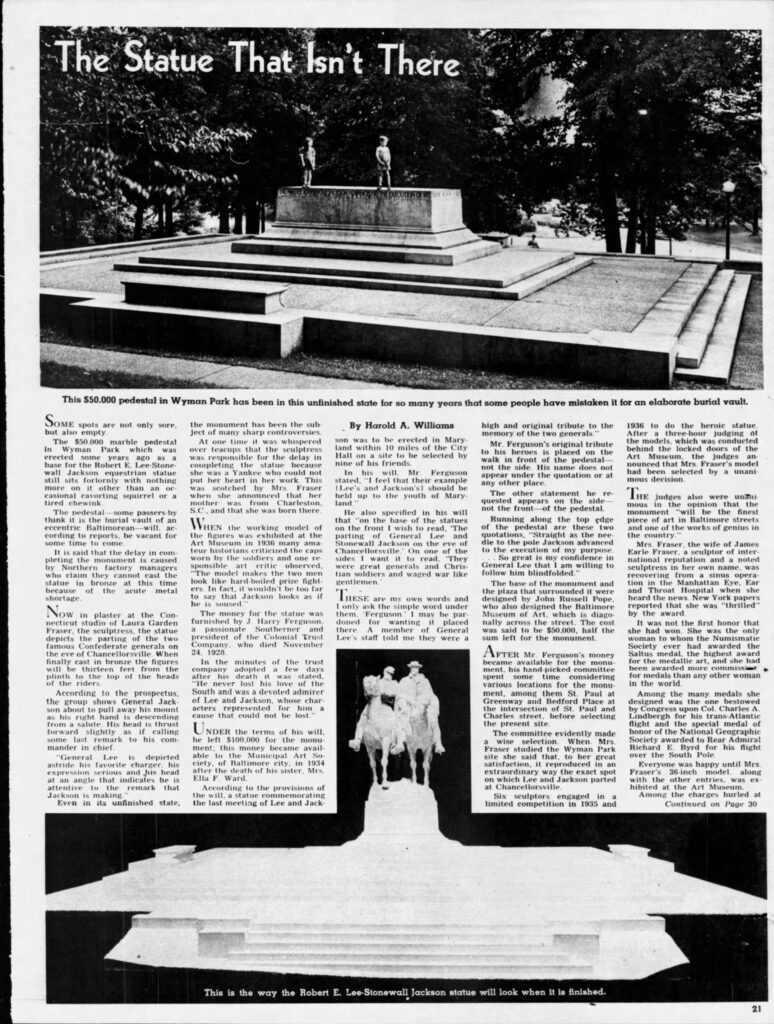
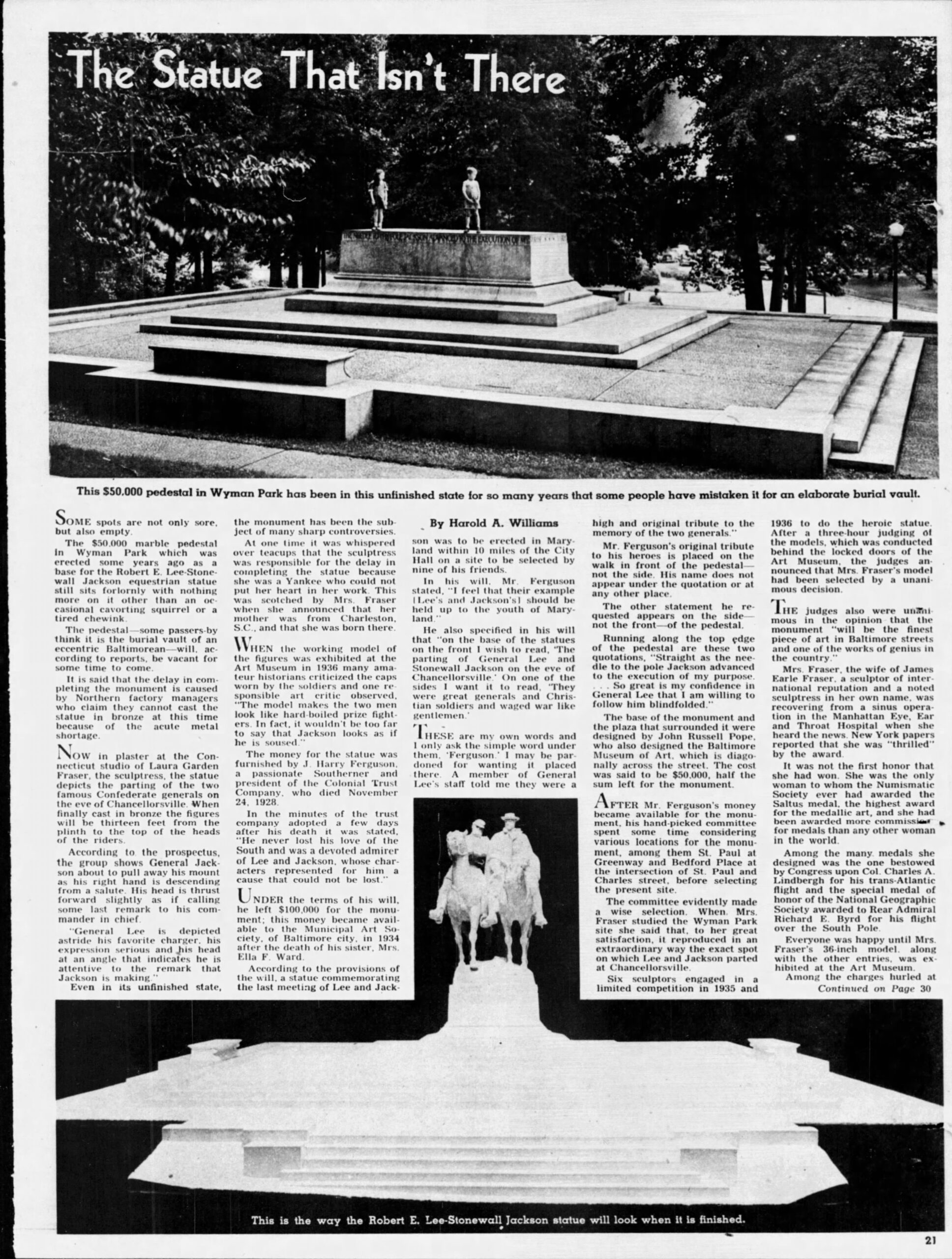
This $50.000 pedestal in Wyman Park has been in this unfinished state for so many years that some people have mistaken it for an elaborate burial vault.
SOME spots are not only sore, but also empty.
The $50.000 marble pedestal In Wyman Park which was erected some years ago as a base for the Robert E. Lee-Stone-wall Jackson equestrian statue still sits forlornly with nothing more on it other than an occasional cavorting squirrel or a tired chewink.
The pedestal-some passers-by think it is the burial vault of an eccentric Baltimorean-will, according to reports, be vacant for some time to come.
It is said that the delay in completing the monument is caused by Northern factory managers who claim they cannot east the statue in bronze at this time because of the acute metal shortage.
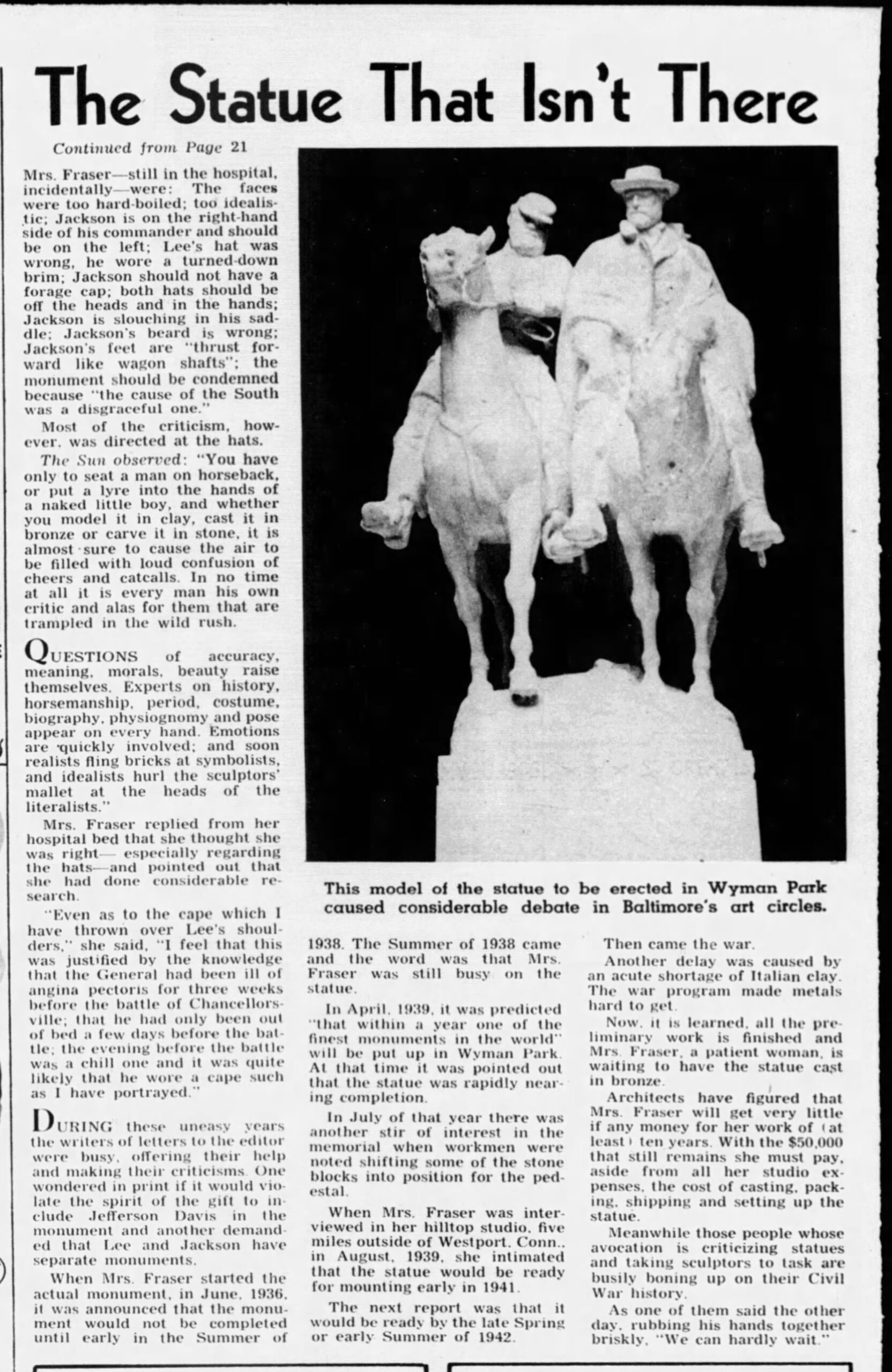
Now in plaster at the Connecticut studio of Laura Garden Fraser, the sculptress, the statue depicts the parting of the two famous Confederate generals on the eve of Chancellorsville. When finally cast in bronze the figures will be thirteen feet from the plinth to the top of the heads of the riders.
According to the prospectus, the group shows General Jackson about to pull away his mount as his right hand is descending from a salute. His head is thrust forward slightly as if calling some last remark to his commander in chief
“General Lee is depicted astride his favorite charger, his expression serious and his head at an angle that indicates he is attentive to the remark that Jackson is making.”
Even in its unfinished state, the monument has been the subject of many sharp controversies.
At one time it was whispered over teacups that the sculptress was responsible for the delay in completing the statue because she was a Yankee who could not put her heart in her work. This was scotched by Mrs. Fraser when she announced that her mother was from Charleston, S.C., and that she was born there.
WHEN the working model of the figures was exhibited at the Art Museum in 1936 many amateur historians criticized the caps worn by the soldiers and one responsible art critic observed, “The model makes the two men look like hard-boiled prize fighters. In fact, it wouldn’t be too far to say that Jackson looks as if he is soused.”
The money for the statue was furnished by J. Harry Ferguson, a passionate Southerner and president of the Colonial Trust Company, who died November 24, 1928.
In the minutes of the trust company adopted a few days after his death it was stated,
“He never lost his love of the South and was a devoted admirer of Lee and Jackson, whose characters represented for him a cause that could not be lost.”
UNDER the terms of his will he left $100,000 for the monument; this money became available to the Municipal Art Society, of Baltimore city, in 1934 after the death of his sister, Mrs. Ella F. Ward.
According to the provisions of the will, a statue commemorating the last meeting of Lee and Jackson was to be erected in Maryland within 10 miles of the City Hall on a site to be selected by nine of his friends.
In his will. Mr. Ferguson stated, “I feel that their example (Lee’s and Jackson’s] should be held up to the youth of Mary-land.”
He also specified in his will that “on the base of the statues on the front I wish to read, ‘The parting of General Lee and Stonewall Jackson on the eve of Chancellorsville.’ On one of the sides 1 want it to read, “They were great generals and Christian soldiers and waged war like gentlemen.’
THESE are my own words and I only ask the simple word under them, ‘Ferguson.’ I may be pardoned for wanting it placed there. A member of General Lee’s staff told me they were a high and original tribute to the memory of the two generals.”
Mr. Ferguson’s original tribute to his heroes is placed on the walk in front of the pedestal not the side. His name does not appear under the quotation or at any other place.
The other statement he requested appears on the side-not the front of the pedestal.
Running along the top edge of the pedestal are these two quotations, “Straight as the needle to the pole Jackson advanced to the execution of my purpose…. So great is my confidence in General Lee that I am willing to follow him blindfolded.”
The base of the monument and the plaza that surrounded it were designed by John Russell Pope. who also designed the Baltimore Museum of Art, which is diagonally across the street. The cost was said to be $50,000, half the sum left for the monument.
AFTER Mr. Ferguson’s money became available for the monument, his hand-picked committee spent some time considering various locations for the monument, among them St. Paul at Greenway and Bedford Place at the intersection of St. Paul and Charles street, before selecting the present site.
The committee evidently made a wise selection. When. Mrs. Fraser studied the Wyman Park site she said that, to her great satisfaction, it reproduced in an extraordinary way the exact spot on which Lee and Jackson parted at Chancellorsville.
Six sculptors engaged in a limited competition in 1935 and 1936 to do the heroic statue, After a three-hour judging of the models, which was conducted behind the locked doors of the Art Museum, the judges announced that Mrs. Fraser’s model had been selected by a unanimous decision.
The Judges also were unanimous in the opinion that the monument “will be the finest piece of art in Baltimore streets and one of the works of genius in the country.”
Mrs. Fraser, the wife of James Earle Fraser, a sculptor of international reputation and a noted sculptress in her own name, was recovering from a sinus operation in the Manhattan Eye, Ear and Throat Hospital when she heard the news. New York papers reported that she was “thrilled” by the award.
It was not the first honor that she had won. She was the only woman to whom the Numismatic Society ever had awarded the Saltus medal, the highest award for the medallic art, and she had been awarded more commissions for medals than any other woman in the world.
Among the many medals she designed was the one bestowed by Congress upon Col. Charles A. Lindbergh for his trans-Atlantic flight and the special medal of honor of the National Geographic Society awarded to Rear Admiral Richard E. Byrd for his flight over the South Pole.
Everyone was happy until Mrs. Fraser’s 36-inch model. along with the other entries, was exhibited at the Art Museum.
Among the charges hurled at Mrs. Fraser-still in the hospital, incidentally-were: The faces were too hard-boiled; too idealistic; Jackson is on the right-hand side of his commander and should be on the left; Lee’s hat was wrong, he wore a turned-down brim; Jackson should not have a forage cap; both hats should be off the heads and in the hands; Jackson is slouching in his saddle: Jackson’s beard is wrong;
Jackson’s feet are “thrust forward like wagon shafts”; the monument should be condemned because “the cause of the South was a disgraceful one.”
Most of the criticism, how-ever, was directed at the hats.
The Sun observed: “You have only to seat a man on horseback, or put a lyre into the hands of a naked little boy, and whether you model it in clay, east it in bronze or carve it in stone, it is almost sure to cause the air to be filled with loud confusion of cheers and catcalls. In no time at all it is every man his own critic and alas for them that are trampled in the wild rush.
QUESTIONS of accuracy, meaning, morals, beauty raise themselves. Experts on history, horsemanship, period, costume, biography, physiognomy and pose appear on every hand. Emotions are quickly involved; and soon and realists fling bricks at symbolists, and idealists hurl the sculptors’ mallet at the heads of the literalists.”
Mrs. Fraser replied from her hospital bed that she thought she was right especially regarding the hats-and pointed out that she had done considerable re-search.
“Even as to the cape which 1 have thrown over Lee’s shoulders,” she said, “I feel that this was justified by the knowledge that the General had been ill of angina pectoris for three weeks before the battle of Chancellorsville; that he had only been out of bed a few days before the battle; the evening before the battle was a chill one and it was quite likely that he wore a cape such as I have portrayed.”
DURING these uneasy years the writers of letters to the editor were busy, offering their help and making their criticisms. One wondered in print if it would violate the spirit of the gift to include Jefferson Davis in the monument and another demanded that Lee and Jackson have separate monuments.
When Mrs. Fraser started the actual monument, in June, 1936. it was announced that the monument would not be completed until early in the Summer of 1938. The Summer of 1938 came and the word was that Mrs. Fraser was still busy on the Statue.
In April, 1939, it was predicted “that within a year one of the finest monuments in the world” will be put up in Wyman Park. At that time it was pointed out that the statue was rapidly nearing completion.
In July of that year there was another stir of interest in the memorial when workmen were noted shifting some of the stone blocks into position for the pedestal.
When Mrs. Fraser was interviewed in her hilltop studio, five miles outside of Westport. Conn.. in August, 1939, she intimated that the statue would be ready for mounting early in 1941.
The next report was that it would be ready by the late Spring or early: Summer of 1942.
Then came the war.
Another delay was caused by an acute shortage of Italian clay.
The war program made metals hard to get.
Now, it is learned, all the preliminary work is finished and Mrs. Fraser, a patient woman, is waiting to have the statue cast in bronze.
Architects have figured that Mrs. Fraser will get very little if any money for her work of (at least) ten years. With the $50,000 that still remains she must pay. aside from all her studio expenses, the cost of casting, pack-ing. shipping and setting up the statue.
Meanwhile those people whose avocation is criticizing statues and taking sculptors to task are busily boning up on their Civil War history.
As one of them said the other day. rubbing his hands together briskly, “We can hardly wait.”