

Descendant

Descendant, 2025
Plywood, MDF, latex paint, metal hardware, steel, aluminum, fiberglass
131 7/8 x 44 3/4 x 53 5/16 in. (335 x 113.7 x 135.4 cm)
Commissioned by MOCA & The Brick
Courtesy of the artist and Salon 94
Filed Under:
Karon Davis
(b. 1977, Reno, Nevada; lives in New York)
Descendant, 2025
Plywood, MDF, latex paint, metal hardware, steel, aluminum, fiberglass
Commissioned by MOCA & The Brick
Descendant is a monumental portrait of the artist’s son Moses, who holds a miniature bronze replica of a statue of Confederate general John Hunt Morgan in his outstretched hand. Working from three-dimensional scans of a monument to Morgan that once stood in front of the Fayette County courthouse in Lexington, Kentucky, Davis shrinks his legacy, offering a powerful image that not only speaks to the contemporary moment but challenges Lost Cause ideology.
The legacy of the Civil War is personal for Davis. As she says, “I come from a long line of pirates, Confederates, and revolutionaries. According to family lore, Davis is a direct descendant of John Hunt Morgan (1825-1864), a Kentucky plantation owner, enslaver , and U.S.-Mexican War veteran who became a Confederate general despite the fact that Kentucky did not secede from the Union. She grew up hearing stories about Morgan and his infamous raids, though she was told that he fought for both the North and the South, a historical revision that Davis believes was meant “to soften the blow of the truth, or my family is holding a secret that never left our home.”
In preparation for creating this work for MONUMENTS, Davis undertook extensive genealogical research to determine whether she could trace her family tree to Morgan. Genealogical research can be challenging for Black Americans. Because enslaved people were viewed by the legal system as property, their names were not regularly recorded in the census, nor were they provided with birth, marriage, or death certificates. They were also legally prohibited from reading and writing. While Davis was unable to definitively confirm a relationship to Morgan, she did uncover the names of two enslaved ancestors—Daphne and Simon Middleton. With these names no longer lost to history, Davis can illuminate more of her personal history and pass that information to later generations.
Davis is known for her use of plaster, making life-size casts of family and friends as well as her own body in a process akin to Egyptian mummification. As the artist describes: “It’s very ceremonial when I plaster cast. The wrapping of the body feels traditional to me, and when I’m doing my work, sometimes I feel like I’m capturing the person’s spirit or soul—or a portion of it. I’m capturing that moment in time.” Exemplifying her mastery of the cast plaster technique, Descendant extends Davis’s explorations of her own lived experiences as well as systemic social issues, including the history of racism and violence in America. Her cast plaster sculptures of historical and imaginary figures are often presented in arresting installations that recall cinematic scenes or stage performances, drawing upon her background in theater and film.
The equestrian statue of Morgan that appears in miniature in Descendant was installed in 1911 in front of the then-county courthouse, the same location where slave auctions were held in the antebellum period. The United Daughters of the Confederacy (UDC) commissioned Italian-born Pompeo Coppini to create a statue of the general on his horse “Black Bess.” Coppini, who sculpted a number of Confederate monuments, put testicles on Hunt’s horse, reportedly stating that “No hero should bestride a mare!” The statue was not without controversy among its creators—a year prior to its unveiling, a member of the committee resigned, writing that the design was “absolutely valueless if not preposterous and is a consummate caricature of a superbly handsome and brilliant man . . . In the North it has been long charged that the South was always ignorant and uncultured; to continue blindly erecting statues of soul deadening ugliness, will but serve to confirm the truth of this charge to future generations.”
In the immediate wake of the Unite the Right rally, the Lexington city council voted in August 2017 to relocate statues of two Confederate figures, including Morgan. It was removed from public space in October 2017 and reinstalled a year later in a cemetery, where it stands today.
Davis’s choice to represent her own son speaks to the role of women in the proliferation of Lost Cause mythology beginning in the 1890s. Rather than ex-soldiers, women’s groups like the UDC were largely responsible for fundraising and commissioning statues honoring their Civil War heroes. Unlike the historic statues in the exhibition that have been removed from their pedestals, Moses stands on a plinth at monumental scale. Reminiscent of Charles Ray’s Boy with Frog (2009), Descendant depicts a thirteen-year-old Moses with one arm outstretched holding a two-foot tall replica of the Morgan statue, a placid expression on his face. With Descendant, Davis recalibrates her family tree, emphasizing Moses’s (re)clamation of the future over a mythological version of the past.
Karon Davis
Karon Davis (b. 1977, Reno, Nevada) creates sculptures and multimedia installations that touch on issues of history, race, and violence in the United States, using materials as varied as plaster strips, chicken wire, glass, and readymade objects. Drawing on her background in theater and film, Davis creates haunting tableaux inhabited by protagonists both historical and imagined. The figures are created using the artist’s unique plaster method, amalgamations of life-size casts taken from friends and family as well as her own body. The material reflects her longtime interest in ancient Egyptian mummification practices, using wrapping to memorialize different bodies and their complex histories.
In Fall 2024 the artist was included in a number of significant group exhibitions, including Edges of Ailey, The Whitney Museum of American Art, New York; Flight into Egypt: Black Artists and Ancient Egypt, 1876-Now, The Metropolitan Museum of Art, New York (for which she performed an iteration of her ballet, The Death of Osiris, in the exhibition space); Movements Toward Freedom, The Museum of Contemporary Art, Denver; World Without End: The George Washington Carver Project, The California African American Museum, Los Angeles; and American Vignettes: Symbols, Society, and Satire, at the Rubell Museum, Washington, D.C. The artist’s work was previously the subject of Karon Davis: Selections from the Hammer Contemporary Collection at the Hammer Museum, University of California, Los Angeles in 2023. That same year, she was commissioned by The High Line, New York, to create Curtain Call, a monumental bowing ballerina in bronze.
Davis’ work is in the collections of the Whitney Museum of American Art, New York (NY); the Museum of Contemporary Art, Los Angeles (CA); the Pérez Art Museum, Miami (FL); the Los Angeles County Museum of Art (CA); the Museum of Fine Arts, Houston (TX); the Hammer Museum, Los Angeles (CA); the Rubell Museum, Miami (FL); the Brooklyn Museum (NY), and MAC3, Los Angeles (CA) among others. In 2017 Davis was the recipient of The Louis Comfort Tiffany Foundation Biennial Grant.
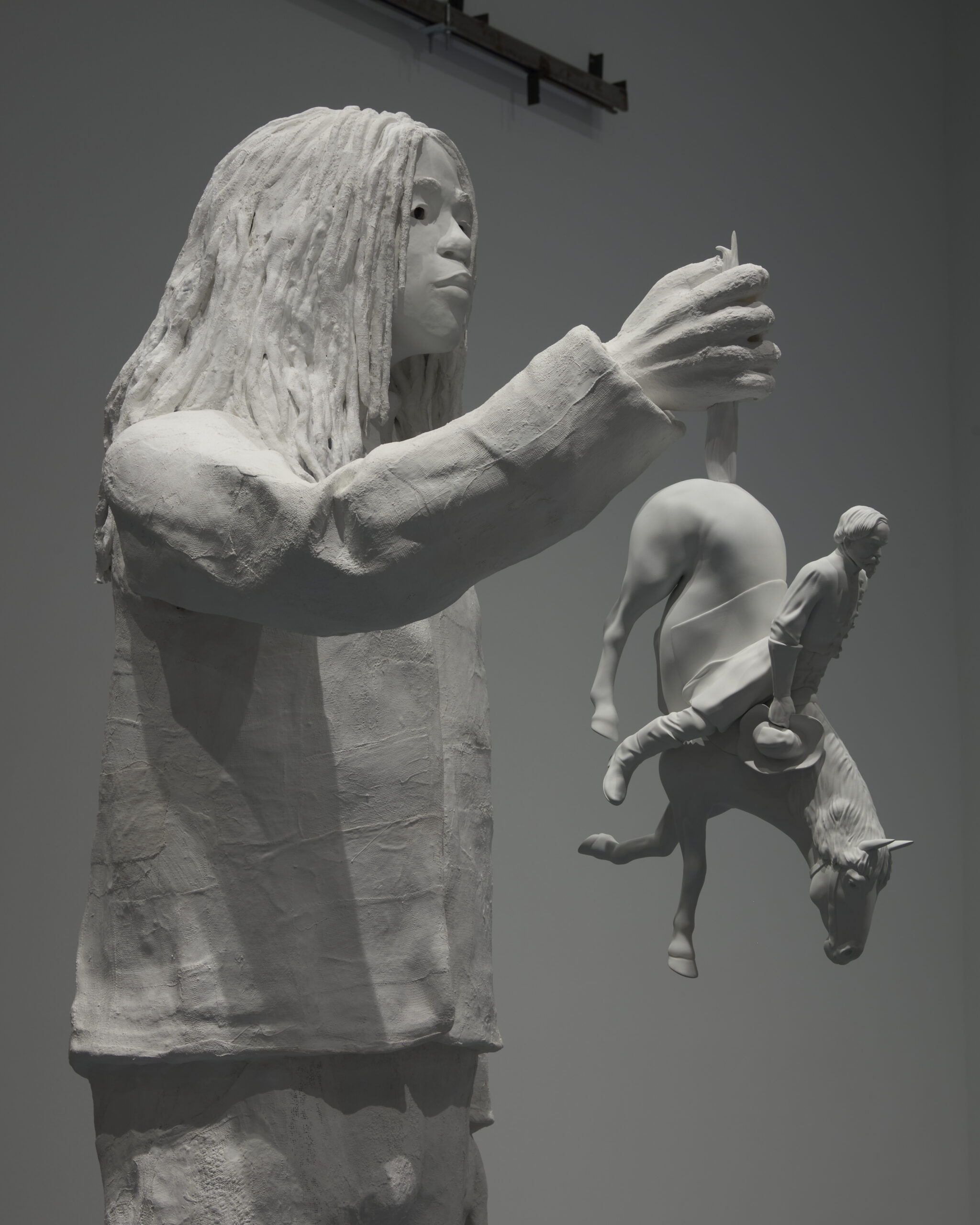
Descendant(detail), 2025
Photo by Frederik Nilsen
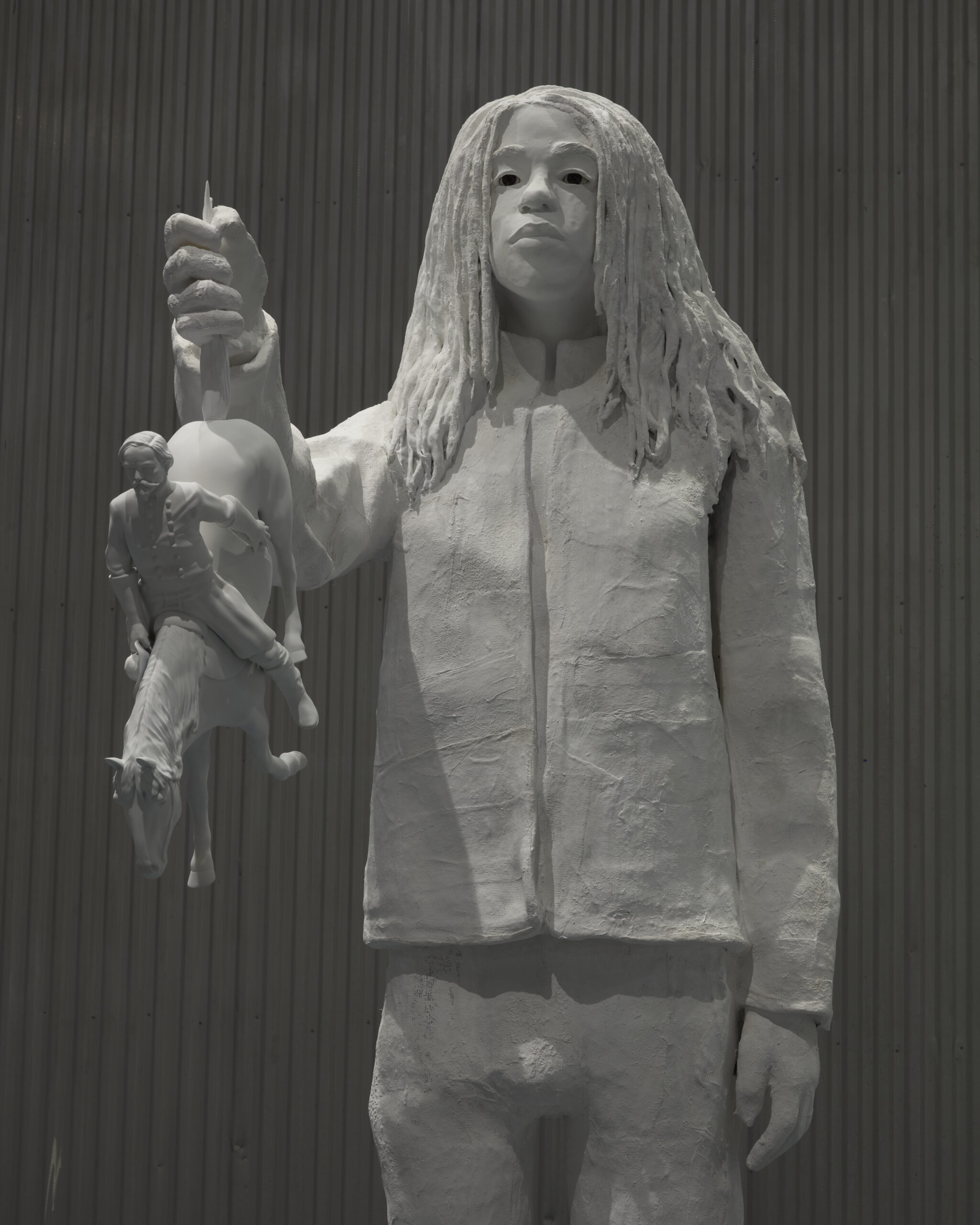
Descendant(detail), 2025
Photo by Frederik Nilsen
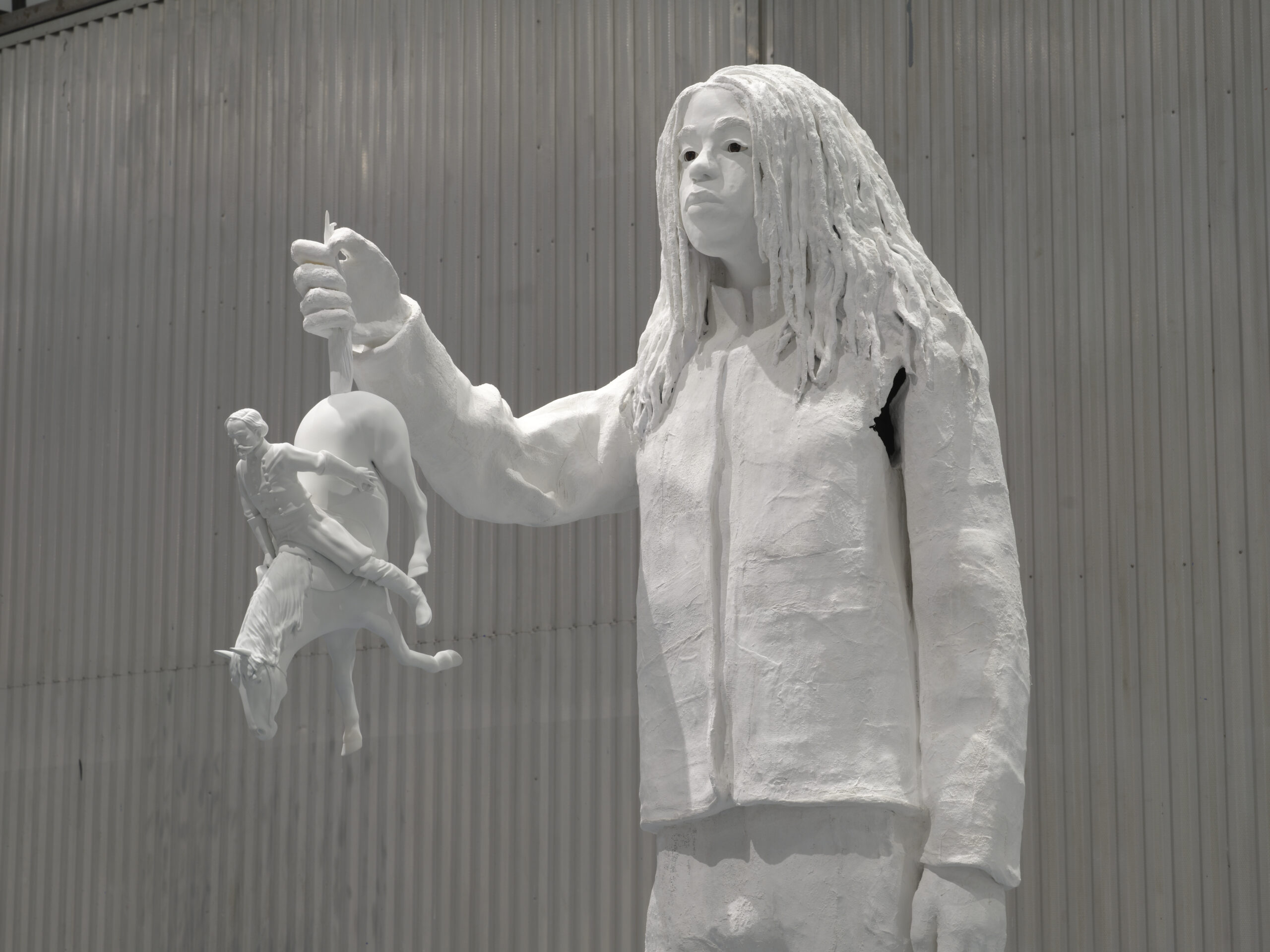
Descendant(detail), 2025
Photo by Frederik Nilsen
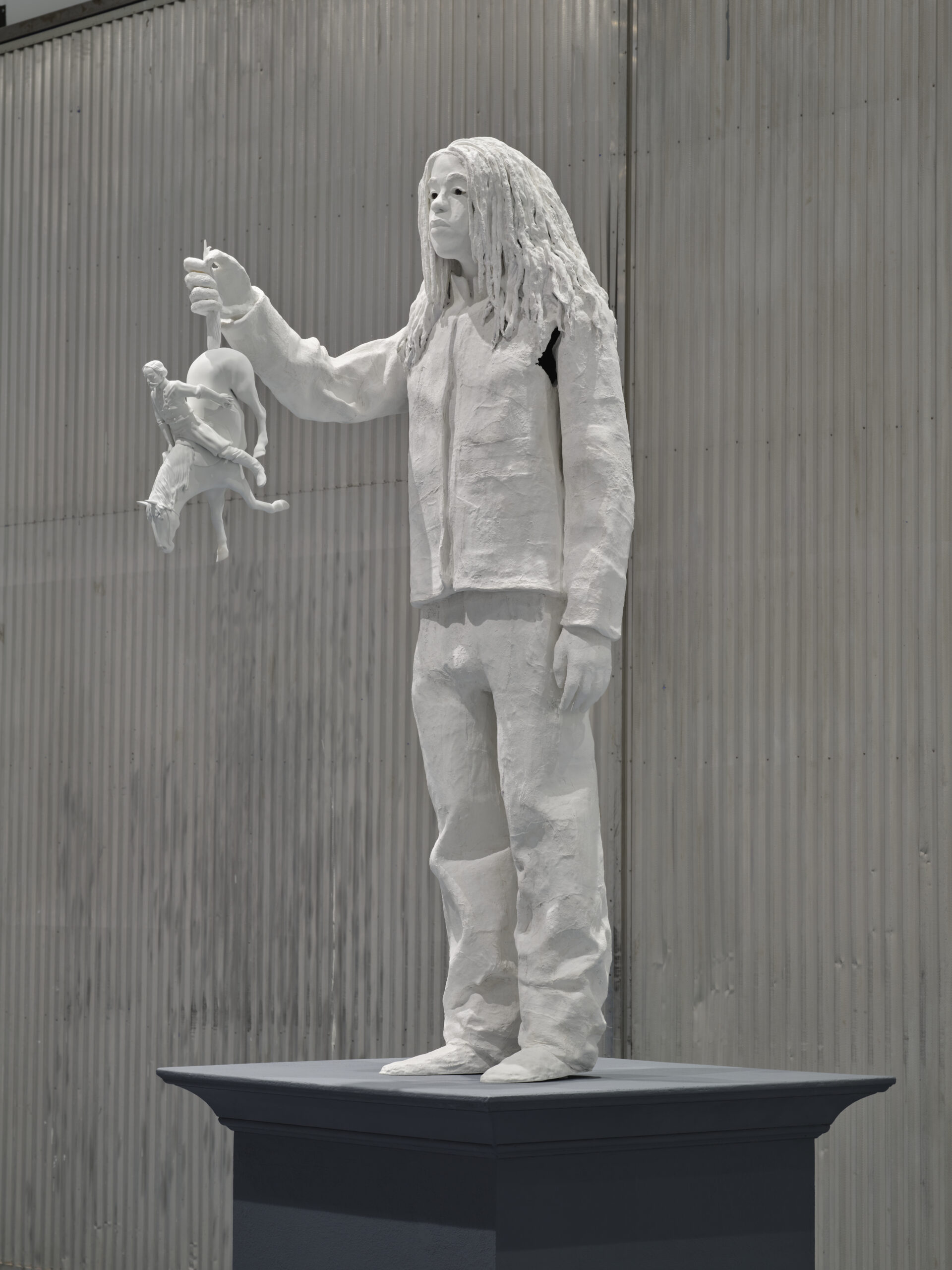
Descendant(detail), 2025
Photo by Frederik Nilsen

Descendant, 2025
Plywood, MDF, latex paint, metal hardware, steel, aluminum, fiberglass
131 7/8 x 44 3/4 x 53 5/16 in. (335 x 113.7 x 135.4 cm)
Commissioned by MOCA & The Brick
Courtesy of the artist and Salon 94
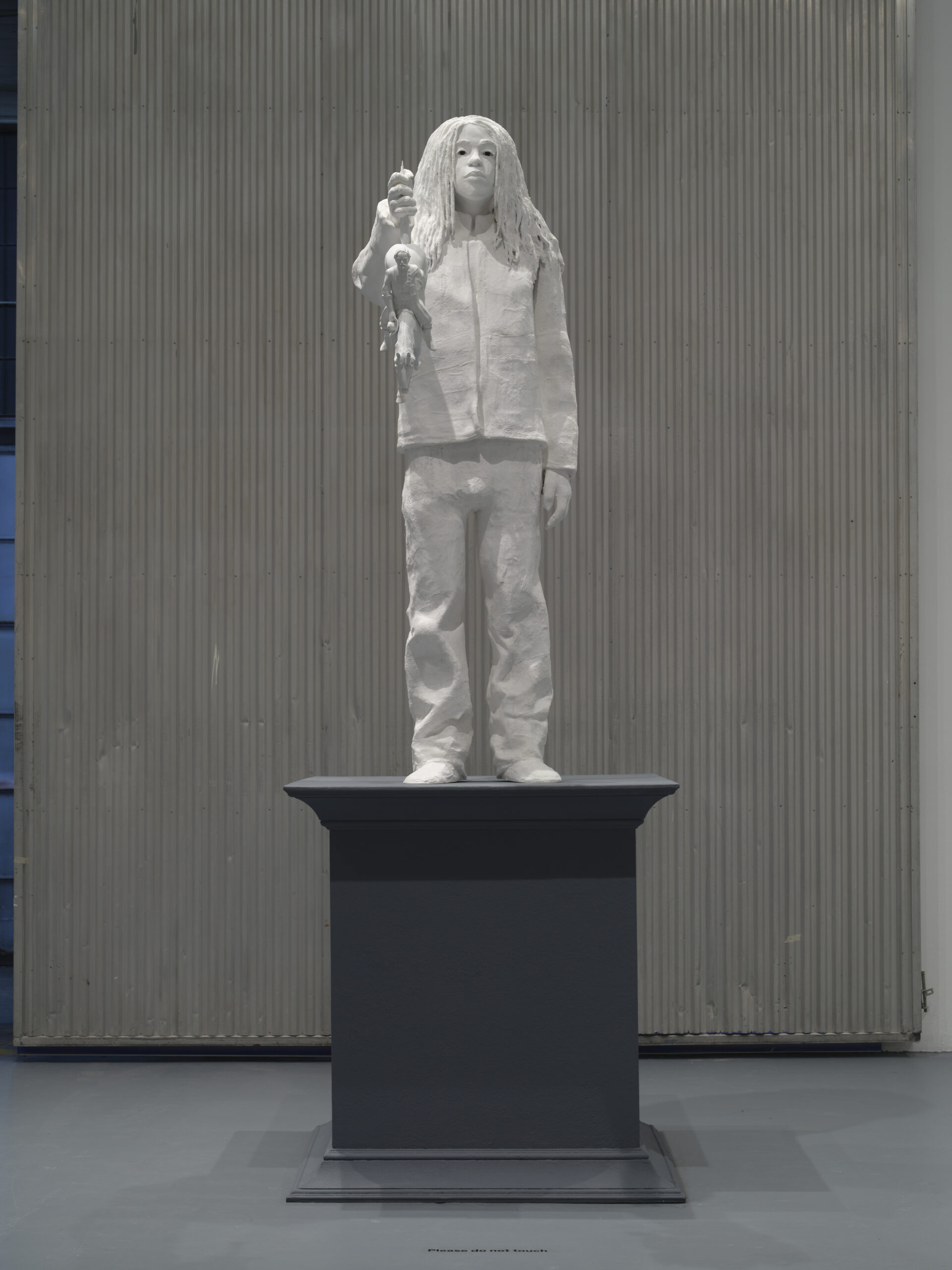
Descendant, 2025
Photo by Frederik Nilsen