

A Suspension of Hostilities

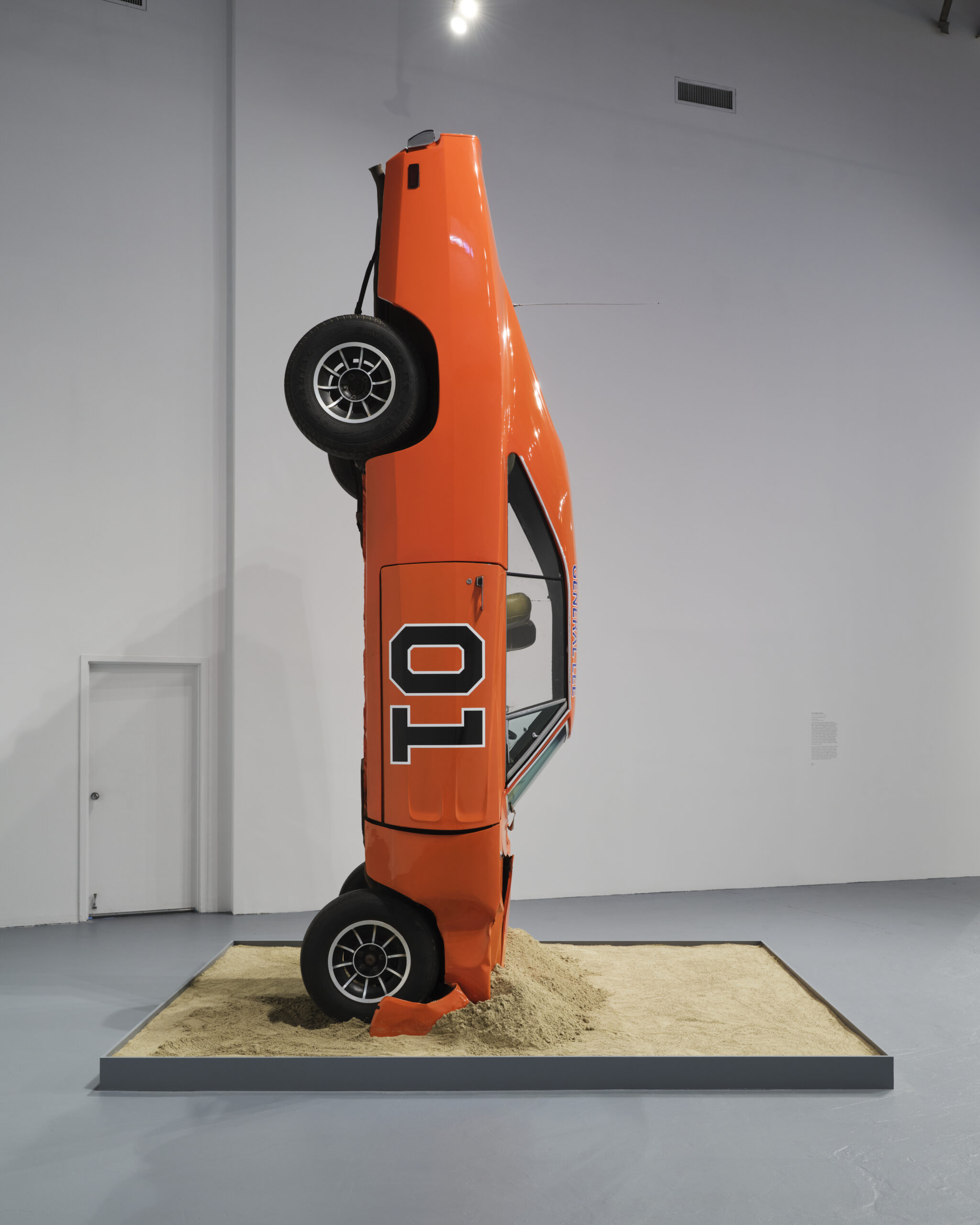
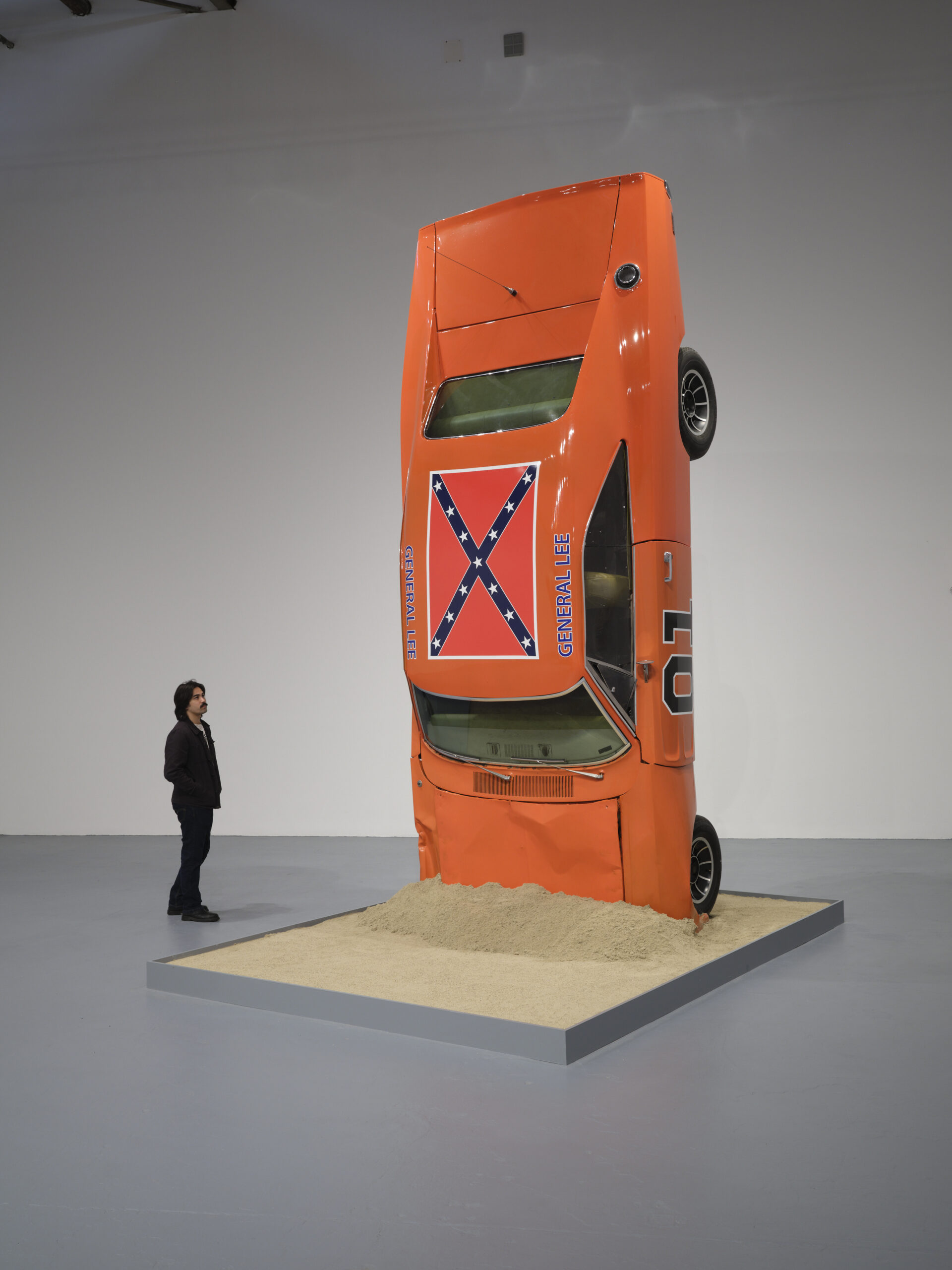
A Suspension of Hostilities, 2019
1969 Dodge Charger
178 x 76 5/8 x 55 in. (452.1 x 194.6 x 139.7 cm)
Filed Under:
Hank Willis Thomas
(b. 1976, Plainfield, New Jersey; lives in New York)
For more than twenty-five years, Hank Willis Thomas has repurposed imagery from popular culture, especially as it pertains to race and representation. Whether working with flags, sports jerseys, or advertisements, he employs familiar iconography to draw incisive parallels between perception and lived experience, often with a sense of humor or joy.
The artist’s 2019 sculptural work A Suspension of Hostilities, titled after a phrase used to describe the truce between the North and South at the end of the Civil War, appropriates imagery from The Dukes of Hazzard. This popular American television show (1979-85) followed the exploits of Luke and Bo Duke, moonshine runners from rural Georgia who often ran afoul of the corrupt local politician (Jefferson Davis “Boss” Hogg) and the sheriff. The Dukes drove a bright orange 1969 Dodge Charger called the General Lee, named after Robert E. Lee, replete with a Confederate battle flag painted on the roof and a horn that plays the first twelve notes of “Dixie,” a minstrel song that served as the de facto Confederate national anthem. Chase scenes were integral to the show, and the General Lee jumped over obstacles, gaps in bridges, and cliffs while police cars struggled to keep up, crashing and allowing the Dukes to escape. The General Lee was such an iconic part of the show, it accounted for over half the fan letters received by the studio and was responsible for $100 million in annual sales of retail products.
A Suspension of Hostilities finds the General Lee standing vertically, nose buried in the ground and hood crumpled. Like many kids, Thomas watched The Dukes of Hazzard growing up, calling it his favorite TV show and even owning Duke action figures and a model of the car itself. “My grandmother watched it with me. My mother watched it with me. There was never any mention or suggestion that there was a problem with the context or the Confederate flag.” The title of the work playfully comments upon the subsumption of Confederate iconography into American pop culture at the expense of historical fact.
The Dukes of Hazzard’s use of the battle flag and “Dixie” exemplifies how the historical specificity of Confederate symbolism has been obscured through popular culture. The Confederate battle flag, sometimes erroneously referred to as the “stars and bars,” was specifically used by the Army of Northern Virginia led by Lee, and was later incorporated into the Confederate States of America’s national flag. Its use by bands like Lynyrd Skynyrd and TV shows like The Dukes of Hazzard obscures the flag’s origins in the fight to preserve slavery and instead links it to the concept of rebellion more broadly. The Dukes of Hazzard appealed largely to a working-class white audience. By the late 1970s, when it began to air, “heritage groups” like the United Daughters of the Confederacy (UDC) and the Sons of Confederate Veterans (SCV) argued that the flag stood for heritage not hate, while segregationists and Klansmembers continued to brandish it at protests and marches. Similarly, the song “Dixie” became synonymous with Southern pride, divorced from its context as a minstrel song, though it begs the question: what “old times” are gone but “not forgotten”?
In 2015, Warner Bros. discontinued production of toy models of the General Lee after receiving criticism in the wake of the Charleston Church Massacre. It was at this time that the history and meaning behind the Confederate battle flag reentered popular discourse. It is now largely viewed unfavorably and is linked with racism and the history of slavery. As if powered by Lost Cause mythology, the General Lee has failed to bridge the gap to a new generation of viewers.
Hank Willis Thomas
Working across various modes of art-making such as sculpture, screen-printing, neon, mixed media, and installation art, Hank Willis Thomas (b. 1976, Plainfield, New Jersey) is a conceptual artist widely known for his investigation of themes relating to mass media, identity, popular culture, and perspective.
Thomas often seeks out and utilizes recognizable icons from popular branding and marketing campaigns. In using icons and other nods to popular culture, he encourages the viewer to question commercial consumer representation and the racial stereotypes it perpetuates. A common practice in his artistic process, Thomas looks to the ways popular imagery informs how people perceive themselves and others around the world, comparing this practice to the one of a “visual cultural archaeologist.” A trained photographer, his work spans across many disciplines and media, and his public works always encourage a form of viewer participation and contribution.
Throughout his career, Thomas has examined the structures, myths, and images that reinforce economic and racial prejudice, as exemplified by mass media, advertising, and popular culture. Thomas’ seminal series, Unbranded (2005–08), which grew out of his B®anded series, builds upon these themes, focusing on the intersection of race, class, media, and popular culture. Mining historical advertisements from the 1960s, he digitally removes all text and logos from the image, revealing the underlying structures of prejudice that inform advertising and highlighting what is really for sale in these images.
Begun in 2019, Thomas’ most recent project, The Embrace (2022), is a memorial inspired by an archival photograph of Dr. Martin Luther King, Jr. and his wife, Coretta Scott King, embracing after he was awarded the Nobel Peace Prize in 1964. In collaboration with Mass Design Group, Embrace Boston, and The Boston Foundation, the 20-foot tall, 32-foot-wide bronze sculpture is a continuation of the artist’s inquiry into economic and racial justice and an ode to collaboration, love, and equality. It was unveiled in January 2023 at its permanent home in Boston Common, where, in 1965, Dr. King led a march from the Roxbury neighborhood to the downtown public park.
Thomas’ collaborative projects include Question Bridge: Black Males, In Search Of The Truth (The Truth Booth) and For Freedoms, which was awarded the 2017 ICP Infinity Award for New Media and Online Platform. In 2012, Question Bridge: Black Males debuted at the Sundance Film Festival and was selected for the New Media Grant from the Tribeca Film Institute. Thomas is also the recipient of the Guggenheim Fellowship (2018), AIMIA | AGO Photography Prize (2017), Soros Equality Fellowship (2017) and is a former member of the New York City Public Design Commission.
Thomas’ work has been exhibited throughout the United States and abroad, including at the Philadelphia Photo Arts Center, Pennsylvania (2008); Baltimore Museum of Art, Maryland (2009); International Center of Photography, New York (2013); California African American Museum, Los Angeles (2016); and SCAD Museum of Art, Savannah, Georgia (2017). His work has been included in important group exhibitions at the International Center of Photography, New York (2013); Guggenheim Museum Bilbao, Spain (2015); Brooklyn Museum, New York (2016); and the Zeitz Museum of Contemporary Art Africa, Cape Town (2016), among others. His work is held in numerous public collections worldwide, including the Kadist Art Foundation, Paris; San Francisco Museum of Modern Art, California; Smart Museum of Art, Chicago; Solomon R. Guggenheim Museum, New York; and the Whitney Museum of American Art, New York.
Thomas earned a BFA from New York University, New York, in 1998 and an MA/MFA from the California College of the Arts, San Francisco, in 2004. He received honorary doctorates from the Maryland Institute of Art, Baltimore, Maryland, and the Institute for Doctoral Studies in the Visual Arts, Portland, Maine, in 2017. The artist lives and works in Brooklyn, New York.

A Suspension of Hostilities, 2019
1969 Dodge Charger
178 x 76 5/8 x 55 in. (452.1 x 194.6 x 139.7 cm)
A Suspension of Hostilities
Photo by Frederik Nilsen
A Suspension of Hostilities (installation view)
Photo by Frederik Nilsen