

Richmond Times-Dispatch · Nov 12, 2017
A MAN OF SCIENCE AND THE SEA
Why we should save the Maury monument
BY DALE M. BRUMFIELD
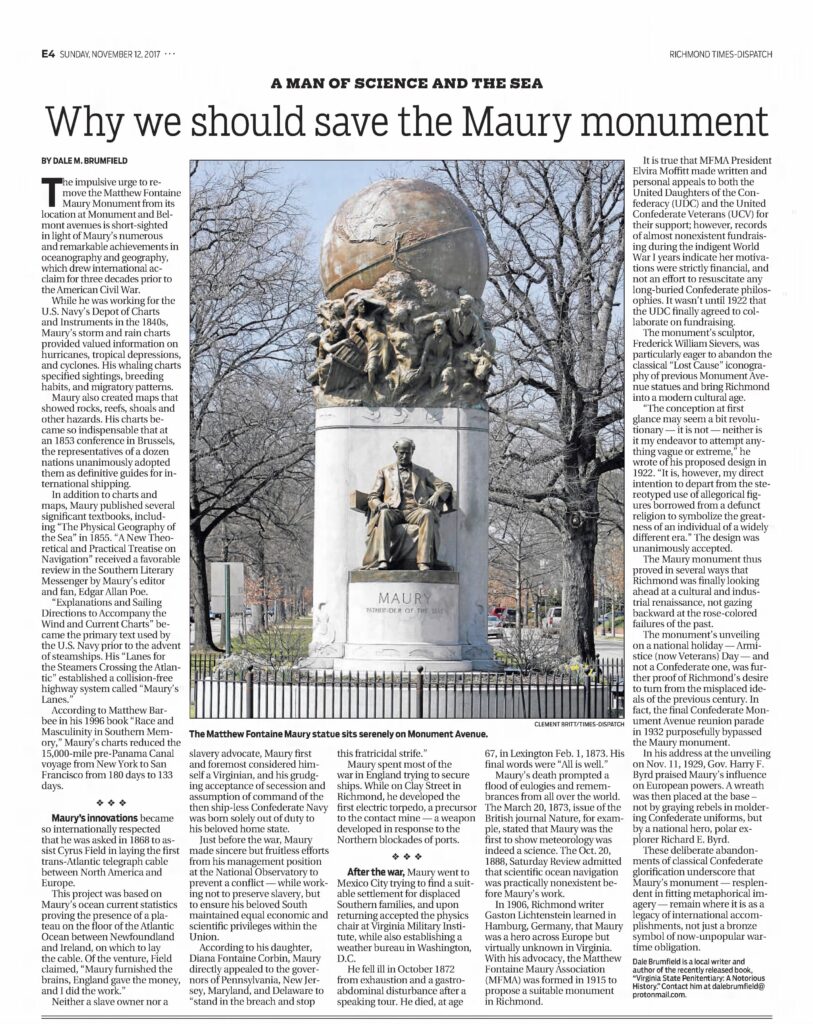
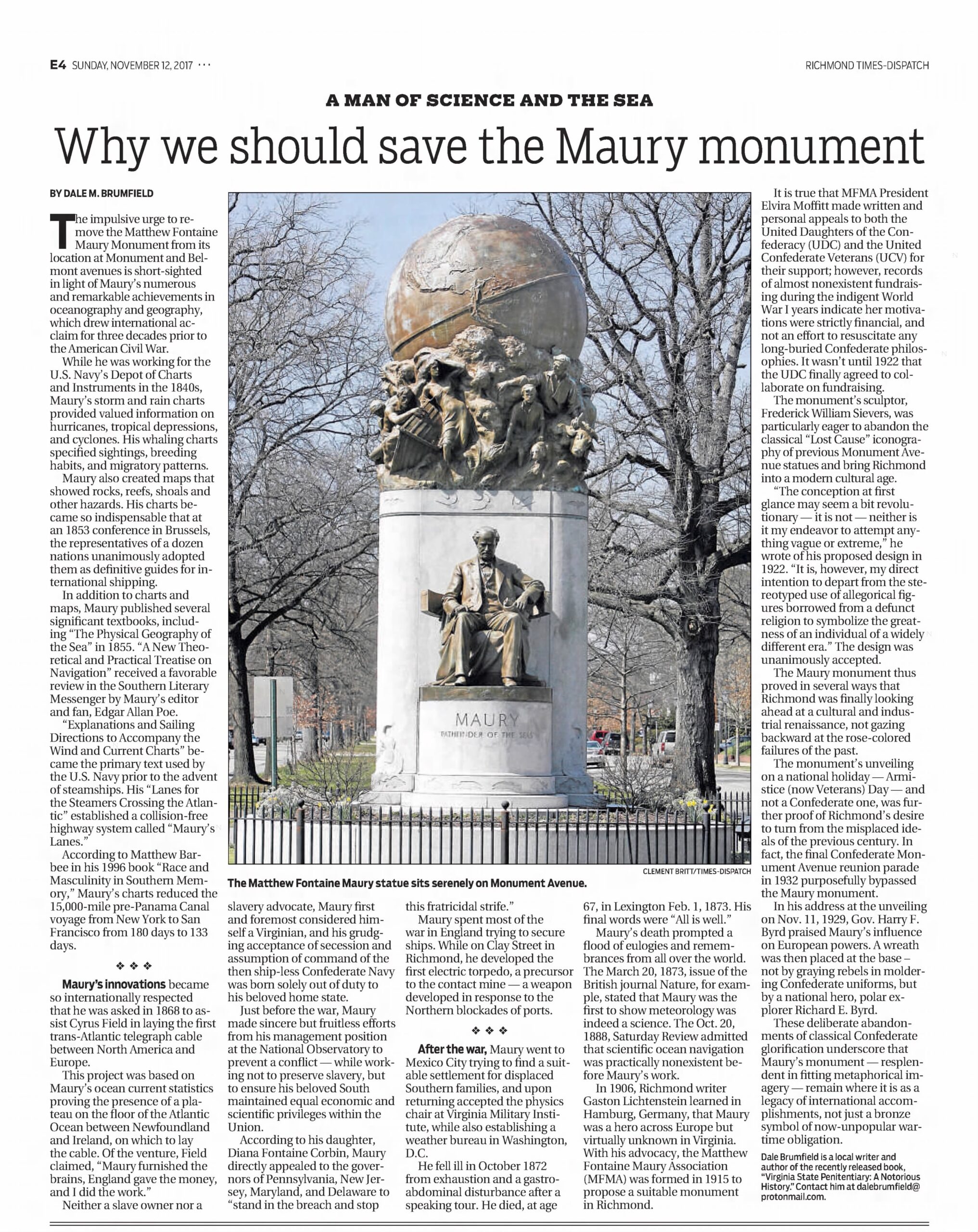
The impulsive urge to remove the Matthew Fontaine Maury Monument from its location at Monument and Belmont avenues is short-sighted in light of Maury’s numerous and remarkable achievements in oceanography and geography, which drew international acclaim for three decades prior to the American Civil War.
While he was working for the U.S. Navy’s Depot of Charts and Instruments in the 1840s, Maury’s storm and rain charts provided valued information on hurricanes, tropical depressions, and cyclones. His whaling charts specified sightings, breeding habits, and migratory patterns.
Maury also created maps that showed rocks, reefs, shoals and other hazards. His charts became so indispensable that at an 1853 conference in Brussels, the representatives of a dozen nations unanimously adopted them as definitive guides for international shipping.
In addition to charts and maps, Maury published several significant textbooks, including “The Physical Geography of the Sea” in 1855. “A New Theoretical and Practical Treatise on Navigation” received a favorable review in the Southern Literary Messenger by Maury’s editor and fan, Edgar Allan Poe.
“Explanations and Sailing Directions to Accompany the Wind and Current Charts” became the primary text used by the U.S. Navy prior to the advent of steamships. His “Lanes for the Steamers Crossing the Atlantic” established a collision-free highway system called “Maury’s Lanes.”
According to Matthew Bar-bee in his 1996 book “Race and Masculinity in Southern Memory,” Maury’s charts reduced the 15,000-mile pre-Panama Canal voyage from New York to San Francisco from 180 days to 133 days.
***
Maury’s innovations became so internationally respected that he was asked in 1868 to assist Cyrus Field in laying the first trans-Atlantic telegraph cable between North America and Europe.
This project was based on Maury’s ocean current statistics proving the presence of a plateau on the floor of the Atlantic Ocean between Newfoundland and Ireland, on which to lay the cable. Of the venture, Field claimed, “Maury furnished the brains, England gave the money, and I did the work.”
Neither a slave owner nor a slavery advocate, Maury first and foremost considered himself a Virginian, and his grudging acceptance of secession and assumption of command of the then ship-less Confederate Navy was born solely out of duty to his beloved home state.
Just before the war, Maury made sincere but fruitless efforts from his management position at the National Observatory to prevent a conflict – while working not to preserve slavery, but to ensure his beloved South maintained equal economic and scientific privileges within the Union.
According to his daughter, Diana Fontaine Corbin, Maury directly appealed to the governors of Pennsylvania, New Jersey, Maryland, and Delaware to
“stand in the breach and stop this fratricidal strife.”
Maury spent most of the war in England trying to secure ships. While on Clay Street in Richmond, he developed the first electric torpedo, a precursor to the contact mine — a weapon developed in response to the Northern blockades of ports.
***
After the war, Maury went to Mexico City trying to find a suitable settlement for displaced Southern families, and upon returning accepted the physics chair at Virginia Military Insti-tute, while also establishing a weather bureau in Washington, D.C.
He fell ill in October 1872 from exhaustion and a gastro-abdominal disturbance after a speaking tour. He died, at age67, in Lexington Feb 1, 1873. His final words were “All is well.”
Maury’s death prompted a flood of eulogies and remembrances from all over the world.
The March 20, 1873, issue of the British journal Nature, for example, stated that Maury was the first to show meteorology was indeed a science. The Oct. 20, 1888, Saturday Review admitted that scientific ocean navigation was practically nonexistent before Maury’s work.
In 1906, Richmond writer Gaston Lichtenstein learned in Hamburg, Germany, that Maury was a hero across Europe but virtually unknown in Virginia. With his advocacy, the Matthew Fontaine Maury Association (MFMA) was formed in 1915 to propose a suitable monument in Richmond.
It is true that MFMA President Elvira Moffitt made written and personal appeals to both the United Daughters of the Confederacy (UDC) and the United Confederate Veterans (UCV) for their support; however, records of almost nonexistent fundraising during the indigent World War I years indicate her motivations were strictly financial, and not an effort to resuscitate any long-buried Confederate philosophies. It wasn’t until 1922 that the UDC finally agreed to collaborate on fundraising.
The monument’s sculptor, Frederick William Sievers, was particularly eager to abandon the classical “Lost Cause” iconography of previous Monument Avenue statues and bring Richmond into a modern cultural age.
“The conception at first glance may seem a bit revolutionary — it is not – neither is it my endeavor to attempt anything vague or extreme,” he wrote of his proposed design in 1922. “It is, however, my direct intention to depart from the stereotyped use of allegorical figures borrowed from a defunct religion to symbolize the greatness of an individual of a widely different era.” The design was unanimously accepted.
The Maury monument thus proved in several ways that Richmond was finally looking ahead at a cultural and industrial renaissance, not gazing backward at the rose-colored failures of the past.
The monument’s unveiling on a national holiday – Armistice (now Veterans) Day – and not a Confederate one, was further proof of Richmond’s desire to turn from the misplaced ideals of the previous century. In fact, the final Confederate Monument Avenue reunion parade in 1932 purposefully bypassed the Maury monument.
In his address at the unveiling on Nov. 11, 1929, Gov. Harry F. Byrd praised Maury’s influence on European powers. A wreath was then placed at the base – not by graying rebels in moldering Confederate uniforms, but by a national hero, polar explorer Richard E. Byrd.
These deliberate abandonments of classical Confederate glorification underscore that Maury’s monument – resplendent in fitting metaphorical imagery — remain where it is as a legacy of international accomplishments, not just a bronze symbol of now-unpopular wartime obligation.
Dale Brumfield is a local writer and author of the recently released book,
“Virginia State Penitentiary: A Notorious History.” Contact him at dalebrumfield@ protonmail.com.