Tabernacle
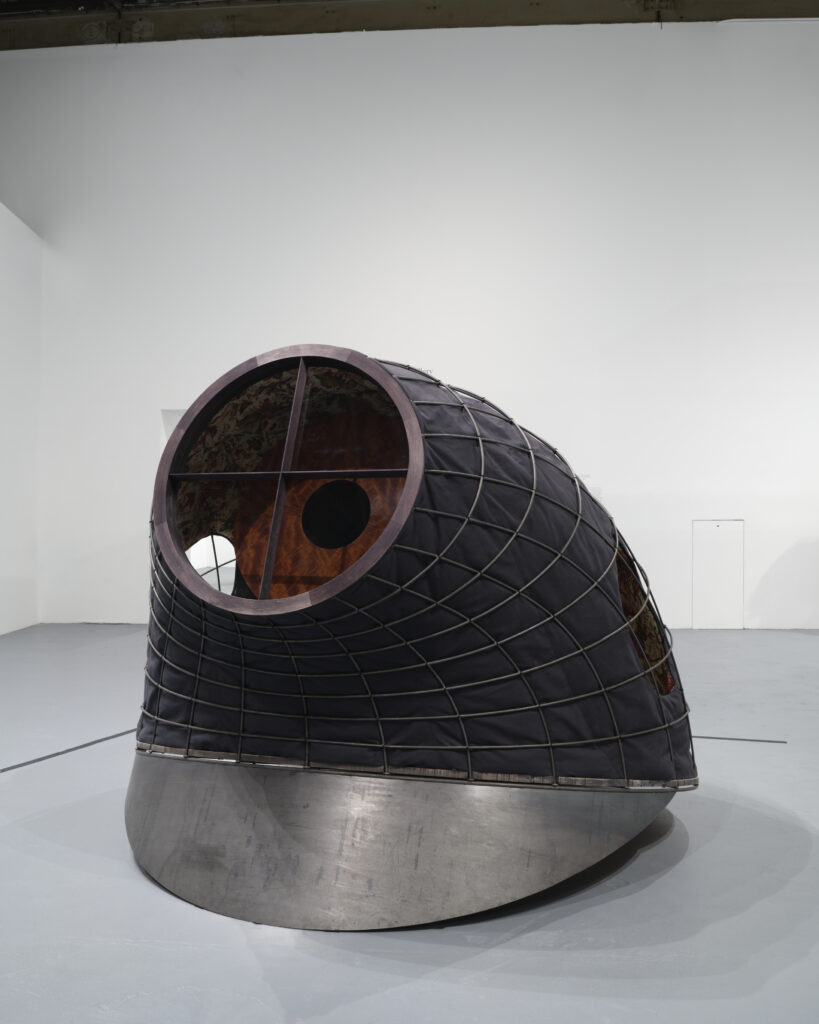
Tabernacle, 2019
Steel, red cedar, American cypress, pine, makore veneer, canvas, printed cotton fabric, glass, stainless steel
74 x 90 x 96 in. (188 x 228.6 x 243.8 cm.)
Glenstone Museum
Photo by Frederik Nilsen
Filed Under:
Martin Puryear
(b. 1941, Washington, D.C.; lives in Hudson River Valley, New York)
Martin Puryear was born and raised in a segregated Washington, D.C. Before completing his MFA at Yale in 1971, he traveled to Sierra Leone as a volunteer in the Peace Corps, which introduced him to traditional woodworking and building practices. He then studied printmaking at the Royal Swedish Academy of Arts in Stockholm. While living in Sweden, he became acquainted with furniture maker James Krenov. These experiences would deeply influence his artistic practice and temper his interest in the fine arts with an equally strong admiration for craft, particularly as it is brought to bear on functional objects such as textiles, baskets, and furniture.
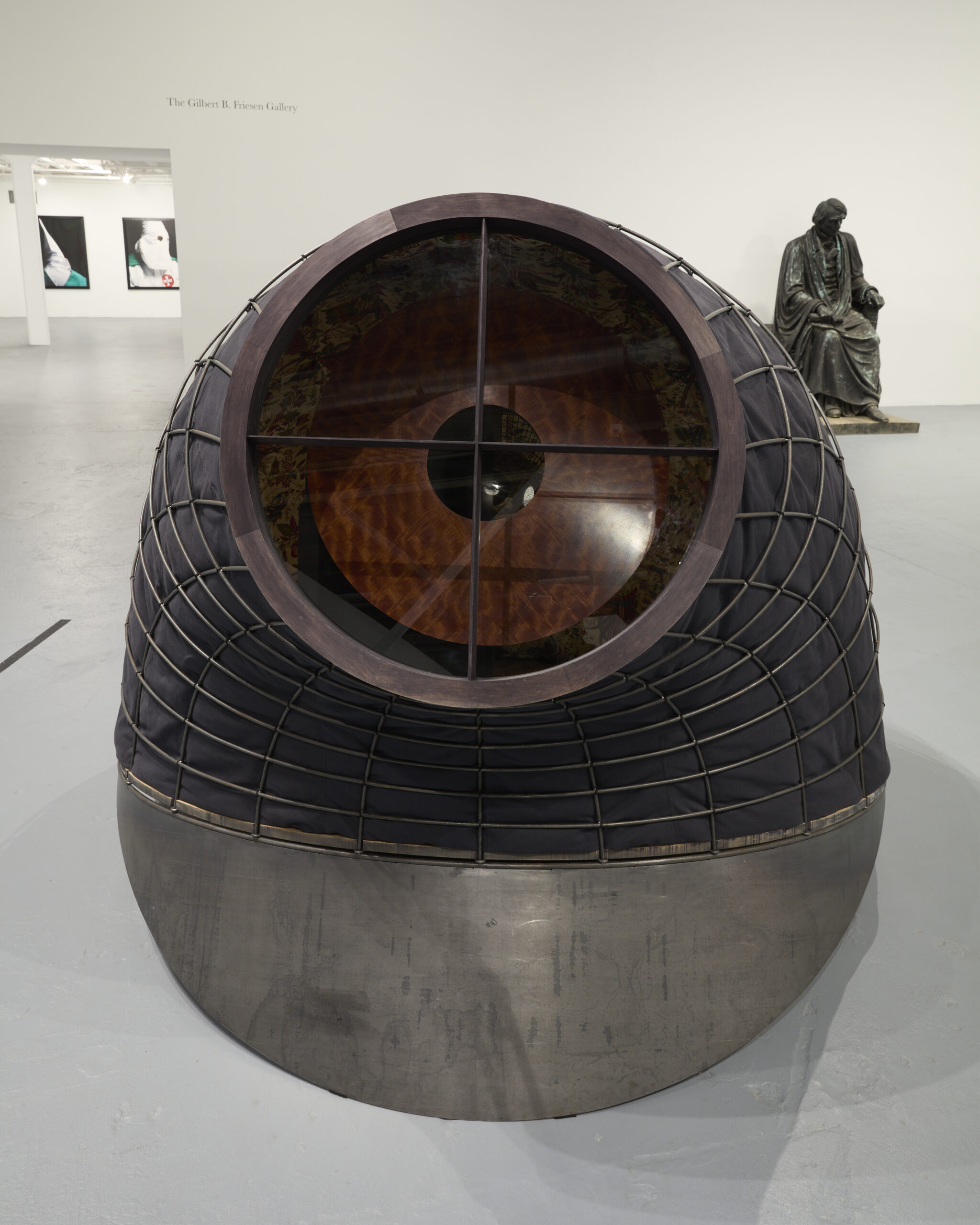
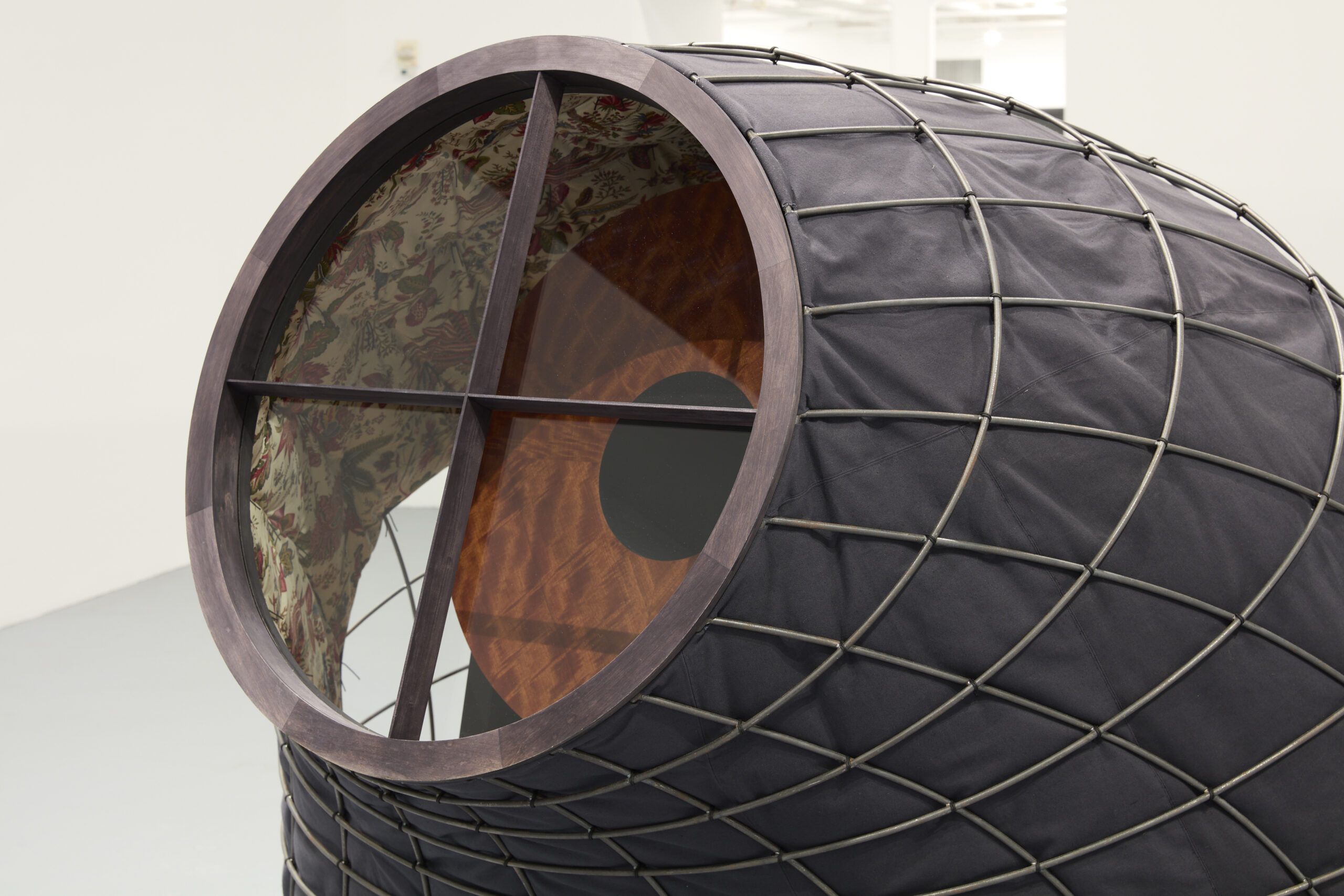
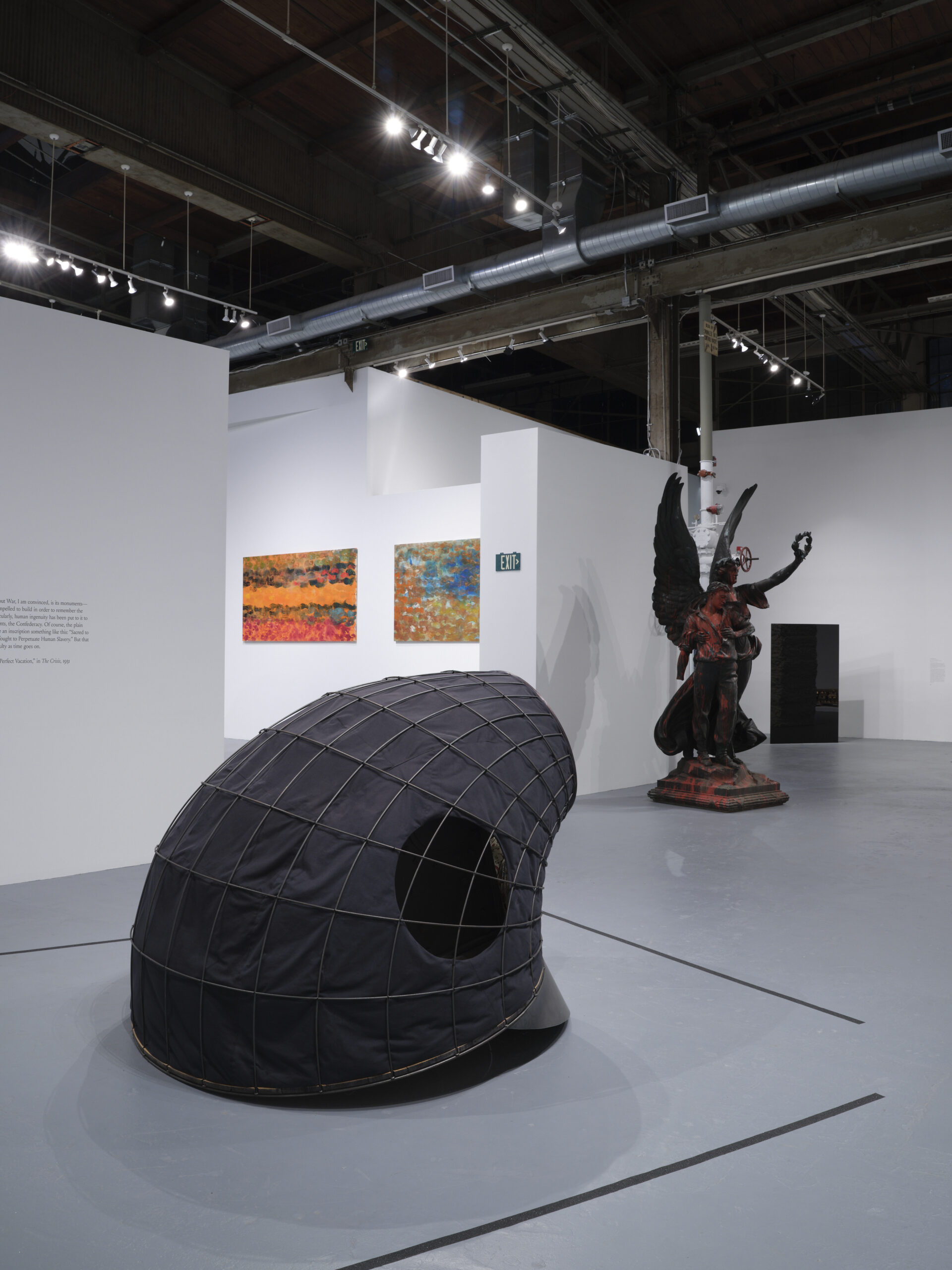
Puryear’s work is marked by organic materials and shapes, eschewing Minimalism’s hard-edged platonic forms and industrial methods of fabrication for softer, irregular, curvilinear geometries and traditional woodworking techniques. Although it is often abstract, his work, by way of title, can refer to specific historical figures, as in Ladder for Booker T. Washington, Some Lines for Jim Beckwourth, and A Column for Sally Hemings. Or it can take its cues from a familiar form, which for Tabernacle is a forage cap, the hat associated with Civil War soldiers.
Puryear chose the title Tabernacle as it refers to a sacred enclosed space containing an object of worship, which in this case is a form based on a Civil War siege mortar, a weapon meant to stand in for firearms more generally. “Enshrined” in the Constitution, the right to bear arms has indeed taken on the character of religious fanaticism, making Tabernacle a forthright statement about American gun culture.
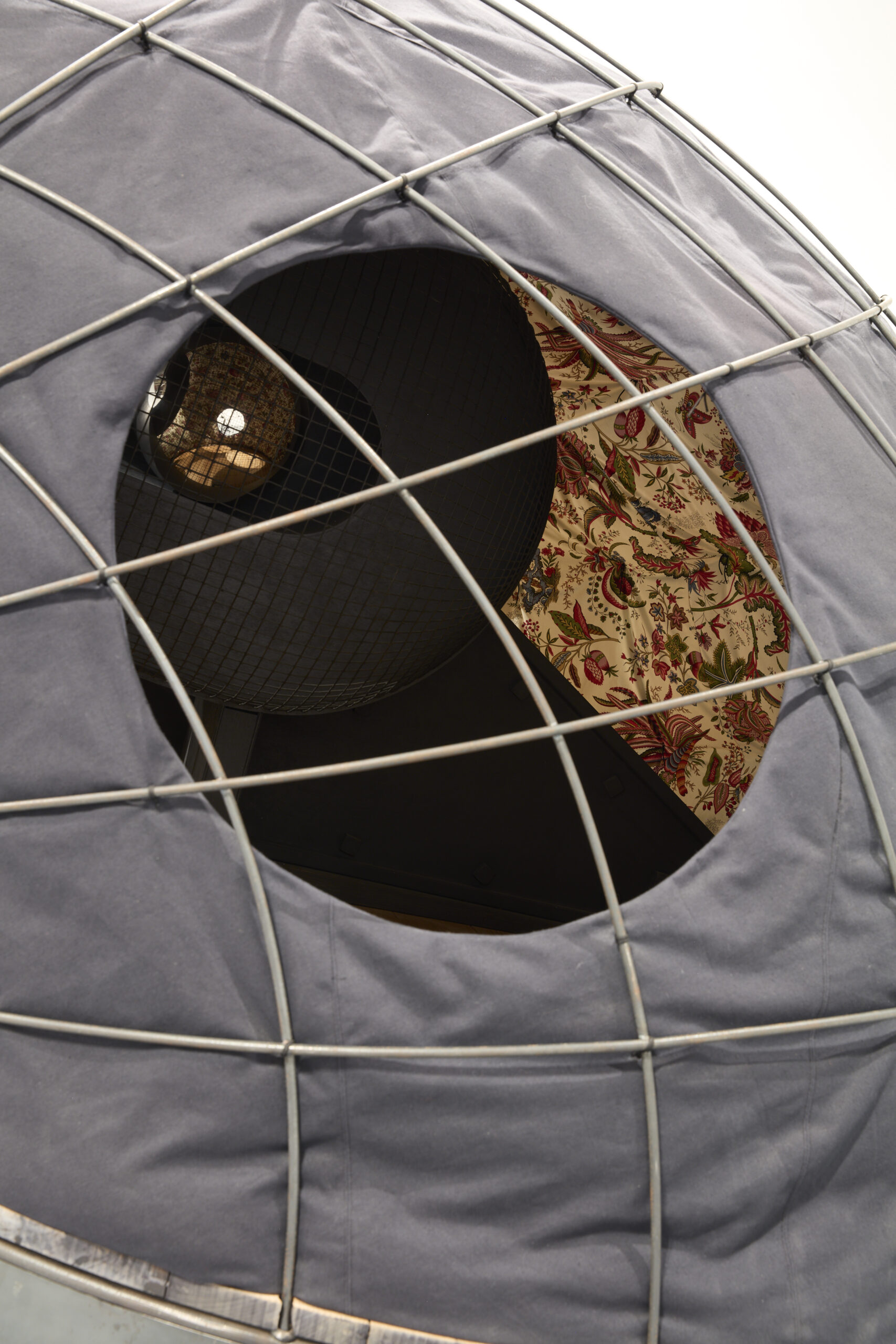
Openings on either side of Tabernacle provide a view into an interior whose walls are covered with a billowing nineteenth-century floral fabric that originated in India. This textile was popularized through European colonization, increasing the demand for cotton and in turn fueling the expansion of chattel slavery in the U.S. At the center of Tabernacle is a steel mortar cannon, invoking mid-nineteenth-century warfare and the iron industry that was likewise reliant on enslaved labor. The opening at the hat’s top resembles the crosshair of a gun and offers a view down the barrel of the cannon loaded with smooth, reflective ammunition. Upon peering inside, the viewer becomes the ammunition’s target, begging the question of who is shooting at whom. The opening at the top of the hat may then be considered a portal between the past as signified by cap and cannon, and our present on this side of the crosshairs. Given that Puryear’s work is more connotative than denotative, how might the viewer consider the relationship between the Civil War and gun violence? And what, if any, relationship is there between that past and this present?
The right to bear arms is emblematic of a freedom that stands in stark contrast to the freedom granted to 4 million Blacks at the close of the Civil War. And bearing in mind that the Civil War was fought to end slavery, how does race factor into a consideration of the relationship between the Civil War and gun violence? While gun violence can affect anyone, regardless of race, perceptions of gun violence may depend on who you ask. Given that Tabernacle overtly references the Civil War and that the legacy of slavery is part and parcel of any historical trajectory which has that as its starting point, questions of who is shooting at whom, under what conditions and in what context, are loaded ones indeed.
Martin Puryear
Over the last five decades Martin Puryear has created a body of work based on abstract organic forms rich with psychological, cultural, and historical references. His labor-intensive sculptures are made by hand at his studio in upstate New York. They combine practices adapted from many different traditions, including wood carving, joinery, and boat building, as well as more recent technology. As a student, Puryear studied ornithology, falconry, and archery, and in the 1960s he volunteered with the Peace Corps in west Africa, where he educated himself in the region’s indigenous crafts. Since then he has continued to travel extensively, observing a range of cultures and their unique approaches to object making. “I think there are a number of levels at which my work can be dealt with and appreciated,” he has said. “It gives me pleasure to feel there’s a level that doesn’t require knowledge of or immersion in the aesthetic of a given time or place.”
Martin Puryear (b. 1941) was born in Washington, DC. His first one-person exhibition was in 1968, and since then he has exhibited throughout the world, including public commissions in Europe, Asia, and the United States. His work was featured in Documenta 9, and in 1989 he represented the United States at the São Paulo Bienal, where he was awarded the festival’s Grand Prize. In 2007 the Museum of Modern Art in New York organized a survey of his work, which traveled to the National Gallery of Art in Washington, the San Francisco Museum of Modern Art, and the Modern Art Museum of Fort Worth. In 2015 the Art Institute of Chicago organized an exhibition of fifty years of his works on paper, which traveled to the Morgan Library and Museum in New York and the Smithsonian American Art Museum in Washington. Puryear received a MacArthur Foundation award in 1989 and a National Medal of Arts from President Obama in 2011. In 2019 he represented the United States at the 58th Venice Biennale.
Tabernacle, 2019
Photo by Frederik Nilsen
Photo by Frederik Nilsen
Photo by Frederik Nilsen
Photo by Frederik Nilsen
Steel, red cedar, American cypress, pine, makore veneer, canvas, printed cotton fabric, glass, stainless steel
74 x 90 x 96 in. (188 x 228.6 x 243.8 cm.)
Glenstone Museum
Photo by Frederik Nilsen