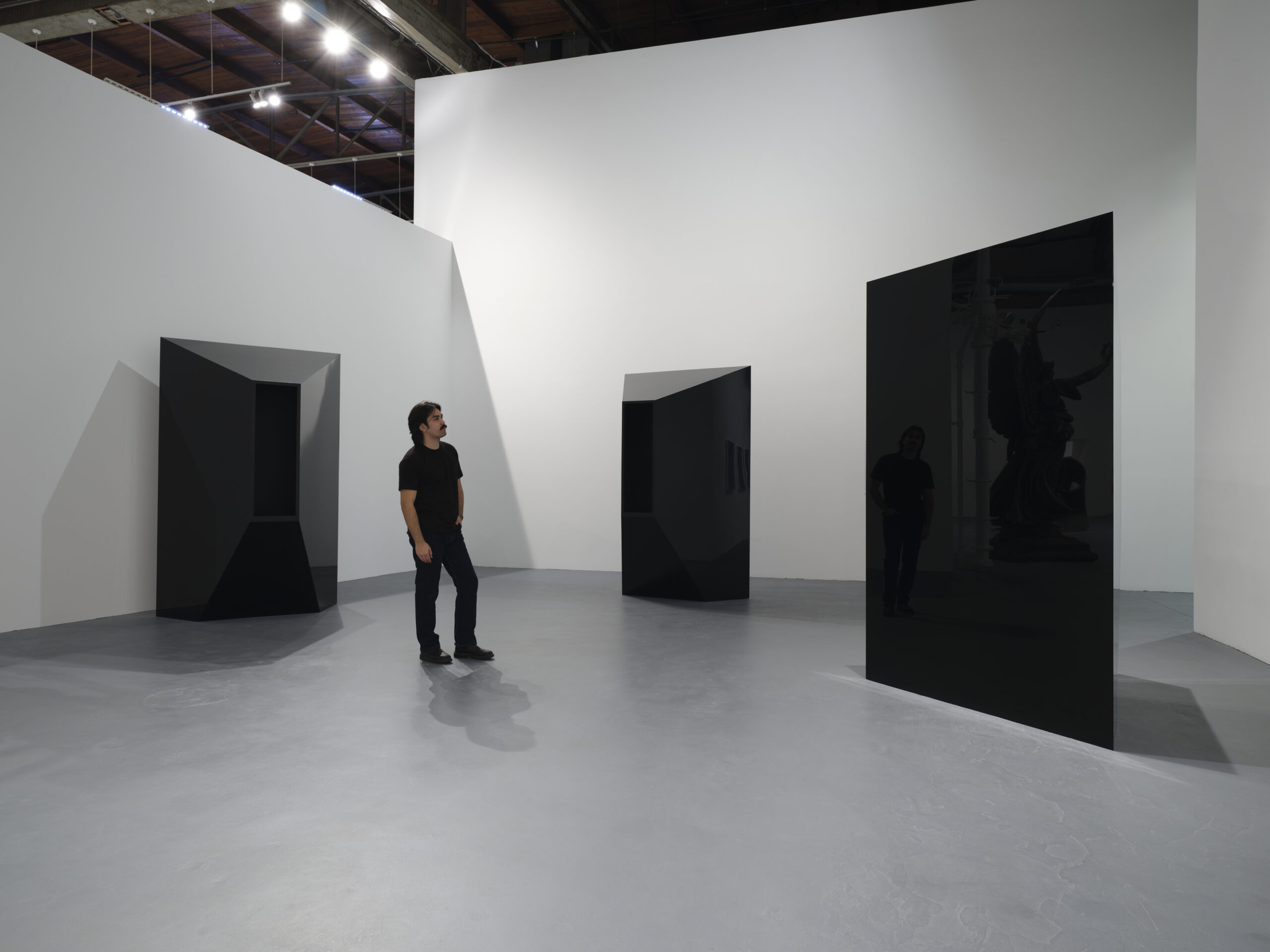
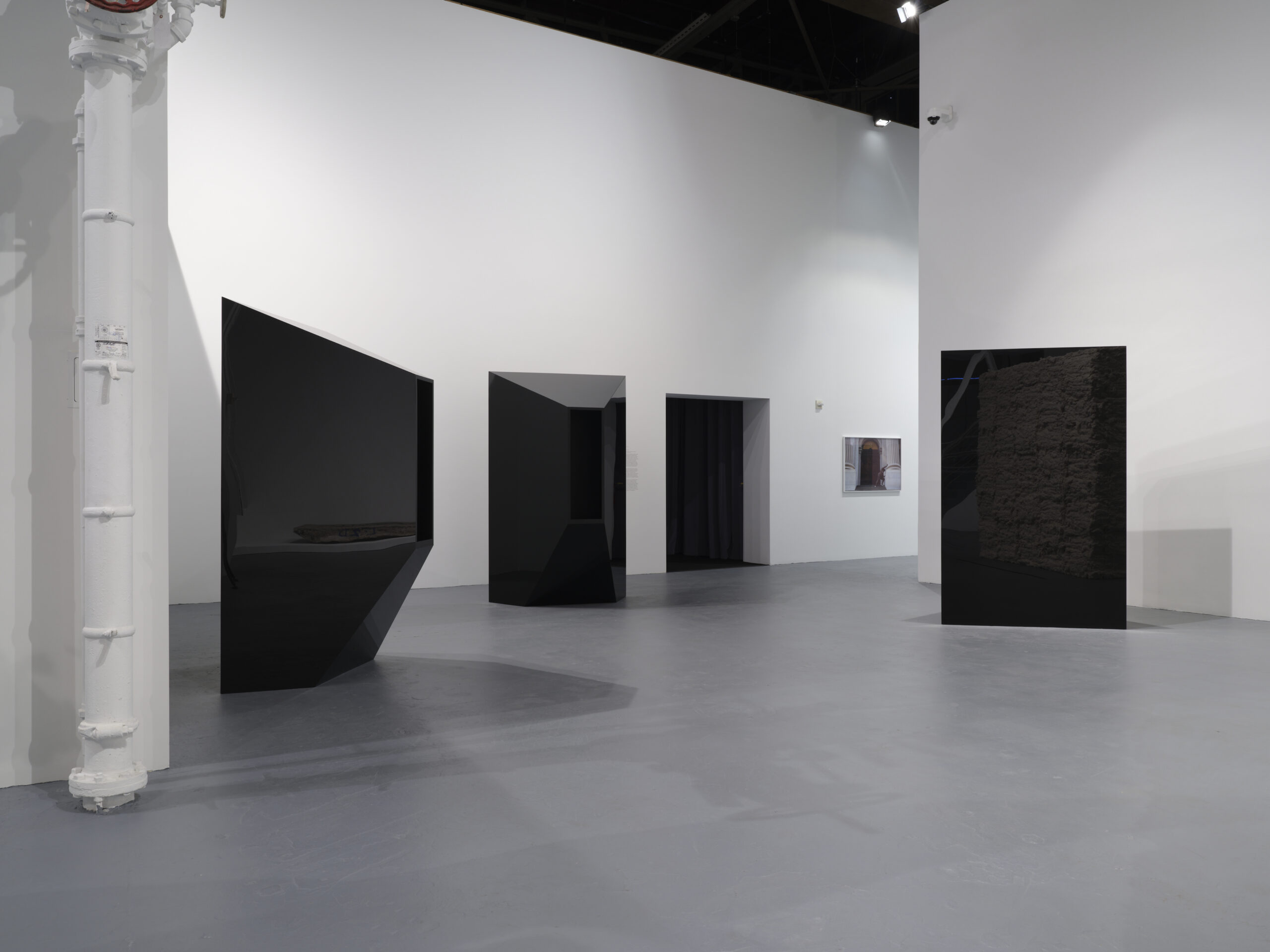
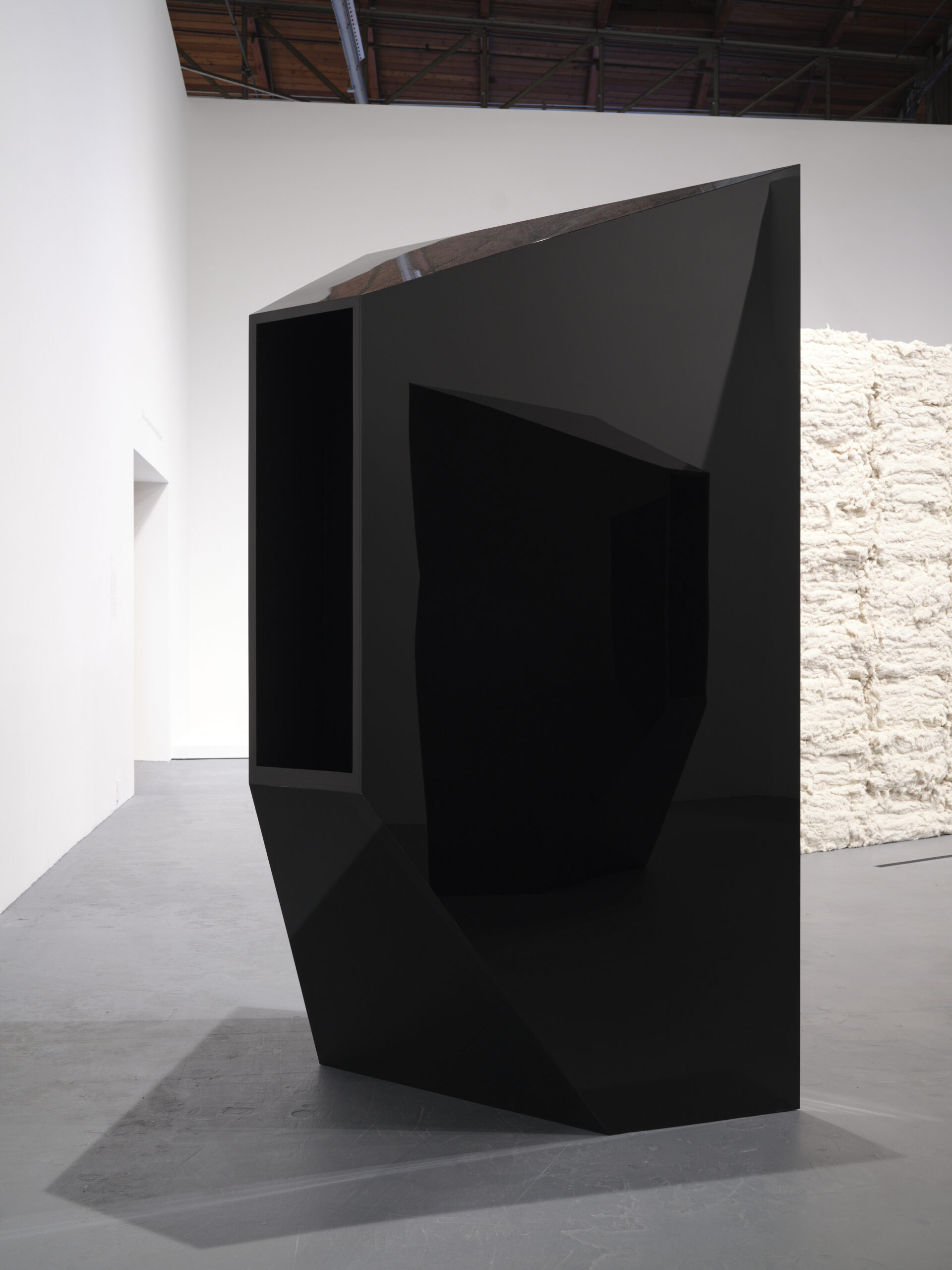
Rate of Transformation, Distance
Rate of Transformation, Distance, 2018/2025
Wood and acrylic
Three parts, each approximately 94 x 58.5 x 40 in (238.8 × 148.6 × 101.6 cm)
Overall dimensions variable
Courtesy of the artist and Pace Gallery
Photo by Fredrik Nilsen
Filed Under:
Torkwase Dyson
(b. 1973, Chicago; lives in Beacon, New York)
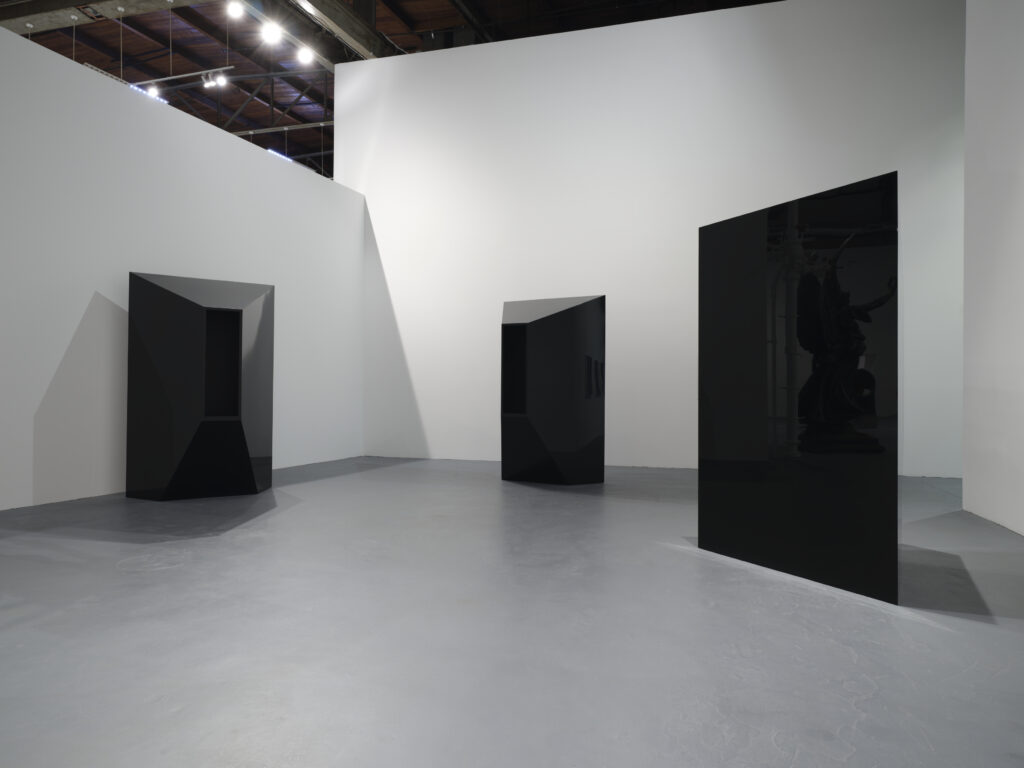
Rate of Transformation, Distance is a stark and unapologetic species of geometric abstraction. The sculpture is comprised of three irregular forms each eight feet high. Largely enclosed, their polished black surfaces and seamless construction betray no sense of how they were made. Moreover, as scalene trapezoids, they stand perpendicular to the floor on their narrowest point, defying physics as the deepest point of each is cantilevered out well beyond its center of gravity. Although firmly planted on the gallery floor, this trio of stolid forms exist outside of time and gravity-bound place. Like icebergs bobbing in the sea, their exact shape is difficult to comprehend. Their central rectangular facets are left open so as to become a portal into the infinite black abyss of the interior. The viewer can stare into the darkness, absorbed in the quietude of nothingness in all its horror and peace.
The work was part of a larger site-specific installation titled Nautical Dusk commissioned by Colby College in Waterville, Maine. Dyson was invited to respond to the figure of Samuel Osborne, who, beginning in 1867, worked as the janitor at the college for thirty-seven years and was an integral part of its community. Osborne’s father was born in Africa and survived the Middle Passage. Osborne himself was born enslaved in 1833 on a Virginia plantation and moved to Maine as a free man with two of his daughters, eventually bringing his wife and their other daughter a few years later.
How does one extract an abstraction from the experience of slavery, where the body is the basic starting point of any kind of narrative? Between Osborne and his father, Dyson could chart an odyssey whose bases include Africa, Middle Passage, slavery, and eventually freedom. It is the geometric shape of their journey that places the Osbornes in Dyson’s pantheon of African Americans whose quests for liberation from slavery involved confinement in discrete architectural spaces or triangulated travels over waterways across distant geographies. This pantheon includes Henry “Box” Brown, Anthony Burns, and Harriet Jacobs, all of whose trials and tribulations provide Dyson a formal basis for her stalwart engagement with geometric abstraction.
But for all of her commitment to abstraction, Dyson’s decision to base her sculptures on historical personages runs counter to one of its most alluring assets, namely the ability to transcend cultural, regional, and historical specificity. To revel in the universal language of shape, line, and color is to forsake both the figure and whatever racial, ethnic, or religious baggage comes with it. Dyson took up geometric abstraction for the opposite reason, as a means to get closer to her capital-R roots, namely the transatlantic slave trade and its aftermath. The stakes of her practice lay in her efforts to nativize abstraction as something that is part and parcel of the Black experience. Her references to African Americans seeking freedom from the yoke of slavery bypass so as to supplant the art-historical narrative of a triumphal postwar abstraction synonymous with the word “freedom.” By placing abstraction at the service of individuals for whom freedom is anything but abstract, Dyson is doubling down.
Within the galleries of MONUMENTS, Rate of Transformation, Distance acts as a counterpoint to figurative work and a corollary to a ubiquitous Confederate memorial form—the obelisk. As a Victorian-era symbol erected in cemeteries, obelisks were borrowed from the iconography of ancient Egypt and were meant to stand for sunlight. But in contrast to the obelisks drawn from antiquity, Dyson’s shapes recall the futuristic monolith of Stanley Kubrick’s 2001: A Space Odyssey.
Torkwase Dyson
Torkwase Dyson (b. 1973, Chicago) describes herself as a painter working across multiple mediums to explore the continuity between ecology, infrastructure, and architecture. Dyson’s abstract works are visual and material systems used to construct fusions of surface tension, movement, scale, real and finite space. With an emphasis on the ways black and brown bodies perceive and negotiate space as information, Dyson looks to spatial liberation strategies from historical and contemporary perspectives, seeking to uncover new understandings of the potential for more livable geographies.
Dyson builds the paintings slowly, accumulating washes, building surface, and configuring minimal geometric elements that lend a productive tension between image and object. The paint-handling producing various visual qualities using brushwork and other tools is made poetic by a juxtaposition of delicate marks and scored diagrammatic lines. This compositional rigor imbues the works with an architectural presence and optical gravity.
Dyson considers spatial relations an urgent question both historically and in the present day. Through abstract paintings, Dyson grapples with ways space is perceived and negotiated. Explorations of how the body unifies, balances, and arranges itself to move through natural and built environments become both expressive and discursive structures within the work.
Rate of Transformation, Distance, 2018/2025
Photo by Fredrik Nilsen
Photo by Fredrik Nilsen
Photo by Fredrik Nilsen

Wood and acrylic
Three parts, each approximately 94 x 58.5 x 40 in (238.8 × 148.6 × 101.6 cm)
Overall dimensions variable
Courtesy of the artist and Pace Gallery
Photo by Fredrik Nilsen