


The Baltimore Sun · May 3, 1903
TO CONFEDERATE VALOR
Monument On Mount Royal Avenue Is Unveiled.
MUSIC, ELOQUENCE, FLOWERS
Veterans March Again With The Old Flags And Are Greeted With Cheers Along The Line.
It was just 3 o’clock, the hour set for the unveiling of the monument erected through the efforts of the Maryland Daughters of the Confederacy to commemorate the valor of the Maryland soldiers and sailors who fought for the cause of the South, when the men who represent the old Maryland commands reached the summit of the hill at Mount Royal avenue yesterday afternoon and lined up beside the memorial. They marched to the strains of “Dixie,” too, and once again they were not veterans, but the boys who wore the gray.
The big stand facing the memorial was filled to overflowing with the “Daughters” and down in the street and far back along the square throngs of men and women pressed as close as possible to the monument, which was still swathed in its canvas wrappings. The windows of the houses on both sides of the place served also as points of vantage for hosts of spectators. Countless little banners, the battle flag of the old days predominating, were carried by the assemblage on the streets and here and there one fluttered from one of the open windows along the way.
Southern Melodies And Banners.
A rope stretched from point to point left an open space about the monument which stands on Mount Royal avenue between Lafayette avenue and Mosher street, and a band that was stationed here played the old melodies of the Southland as the crowds assembled. A wave of enthusiasm broke over the assemblage as the line of veterans reached the monument, the members of the Confederate societies leading, the old wearers of the gray from the Home at Pikesville coming next, then the members of the Veterans’ camps in their uniforms of gray. Cheers and applause, with something here and there that sounded like a sob, marked the passing of the scarred old battle flags as they were born aloft by the old color-bearers. The lines came to rest along either side of the avenue, and the color-bearers took their stand, as a guard of honor, beside the monument.
The most picturesque figure in the group was John Adams, of the Confederate Home at Pikesville, an old soldier whose long white locks, which fall like spun silk far below his shoulders, are a reminder of his vow registered during the heat of the conflict never to be shorn again if the Confederacy were not successful. William M. Barry, Richard Gilmor, a brother of Col. Harry Gilmor, Frederick Dittus and Frederick Heister shared the honors with him as color-bearers and as guard. And the flags they bore were those of the Eighth Virginia Cavalry, the First Maryland Cavalry, the First Maryland Infantry, Second Maryland Cavalry and Second Maryland Infantry, the latter the banner that was carried in the terrible engagement at Culp’s Hill, the only one of the Confederate flags which is known to have been carried through the lines at the battle of Gettysburg and to have been brought out again safely.
The Veil Falls.
As the members of the honorary guard took their places at the monument, the bands struck up “Dixie,” and again the pent-up enthusiasm broke out into applause and cheers. At a signal from Rev. Dr. William M. Dame, chaplain of the Daughters of the Confederacy in the State of Mary-land, there was a moment of quiet, then under the leadership of the bands, “Praise God From Whom All Blessings Flow” was sung by the assemblage. This was followed by the recitation of the Apostles’ Creed, and then the invocation was pronounced by Dr. Dame.
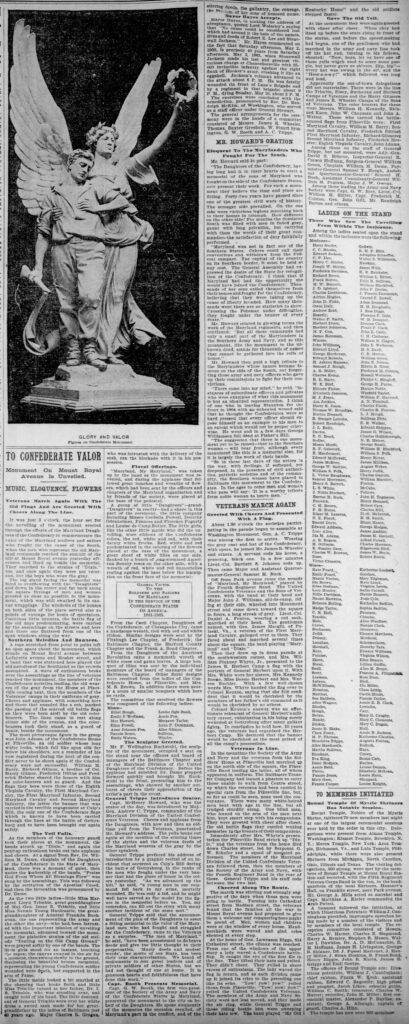
As the two little ladies-little Miss Mar garet Lloyd Trimble, great-granddaughter of Maj.-Gen. Isaac R. Trimble, and little Miss Nannie Young Hardcastle, the great-granddaughter of Admiral Franklin Buch-anan, the one representing the army and the other the navy-who had, been intrust-ed with the important mission of unveiling the memorial, advanced toward the monument the plaintive strains of the old melody “Tenting on the Old Camp Ground” were played softly by one of the bands. The little girls stood for an instant, touching the ropes; the canvas swayed in the air for a moment, then swung slowly to the ground, disclosing the beautiful bronze memorial, representing the young Confederate soldier wounded unto death, but supported in the arm of Fame. The little maids looked a bit startled at the cheering that broke forth and little Miss Trimble turned to her father, Dr. I. R. Trimble, who was standing near, and caught hold of his hand. The little descendant of General Trimble wore over her white dress a sword sash made for her great-grandfather by the ladies of Baltimore just 40 years ago. Major Charles R. Grogan, who was intrusted with the delivery of the sash, ran the blockade with it in his pos-session.
Floral Offerings.
“Maryland, My Maryland.” was taken up by the band as the monument was revealed, and during the applause that followed great bunches and wreaths of flowers, which had been sent by the officers and chapters of the Maryland organization and by friends of the society, were placed at the base of the pedestal.
A group of little “Daughters” ーgrand- “Daughters” in reality-had a share in this part of the ceremony, the little company Including Misses Cordelia Powell, Dorothy Odenheimer, Frances and Florence Fogarty and Louise de Camp Butler. The little girls. like the other little maids who did the unveiling, wore ribbons of the Confederate colors, the red, white and red, with their dainty white frocks. Red, white and red predominated in the coloring of the flowers placed great at the base of the monument, sheaf of white lilies on one side flanked by a bunch of long-stemmed American Beauty roses on the other side, with a wreath of red, white and red immortelles resting against the base below the inscription on the front face of the memorial:
GLORIA VICTIS.
TO THE
SOLDIERS AND SAILORS OF MARYLAND
IN THE SERVICE OF THE CONFEDERATE STATES
OF AMERICA.
1861-1865.
From the Cecil Chapter, Daughters of the Confederacy, of Chesapeake City, came a handsome wreath, tied with red and white ribbon. Similar designs were sent by the Fitzhugh Lee Chapter, of Frederick; the Baltimore Chapter, the Harford County Chapter and the Frank A. Bond Chapter. From the Daughters of the American Revolution came a mammoth wreath of white roses and galax leaves. A large bouquet of lilies was sent by the individual members of the board of managers of the Baltimore Chapter. Other floral designs were received from the ladies of the Confederate Home, at Pikesville, and Mrs. M. B. Brown. In addition there were nearly a score of smaller bouquets which bore no cards.
The committee that received the flowers was composed of the following ladies:
Misses—
Ethel Hough, Louise Ogle Beall,
Emily J. Hoffman, Annie Poe,
May Howard, Margaret Taylor,
Ellen Powell, Anne Johnson Poe,
Anna P. Dammann, Alice Gilmor,
Nannie Brent, Sullivan,
Emily Waters, Winder.
The Sculptor Greeted.
Mr. F. Wellington Ruckstuhl, the sculptor of the monument, occupied a seat on the stand near the officers and board of managers of the Baltimore Chapter and of the Maryland Division of the United Daughters of the Confederacy. Before the applause had subsided Dr. Dame stepped forward quickly and brought Mr. Ruckstuhl to the front, presenting him to the assemblage, who showed by another outburst of cheers their appreciation of the artist’s part in the event.
General Trippe Introduces Orator.
Capt. McHenry Howard, who was the orator of the day, was introduced by Maj.-Gen. Andrew C. Trippe, commander of the Maryland Division of the United Confederate Veterans. Cheers and applause from the Daughters, with now and then an old-time yell from the Veterans, punctuated Mr. Howard’s address. The yells broke out again at the mention of the stirring times of the sixties and the valorous deeds of the Maryland wearers of the gray by the other speakers.
General Trippe prefaced his address of Introduction by a graphic recital of an incident that occurred on Culp’s Hill during the battle of Gettysburg, in the ranks of the men who fought under the very banner that had the place of honor in the colors yesterday. “As we advanced up the hill,” he said, “a young man in our command fell back in my arms, mortally wounded. He was only a lad, and he might well have served as the model for the figure in the memorial before us. You, my comrades, can fill out the story with many another incident of the same sort.”
General Trippe said that the announcement of the plan of the Daughters to erect a fitting memorial to the valor of the Maryland men who had fought and struggled for the Confederacy, came to the Veterans as a surprise. “The men of Maryland,” he said, “have been accustomed to do brave deeds and give too little thought to their perpetuation. ‘Manly deeds and modest words’, the motto of our State, has been their true characterization. We heard of monuments to our great leaders and of private soldiers of other States, but we had not thought of one at home. It is generous hearts and faithfulness that have done this work.”
Capt. Booth Presents Memorial.
Capt. G. W. Booth, the first vice-president of the Society of the Army and Navy of the Confederate States in Maryland, presented the monument to the city on behalf of the Daughters. He spoke eloquently of the memories the occasion recalled, of Maryland’s part in the conflict, and of the stirring deeds, the gallantry, the courage. the heroism of her sons of honored name.
Mayor Hayes Accepts.
Mayor Hayes, in making the address of acceptance, quoted Lord Wolseley’s saying that “No cause could be considered lost which had around it the halo of the names, lives and deeds of Robert E. Lee and Stonewall Jackson.” Mr. Hayes commented on the fact that Saturday afternoon, May 2, 1903, Is precisely 40 years from Saturday afternoon, May 2, 1863, when Stonewall Jackson made his last and greatest victorious charge at Chancellorsville with 25,000 invincible infantry against the right flank of Hooker’s army, crushing it like an eggshell. Jackson’s columns advanced to the attack about 6 P. M. He was fatally wounded (in front of Lane’s Brigade and by a regiment in that brigade) about 3 P. M., dying Sunday, May 10, about 3 P.M.
The exercises were concluded with the benediction, pronounced by Rev. Dr. Randolph McKim, of Washington, who served as a staft officer under General Stewart.
The general arrangements for the ceremony were in the hands of a committee consisted of Messrs. James R. Wheeler, Thomas, Baxter Gresham, W. Stuart Symington, G. W. Booth and A. C. Trippe.
MR. HOWARD’S ORATION
Eloquent To The Marylanders Who Fought For The South.
Mr. Howard said in part:
“The Daughters of the Confederacy, hav. ing long had it in their hearts to erect a memorial of the sons of Maryland who fought on the side of the Confederate States, now present their work. For such a monument they believe the time and place are fitting. Forty-two years have passed since one of the greatest civil wars of history. The stronger side prevailed. On the one side were victorious legions marching back to their homes in triumph. How different on the other side! For months the desolated South was filled with men in faded gray. gaunt with long privation, but carrying with them the words of their great commander-the satisfaction of duty faithfully performed.
“Maryland was not in fact one of the Southern States. Others could call their conventions and withdraw from the Federal compact. The capital of the country on its Southern border, it must be held at any cost. The General Assembly had expressed the desire of the State for recognition of the Confederacy. I think that if Maryland had had the opportunity she would have joined the Confederacy. Thousands of her sons exiled themselves from their homes and fought for the Confederacy, believing that they were taking up the cause of liberty invaded. How many thousands went there are no statistics to show. Crossing the Potomac under difficulties, they fought under the banner of every State.”
Mr. Howard related in glowing terms the work of the Maryland regiments, and then continued: “But all these commands had only a small part of the Marylanders in the Southern Army and Nary, and so this monument, like the monument to the unknown dead, stands for thousands of names that cannot be gathered into the rolls of honor.”
Mr. Howard then paid a high tribute to the Marylanders whose names became famous on the side of the South, not forgetting those army and navy officers who gave up their commissions to fight for their con-victions.
“There come into my mind,” he said, “in-stances of subordinate officers and privates who were examples of what this monument is but an idealized representation.
I think
of one who in leaving Staunton for the front in 1864 with an unhealed wound said that he thought the Confederates were so hard pressed that every officer should expose himself as an example to his men to an extent which would not be proper other-wise.
He went and in a few days George
Williamson fell dead at Fisher’s Hill.
“The suggestion that there is one monument yet to be raised-that to the Southern woman – will bear fruit, although every monument like this is a memorial also, for it is largely the work of their hands.
“So in these last days of the actors in the war, with feelings, if softened, yet deepened, in the presence of civil authorities, patriotic societies and of the community, the Southern women have placed in Baltimore this monument to the Confederates. In the ages to come men and women who pass will say: It is a worthy tribute from noble women to brave men.'”
VETERANS MARCH AGAIN
Greeted With Cheers And Presented With A Flag.
About 1.30 o’clock the societies participating in the parade began to assemble at Washington Monument. Gen. A. C. Trippe was among the first to arrive. Wearing the gray coat and hat of the Confederacy, with spurs, he joined Mr. James R. Wheeler and others. A servant rode his horse, a prancing, black one. In a few minutes Lieut.-Col. Bartlett S. Johnson rode up. Then came Major and Assistant Quarter-master-General Samuel H. Buck.
Off from Park avenue came the sounds of “Maryland, My Maryland,” played by the Fourth Regiment Band. The United Confederate Veterans and the Sons of Veterans, with the band at their head and Major John J. Willlams, ald-de-camp, riding at their side, wheeled into Monument street and came down toward the square in fours, a long streak of gray. Lieut.-Col. Daniel A. Fenton, wearing a red sash, marched at their head. The gentleman named, with Gen. James Macgill, of Pulaski, Va, a veteran of the First Maryland Cavalry, galloped over to them. They faced about and marched several times about the square, the band playing “Maryland” and “Dixie.”
Then they drew up in dress parade at the southwestern corner, and Mrs. William Pinkney Whyte, Jr., presented to the James R. Herbert Camp a flag with the portrait of General Herbert upon it. With Mrs. White were her sisters, Mrs. Kennedy Boone, Miss Bessie Herbert and Mrs. Warren Buckler. With a few well chosen words Mrs. Whyte handed the flag over to Colonel Kenton, saying that she felt confident that it would be cherished by the members of her father’s old command as it would be cherished by no others.
Colonel Kenton’s answer was an affectionate rehearsal of General Herbert’s military career, culminating in his being sorely wounded at Gettysburg after many gallant fights. In conclusion he told how, 10 years ago, the veterans had organized the Herbert Camp. He declared that the banner would be cherished as the most prized of all the camp’s possessions.
Veterans In Line.
In the meantime the Society of the Army and Navy and the veterans from the Soldiers’ Home at Pikesville had marched up on the north side of the square, the Pikesville Band leading the latter, all of whom appeared in uniform. The Baltimore Transfer Company had loaned a phaeton to carry those unable to walk from Centre street, up which the veterans had been carried in special cars from the Pikesville line, but, so far as could be seen, none used the conveyance. There were many white-haired men bent with age in the line, but all trudged sturdily along. One blind man, who leaned on the arm of the man next him, kept smart step with his companions. They were greeted with cheer after cheer, the old battle flags they carried waking memories in the breasts of their companions.
Immediately after Mrs. Whyte’s presentation the Pikesville Band struck up “Dixie,” and the veterans from the home filed down Charles street, led by Sergeant G. W. Schafer and a squad of mounted policemen. The members of the Maryland Division of the United Confederate Veterans followed them, then the members of the Society of the Army and Navy, with the Fourth Regiment Band in the rear of these. General Trippe and his staff rode between the two last.
Cheered Along The Route.
The march was stirring and strongly suggestive of the days when those men were going to battle. Turning into Cathedral street from Madison street, the veterans found that the families all the way to Mount Royal arenue had prepared to give them a welcome any conquering hero might be proud of. Men, women and children were at the window of every house. Handkerchiefs were waved and glad eries shouted at every step.
At the home of Gen. Lawrason Riggs, 814 Cathedral street, the climax was reached. From one of the windows of the upper story a lady waved a Confederate battle-flag. It caught the eye of the first file in the line. They lifted their hats and yelled. They didn’t cheer. They yelled in sheer excess of enthusiasm. The lady waved the flag in return, and as each division came up it joined its cries to the preceding one like its echo. “Yow! yow! yow!”‘ those from Pikesville;’ yelled “Yow! yow! yow!” yelled the United Confederate Veterans. The members of the Army and Navy Society were not less mored, and they made the air ring, while General Trippe and those riding beside him were sweeping their hats low. The band played “My Old
Kentucky Home” and the old soldiers stepped faster.
Gave The Old Yell.
At the monument they were again greeted with cheer after cheer. When they had lined up before the seats rising in front of the statue, and before the speechmaking had begun, one of the gentlemen who had marched in the army and navy line took off his hat and, turning to his fellows, shouted: “Now, boys, let us have one of those yells which used to scare some people, but never gave us shivers. Hip, hip”-every hat was swung in the air, and the “Hoor-a-a-a-y!” which followed was long and loud.
Apparently the out-of-town delegations did not materialize. There were in the line the Trimble, Elzey, Buchann and Herbert Camps of Veterans and the Harry Gilmore and James R. Wheeler Camps of the Sons of Veterans. The color bearers for these were Messrs. William H. Kennedy, Richard Knox, John W. Chapman and John A. Walter. Those who carried the battle-scarred fags from Pikesville were: First Maryland Cavalry. William M. Barry: Second Maryland Cavalry, Frederick Dittus: First Maryland Infantry, Richard Gilmore; Second Maryland Infantry, Frederick Herster; Eighth Virginia Cavalry, John Adams.
Among those on the staff of General Trippe, but not mounted, were Adjt.-Gen. David S. Briscoe, Inspector-General R. Curzon Hoffman, Surgeon-General Willlam Green, Chaplain William M. Dame, Pay-master-General Samuel T. Hough, Assistant Quartermaster-General / Samuel H. Buch, Assistant Commissary-General William M. Pegram, Major J. W. Owens. Among those leading the Army and Navy Society were Capt. G. W. Bret, Lieut.-Col. William M. Ritter, Capt. Frederick J. Colston, Gen. John Gill, Mr. Randolph Barton and others.