

Richmond Times-Dispatch · Jun 5, 1960
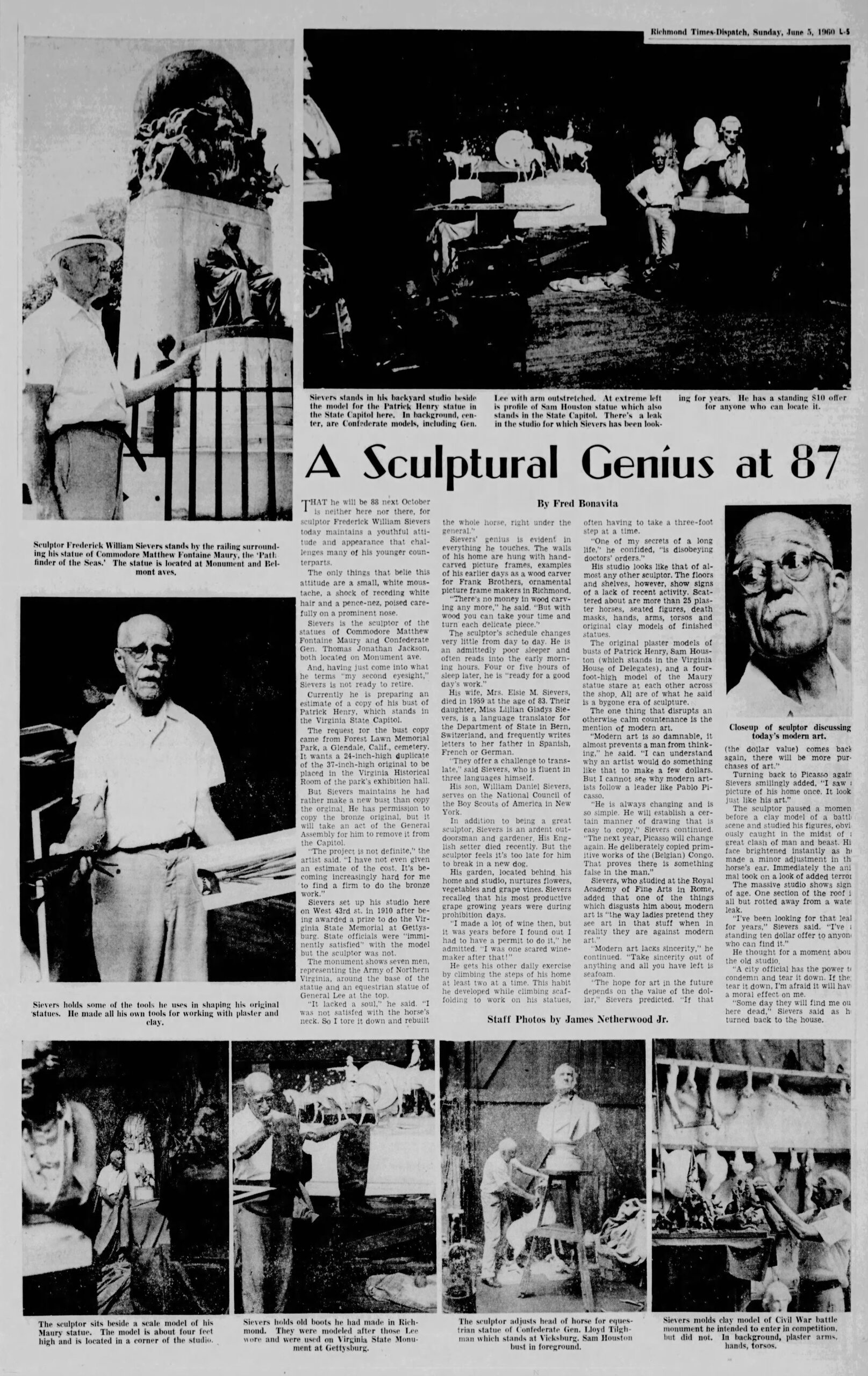
Sievers stands in his backyard studio beside the model for the Patrick Henry statue in the State Capitol here. In background, center, are cConfederate models, including Gen. Lee with arm outstretched. At extreme left is profile of Sam Houston statue which also stands in the State Capitol. There’s a leak in the studio for which Sievers has been looking for years. He has a standing $10 offer for anyone who can locate it.
A Sculptural Geníus at 87
by Fred Bonavita
THAT he will be 88 next October is neither here nor there, for sculptor Frederick William Sievers today maintains a youthful attitude and appearance that challenges many of his younger counterparts.
The only things that belle this attitude are a small, white moustache, a shock of receding white hair and a pence-nez, poised carefully on a prominent nose.
Sievers is the statues of sculptor of the Commodore Matthew Fontaine Maury and Confederate Gen. Thomas Jonathan Jackson, both located on Monument ave.
And, having just come into what he terms “my second eyesight,” Sievers is not ready to retire.
Currently he is preparing an estimate of a copy of his bust of Patrick Henry, which stands in the Virginia State Capitol.
The request for the bust copy came from Forest Lawn Memorial Park, a Glendale, Calif., cemetery. It wants a 24-inch-high duplicate of the 37-inch-high original to be placed in the Virginia Historical Room of the park’s exhibition hall.
But Sievers maintains he had rather make a new bust than copy the original, He has permission to сору the bronze original, but it will take an act of the General Assembly for him to remove it from the Capitol,
“The project is not definite,” the artist said. “I have not even given an estimate of the cost. It’s becoming increasingly hard for me to find a firm to do the bronze work.”
Sievers set up his studio here on West 43rd st. in 1910 after being awarded a prize to do the Virginia State Memorial at Gettysburg. State officials were “imminently satisfied” with the model but the sculptor was not.
The monument shows seven men, representing the Army of Northern Virginia, around the base of the statue and an equestrian statue of General Lee at the top.
“It lacked a soul,” he said. “I was not satisfied with the horse’s neck. So I tore it down and rebuilt the whole horse, right under the general.”
Sievers’ genius is evident in everything he touches. The walls of his home are hung with hand-carved picture frames, examples of his earlier days as a wood carver for Frank Brothers, ornamental picture frame makers in Richmond,
“There’s no money in wood carving any more,” he said. “But with wood you can take your time and turn each delicate piece.”
The sculptor’s schedule changes very little from day to day. He is an admittedly poor sleeper and often reads into the early morning hours. Four or five hours of sleep later, he is “ready for a good day’s work.”
His wife, Mrs. Elsie M. Sievers, died in 1959 at the age of 83. Their daughter, Miss Lillian Gladys Sievers, is a language translator for the Department of State in Bern, Switzerland, and frequently writes letters to her father in Spanish, French or German. “They offer a challenge to trans-late,” said Sievers, who is fluent in three languages himself. His son, William Daniel Sievers, serves on the National Council of the Boy Scouts of America in New York.
In addition to being a great sculptor, Sievers is an ardent outdoorsman and gardener. His English setter died recently. But the sculptor feels it’s too late for him to break in a new dog.
His garden, located behind his home and studio, nurtures flowers, vegetables and grape vines. Sievers recalled that his most productive grape growing years were during prohibition days.
“I made a lot of wine then, but it was years before I found out I had to have a permit to do it,” he admitted. “I was one scared wine-maker after that!”
He gets his other daily exercise by climbing the steps of his home at least two at a time. This habit he developed while climbing scaffolding to work on his statues, often having to take a three-foot step at a time.
“One of my secrets of a long life,” he confided, “is disobeying doctors’ orders.”
His studio looks Iike that of almost any other sculptor. The floors and shelves, however, show signs of a lack of recent activity. Scattered about are more than 25 plaster horses, seated figures, death masks, hands, arms, torsos and original clay models of finished statues.
The original plaster models of busts of Patrick Henry, Sam Houston (which stands in the Virginia House of Delegates), and a four-foot-high model of the Maury statue stare at each other across the shop. All are of what he said is a bygone era of sculpture.
The one thing that disrupts an otherwise calm countenance is the mention of modern art.
“Modern art is so damnable, it almost prevents a man from think-ing,” he said. “I can understand why an artist would do something like that to make a few dollars. But I cannot see why modern artists follow a leader like Pablo Picasso.
“He is always changing and is so simple. He will establish a certain manner of drawing that is easy to copy,” Sievers continued. “The next year, Picasso will change again. He deliberately copied primitive works of the (Belgian) Congo. That proves there is something false in the man.”
Sievers, who studied at the Royal Academy of Fine Arts in Rome, added that one of the things which disgusts him about modern art is “the way ladies pretend they see art in that stuff when in reality they are against modern art.”
“Modern art lacks sincerity,” he continued. “Take sincerity out of anything and all you have left is seafoam.
“The hope for art in the future depends on the value of the dollar,” Sievers predicted. “If that (the dollar value) comes back again, there will be more purchases of art.”
Turning back to Picasso again Sievers smilingly added, “I saw : picture of his home once. It look just like his art.”
The sculptor paused a moment before a clay model of a battle scene and studied his figures, obviously caught in the midst of : great clash of man and beast. His face brightened instantly as he made a minor adjustment in the horse’s ear. Immediately the animal took on a look of added terror
The massive studio shows sign of age. One section of the roof i all but rotted away from a waste leak.
“I’ve been looking for that leal for years,” Sievers said. “I’ve : standing ten dollar offer to anyone who can find it.”
He thought for a moment about the old studio.
“A city official has the power to condemn and tear it down. If they tear it down, I’m afraid it will have a moral effect on me.
“Some day they will find me out here dead,” Sievers said as he turned back to the house.
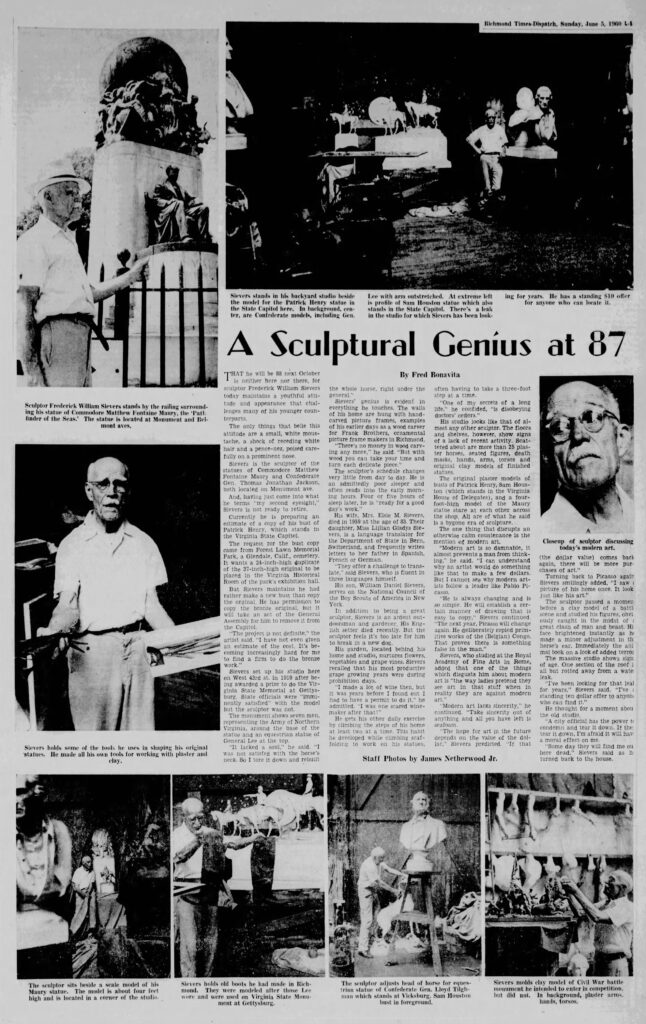
Sculptor Frederick William Sievers stands by the railing surrounding his statue of Commodore Matthew Fontaine Maury, the ‘Pathfinders of the Seas.’ The statue is located at Monument and Belmont aves.
Sievers holds some of the tools he uses in shaping his original statues. He made all his own tools for working with plater and clay.
The sculptor sits beside a scale model of his Maury statue. The model is about four feet high and is located in a corner of the studio.
Sievers holds boots he had made in Richmond. They were modeled after those Lee wore and were used on Virginia State Monument at Gettysburg.
The sculptor adjusts head of horse for equestrian statue of Confederate Gen. Lloyd Tilghman which stands at Vicksburg. Sam Houston bust in foreground.
Sievers molds clay model of Civil War battle monument he intended to enter in competition, but did not. In background, plaster arms, heads, torsos.