


The Baltimore Sun· Jan 21, 2016
A monumental decision
Contemporary teaching tools
BY FRANK P. L. SOMERVILLE
Back in 1955, a time very different from today culturally and stylistically, Baltimore Mayor Thomas D’Alesandro Jr. was roundly ridiculed for removing as “morally objectionable” a painting in the city-owned Peale Museum.
The banned work was local artist Glenn F. Walker’s “In A Room,” a rather abstract small rendering of a nude man and woman lying side by side on a bed. Someone had apparently
convinced the late mayor that the painting was obscene. Seeing the painting now, it is difficult to imagine even the most tradition-obsessed and morally scrupulous viewer ever having had such an objection to “In A Room.” It was included entirely without controversy in a recent exhibit of University of Baltimore Student Center Gallery on Mount Royal Avenue.
Fortunately for D’Alesandro, who died in 1987, and Walker, who died a year later, their political and artistic careers continued unscathed after 1955’s dissension over morality and taste. The mayor outlived the ridicule, and the painter’s reputation as an artist and teacher was actually given a boost.
But clearly there is a lesson to be learned as Baltimoreans face a decision 61 years later about whether major sculptural art on public land should be banned for moral reasons. This time it is not the suggestion that sex may be involved, absurd as that would seem in tje current stare of culture. The contended immorality at issue is an acknowledged bond of subjects of the sculptures with the undisputed sin of human slavery.
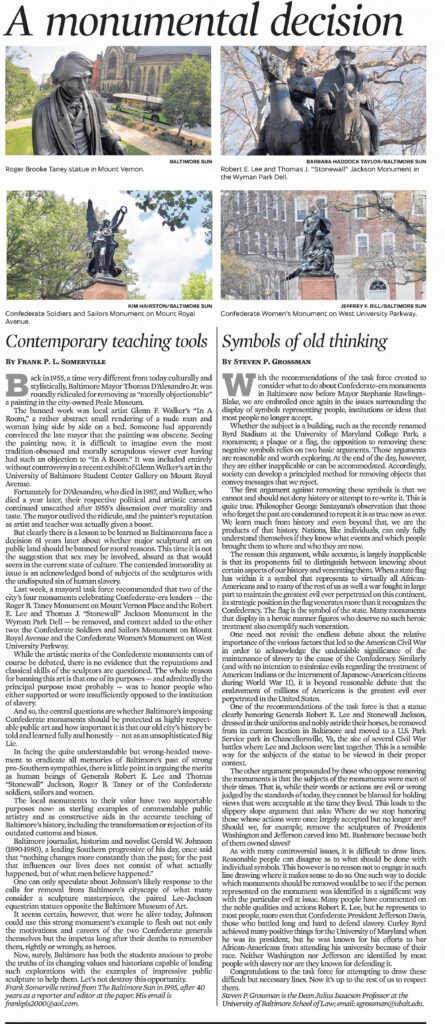
Last week, a mayoral task force recommended that two of the city’s four monuments celebrating Confederate-era leaders – the Roger B. Taney Monument on Mount Vernon Place and the Robert E. Lee and Thomas J. “Stonewall Jackson” Monument in the Wyman Park Dell – be removed, and context added to the other two: the Confederate Soldiers and Sailors Monument on Mount Royal Avenue and the Confederate Women’s Monument on West University Parkway.
While the artistic merits of the Confederate monuments can of course be debated, there is no evidence that the reputations and classical skills of the sculptors are questioned. The whole reason for banning this art is that one of its purposes – and admittedly the principal purpose most probably – was to honor people who either supported or were insufficiently opposed to the institution of slavery.
And so, the central questions are whether Baltimore’s imposing Confederate monuments should be protected as highly respectable public art and how important it is that our old city’s history be told and learned fully and honestly – not as an unsophisticated Big Lie.
In facing the quite understandable but wrong-headed movement to eradicate all memories of Baltimore’s past pro-Southern sympathies, there is little point in arguing the merits as human beings of Generals Robert E. Lee and Thomas “Stonewall” Jackson, Roger B. Taney or of the Confederate soldiers, sailors and women.
The local monuments to their valor have two supportable purposes now: as sterling examples of commendable public artistry and as constructive aids in the accurate teaching of Baltimore’s history, including the transformation or rejection of its outdated customs and biases.
Baltimore journalist, historian and novelist Gerald W. Johnson (1890-1980), a leading Southern progressive of his day, once said that “nothing changes more constantly than the past; for the past that influences our lives does not consist of what actually happened, but of what men believe happened.”
One can only speculate about Johnson’s likely response to the calls for removal from Baltimore’s cityscape of what many consider a sculpture masterpiece, the paired Lee-Jackson equestrian statues opposite the Baltimore Museum of Art.
It seems certain, however, that were he alive today, Johnson could use this strong monument’s example to flesh out not only the motivations and careers of the two Confederate generals themselves but the impetus long after their deaths to remember them, rightly or wrongly, as heroes.
Now, surely, Baltimore has both the students anxious to probe the truths of its changing values and historians capable of leading such explorations with the examples of impressive public sculpture to help them. Let’s not destroy this opportunity.
Frank Somerville retired from the Baltimore Sun in 1995, after 40 years as a reporter and editor at the paper.
Symbols of old thinking
BY STEVEN P. GROSSMAN
With the recommendations of the task force created to consider what to do about Confederate-era monuments in Baltimore now before Mayor Stephanie Rawlings- Blake, we are embroiled once again in the issues surrounding the display of symbols representing people, institutions or ideas that most people no longer accept.
Whether the subject is a building, such as the recently renamed Byrd Stadium at the University of Maryland College Park; a monument; a plaque or a flag, the opposition to removing these negative symbols relies on two basic arguments. Those arguments are reasonable and worth exploring. At the end of the day, however, they are either inapplicable or can be accommodated. Accordingly, society can develop a principled method for removing objects that convey messages that we reject.
The first argument against removing these symbols is that we cannot and should not deny history or attempt to re-write it. This is quite true. Philosopher George Santayana’s observation that those who forget the past are condemned to repeat it is as true now as ever. We learn much from history and even beyond that, we are the products of that history. Nations, like individuals, can only fully understand themselves if they know what events and which people brought them to where and who they are now.
The reason this argument, while accurate, is largely inapplicable is that its proponents fail to distinguish between knowing about certain aspects of our history and venerating them. When a state flag has within it a symbol that represents to virtually all African-Americans and to many of the rest of us as well a war tought in large part to maintain the greatest evil ever perpetrated on this continent, its strategic position in the flag venerates more than it recognizes the Confederacy. The flag is the symbol of the state. Many monuments that display in a heroic manner figures who deserve no such heroic treatment also exemplify such veneration.
One need not revisit the endless debate about the relative importance of the various factors that led to the American Civil War in order to acknowledge the undeniable significance of the maintenance of slavery to the cause of the Confederacy. Similarly (and with no intention to minimize evils regarding the treatment of American Indians or the internment of Japanese-American citizens during World War II), it is beyond reasonable debate that the enslavement of millions of Americans is the greatest evil ever perpetrated in the United States.
One of the recommendations of the task force is that a statue clearly honoring Generals Robert E. Lee and Stonewall Jackson, dressed in their uniforms and nobly astride their horses, be removed from its current location in Baltimore and moved to a U.S. Park Service park in Chancellorsville, Va, the site of several Civil War battles where Lee and Jackson were last together. This is a sensible way for the subjects of the statue to be viewed in their proper context.
The other argument propounded by those who oppose removing the monuments is that the subjects of the monuments were men of their times. That is, while their words or actions are evil or wrong judged by the standards of today, they cannot be blamed for holding views that were acceptable at the time they lived. This leads to the slippery slope argument that asks: Where do we stop honoring those whose actions were once largely accepted but no longer are? Should we, for example, remove the sculptures of Presidents Washington and Jefferson carved into Mt. Rushmore because both of them owned slaves?
As with many controversial issues, it is difficult to draw lines. Reasonable people can disagree as to what should be done with individual symbols. This however is no reason not to engage in such line drawing where it makes sense to do so. One such way to decide which monuments should be removed would be to see if the person represented on the monument was identified in a significant way with the particular evil at issue. Many people have commented on the noble qualities and actions Robert E. Lee, but he represents to most people, more even that Confederate President Jefferson Davis, those who battled long and hard to detend slavery. Curley Byrd achieved many positive things for the University of Maryland when he was its president, but he was known for his efforts to bar African-Americans from attending his university because of their race. Neither Washington nor Jefferson are identified by most people with slavery nor are they known for defending it.
Congratulations to the task force for attempting to draw these difficult but necessary lines. Now it’s up to the rest of us to respect them.
Steven P. Grossman is the Dean Julius Isaacson Professor at the University of Baltimore School of Law