


The Baltimore Sun· Feb 20, 2016
Taney deserves his tribute
In its editorial supporting the removal of the memorial to Chief Justice Roger B. Taney in Mount Vernon Place, The Sun referred to the Dred Scott decision as Justice Taney’s “best known achievement in life” as though the monument was explained by the opinion and as though the famous line “they had no rights which the white man was bound to respect” was the only line Taney ever wrote (“Take the statues down, Jan, 19). The sentence was a description of the federal law as of 1789 under a Constitution that recognized slavery. “It does not by any means follow,” Taney said in the same opinion, that because a person “has all the rights and privileges of a citizen of a State, that he must be a citizen of the United States.”
That the opinion was unnecessarily broad and disastrous is generally agreed, though one historian found “there had been no popular excitement over the decision for over a year and until it was made the object of a campaign attack.” The opinion dealt with slavery in the territories; it did not deny the rights of black citizens of free states.
Taney had manumitted his own slaves, and died a poor man. It is doubtful that any of the academics clamoring for removal of his statue have made similar sacrifices for their beliefs. In successfully defending an abolitionist in the Gruber case in 1819, he had described slavery as “a blot on our national character and every real lover of freedom confidently hopes that it will be effectively, though it must be gradually, wiped away” In 1857, after Dred Scott, he wrote “I am glad to say that none of those who I manumitted disappointed my expectations, but have shown by their conduct that they were worthy of freedom and knew how to use it”
The Taney opinion that endures in memory and law today was his opinion in Ex Parte Merryman rendered at some risk to his own liberty holding that the power to suspend the writ of habeas corpus and to detain citizens without trial was vested not in the president but in Congress. Justice Taney’s opinion was followed by the Supreme Court after the Civil War in Ex Parte Milligan, an opinion written by Justice David Davis, President Abraham Lincoln’s former campaign manager and law partner. It figures prominently in books on executive power in wartime, including those by Charles Warren (1935), Frederick Bernays Wiener 1940), Clinton Rossiter (1945), Carl Brent Swisher (1974) and Chief Justice William Rehnquist (1998). At least as to civilians not affiliated with a foreign military force, it is almost certainly still good law.
It was almost certainly the Merryman opinion that inspired the erection of Baltimore’s monument in 1887. The scheduled speaker at the dedication was Severn Teackle Wallis, who along with Baltimore Mayor George William Brown has been imprisoned for 15 months without trial and without charges by President Lincoln. Both opposed the secession of Maryland; both also, along with Taney, opposed both slavery and the coercion of the South. After the Civil War, Brown and Wallis joined in opposing the exclusion of blacks from the University of Maryland Law School and Mr. Brown as a judge ordered the admission to the Maryland Bar of Everett Waring, the first black to be so admitted.
Taney, like the demonstrators against Freddie Gray’s alleged “rough ride” did not approve of extra-judicial punishment. The Merryman opinion declared: “if the authority which the Constitution has confided to the judiciary department and judicial officers may thus upon any pretext or under any circumstances be usurped by the military power at its discretion, the people of the United States are no longer living under a government of laws, but every citizen holds life, liberty and property at the will and pleasure of the army officer in whose military district he may happen to be found.”
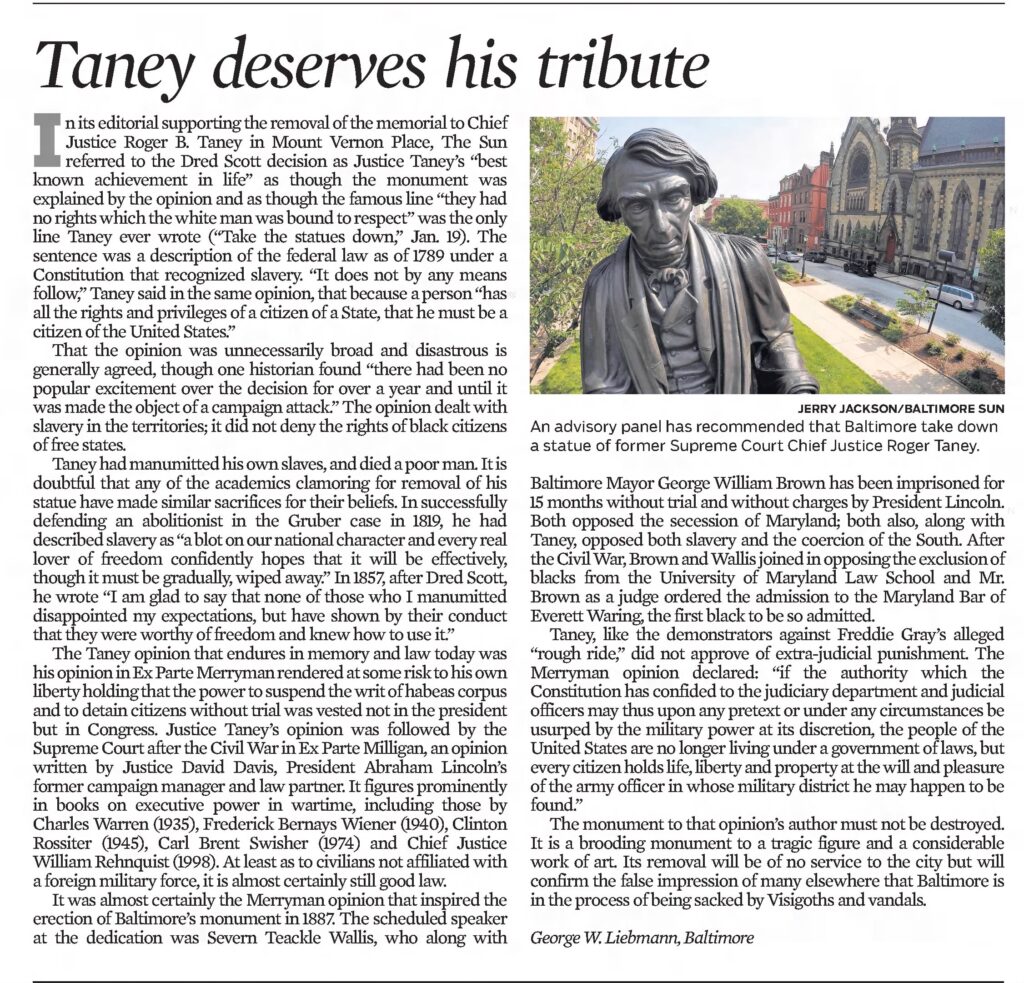
The monument to that opinion’s author must not be destroyed. It is a brooding monument to a tragic figure and a considerable work of art. Its removal will be of no service to the city but will confirm the false impression of many elsewhere that Baltimore is in the process of being sacked by Visigoths and vandals.
George W. Liebmann, Baltimore