

Richmond Times-Dispatch · Feb 6, 1949
“I REMEMBER WHEN..”
Neil November
GASTON LICHTENSTEIN spending his late years at the Gilbert Hotel on Franklin street, remembers the personality of Richmond decades before he turn of the century. He has been prominent in city activities since the gay 90’s but prefers to recall the comparatively recent days of the roaring 20’s. “I remember when I first thought of the idea of erecting i monument to the memory of Matthew Fontaine Maury,” he says. “That was back in 1906 when I visited Hamburg, Germany. The Seaman’s Institute in that city had names of famous seafaring men embossed around he exterior of its building, very much like the State Library has lames and phrases inscribed on ts surface. I noticed one name vas Matthew Fontaine Maury, ur own famous Virginian,” who studied ocean winds and currents as an aid to ocean navigation.
Many years after his return rom Europe Lichtenstein, through fetters to the newspapers, finally stirred the citizens of Richmond to do something bout honoring Virginia’s native on. His appeals were read by Mrs. E. E. Moffitt who thought the idea an excellent one and organized the Matthew Fontaine Maury Association to raise money and build the memorial. She enrolled President Woodrow Wilson among the life members of the group.
“Miss Moffitt was a great lady.” Lichtenstein recalls. “She was 79 when she started the Association and was its active resident until past 90. She died just before the statue was unveiled.”
Sievers Selected
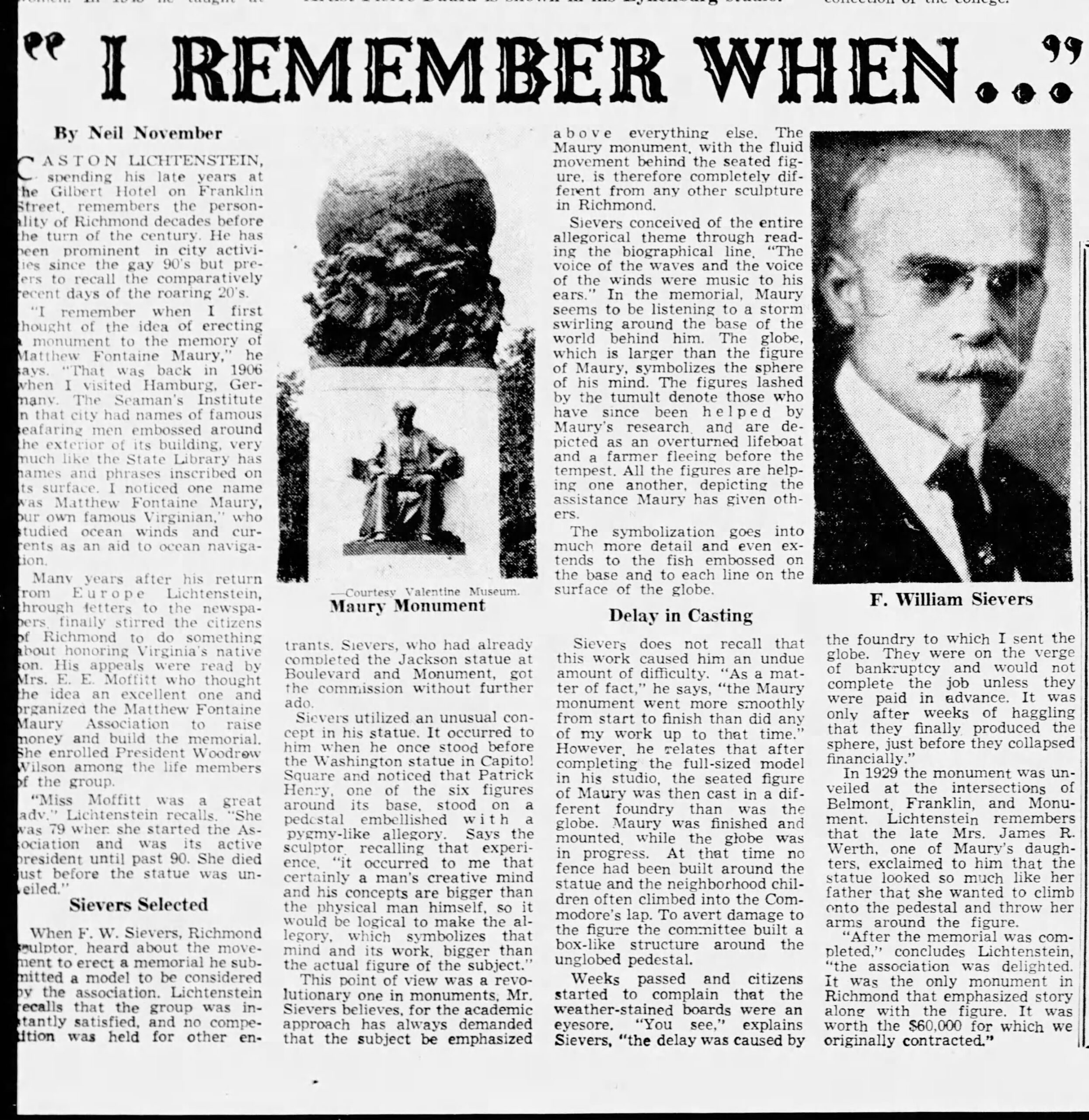
When F. W. Sievers, Richmond sculptor, heard about the movement to erect a memorial he submitted a model to be considered y the association. Lichtenstein recalls that the group was instantly satisfied, and no competition was held for other entrants. Sievers, who had already completed the Jackson statue at Boulevard and Monument, got the commission without further ado.
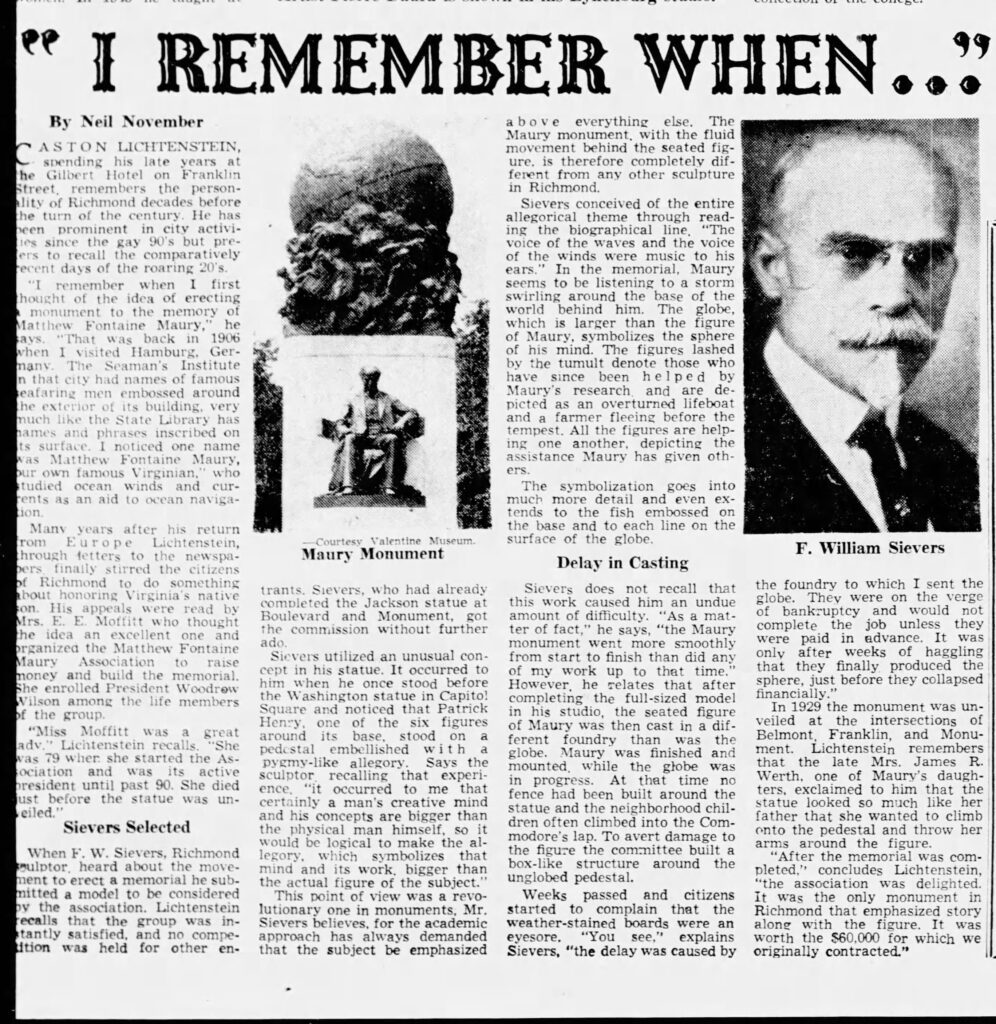
Sievers utilized an unusual concept in his statue. It occurred to him when he once stood before the Washington statue in Capitol Square and noticed that Patrick Henry, one of the six figures around its base, stood on a pedestal embellished with a pygmy-like allegory. Says the sculptor, recalling that experience, “it occurred to me that certainly a man’s creative mind and his concepts are bigger than the physical man himself, so it would be logical to make the allegory, which symbolizes that mind and its work, bigger than the actual figure of the subject.”
This point of view was a revolutionary one in monuments, Mr. Sievers believes, for the academic approach has always demanded that the subject be emphasized above everything else. The Maury monument, with the fluid movement behind the seated figure, is therefore completely different from any other sculpture in Richmond.
Sievers conceived of the entire allegorical theme through reading the biographical line. “The voice of the waves and the voice of the winds were music to his ears.” In the memorial, Maury seems to be listening to a storm swirling around the base of the world behind him. The globe, which is larger than the figure by the tumult denote those who have since been helped by Maury’s research and are depicted as an overturned lifeboat and a farmer fleeing before the tempest. All the figures are helping one another, depicting the assistance Maury has given others.
The symbolization goes into much more detail and even extends to the fish embossed on the base and to each line on the surface of the globe.
Delay in Casting
Sievers does not recall that this work caused him an undue amount of difficulty. “As a matter of fact,” he says, “the Maury monument went more smoothly from start to finish than did any of my work up to that time.” However, he relates that after completing the full-sized model in his studio, the seated figure of Maury was then cast in a different foundry than was the globe. Maury was finished and mounted, while the globe was in progress. At that time no fence had been built around the statue and the neighborhood children often climbed into the Commodore’s lap. To avert damage to the figure the committee built a box-like structure around the unglobed pedestal.
Weeks passed and citizens started to complain that the weather-stained boards were an eyesore. ”You see,” explains Sievers, “the delay was caused by the foundry to which I sent the globe. They were on the verge of bankruptcy and would not complete the job unless they were paid in advance. It was only after weeks of haggling that they finally produced the sphere, just before they collapsed financially.”
In 1929 the monument was unveiled at the intersections of Belmont, Franklin, and Monument. Lichtenstein remembers that the late Mrs. James R. Werth, one of Maury’s daughters, exclaimed to him that the statue looked so much like her father that she wanted to climb onto the pedestal and throw her arms around the figure. “After the memorial was completed,” concludes Lichtenstein, “the association was delighted. it was the only monument in Richmond that emphasized story along with the figure. It was worth the $60,000 for which we originally contracted.”