

Richmond Times-Dispatch · Nov 12, 1929
Richmond Times-Dispatch · Nov 12, 1929
Richmond Times-Dispatch · Nov 12, 1929
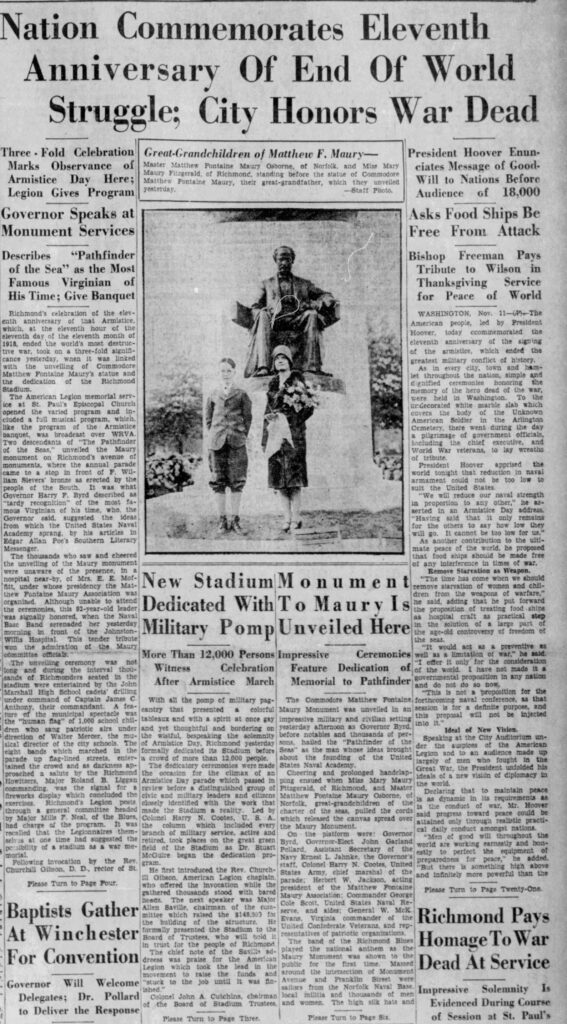
Nation Commemorates Eleventh Anniversary Of End Of World Struggle; City Honors War Dead
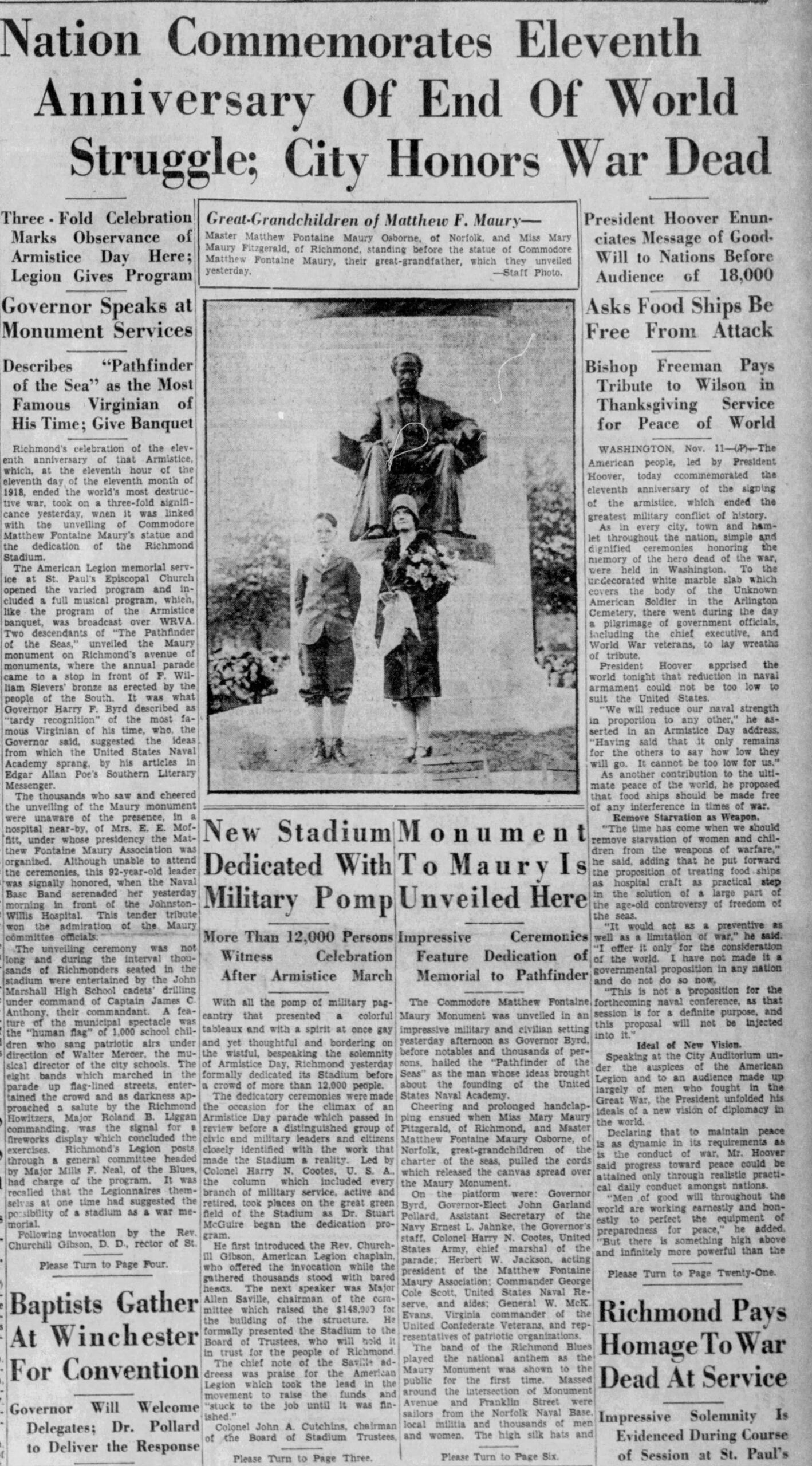
Great-Grandchildren of Matthew F. Maury—
Master Matthew Fontaine Maury Osborne, of Norfolk, and Miss Mary Maury Fitzgerald, of Richmond, standing before the statue of Commodore Matthew Fontaine Maury, their great-grandfather, which they unveiled yesterday.
-Staff Photo.
Three – Fold Celebration Marks Observance of Armistice Day Here; Legion Gives Program
Governor Speaks at Monument Services
Describes “Pathfinder of the Sea” as the Most Famous Virginian of His Time; Give Banquet
Richmond’s celebration of the eleventh anniversary of that Armistice, which, at the eleventh hour of the eleventh day, of the eleventh month of 1918, ended the world’s most destructive war, took on a three-fold significance yesterday, when it was linked with the unveiling of Commodore Matthew Fontaine Maury’s statue and the dedication of the Richmond Stadium.
The American Legion memorial service at St. Paul’s Episcopal Church opened the varied program and included a full musical program, which, like the program the
Armistice banquet, was broadcast over WRVA. Two descendants of “The Pathfinder of the Seas,” unveiled the Maury monument on Richmond’s avenue of monuments, where the annual parade came to a stop in front of F. William Sievers’ bronze as erected by the people of the South. It was what Governor Harry F. Byrd described as “tardy recognition” of the most famous or Virginian of his time, who the Governor said, suggested the ideas from which the United States Naval Academy sprang: by his articles in Edgar Allan Poe’s Southern Literary Messenger.
The thousands who saw and cheered the unveiling of the Maury monument were unaware of the presence, in a hospital near-by, of Mrs. E. E. Mofftt, under whose presidency the Matthew Fontaine Maury Association was organized. Although unable to attend the ceremonies, this 92-year-old leader was signally honored, when the Naval Base Band serenaded her yesterday morning in front of the Johnston-Willis Hospital. This tender tribute won the admiration of the Maury committee officials.
The unveiling ceremony was not long and during the interval thousands of Richmonders seated in the stadium were entertained by the John Marshall High School cadets’ drilling under command of Captain James C. Anthony, their commandant. A feature of the municipal spectacle was the “human flag” of 1,000 school children who sang patriotic airs under direction of Walter Mercer, the musical director of the city schools. The eight bands which marched in the parade up flag-lined streets, entertained the crowd and as darkness approached a salute by the Richmond Howitzers, Major Roland B. Liggan commanding, was the signal for fireworks display which concluded the exercises. Richmond’s Legion posts through a general committee headed by Major Mills P. Neal, of the Blues, had charge of the program. It was recalled that the Legionnaires themselves at one time had suggested the possibility of a stadium as a war memorial.
Following invocation by the Rev. Churchill Gibson, D. D., rector of St. ¡James Episcopal Church, Dr. Stuart McGuire took: charge of the program and Colonel John A. Cutchins, president of the stadium trustees, officially accepted the sports arena from Allen
J. Saville, chairman of the committee which raised the funds to build It, while Alderman Ordway Puller, actIng Mayor, formally dedicated the stadium.
The parade itself formed at the Lee Monument and marched to the stadium, going west on Monument Avenue to the Maury Monument, after which the marchers went out the Boulevard to Idlewood Avenue, to proceed west to the stadium. The line of march was colorful with ex-service men, a naval battalion which came up by boat from Norfolk and camped at the Blues’ Armory, and uniformed marching bodies of Shriners and Samis Gresto, groups. Colonel Harry N. Cootes, United States Army, was chief marshal and the parade marched on schedule
Colonel B. M. Roszel, of Winchester, department commander of the Legion, was the principal speaker at the banquet which was held at Murphy’s Hotel.
Members of the Maury and related families, as well as a few special friends of the late Commodore and Mrs. Maury, were the guests at a buffet luncheon given by Mr. and Mrs. Littleton Fitzgerald. Mrs. Fitzgerald is a granddaughter of the Commodore.
A three-gun salute by the Howitzers signalled the end of the memorial service to the dead, conducted at St. Paul’s by the rector, First Lieutenant Beverly D. Tucker, JI and other ex-service men. The church was crowded for the impressive exercises.
Monument, To Maury Is Unveiled Here
Impressive Ceremonies Feature Dedication of Memorial to Pathfinder
The Commodore Matthew Fontaine, Maury Monument was unveiled in an impressive military and civilian setting yesterday afternoon as Governor Byrd, before notables and thousands of per-sons, hailed the “Pathfinder of the Seas” as the man whose ideas brought about the founding of the United States Naval Academy.
Cheering and prolonged handclap-ping ensued when Miss Mary Maury Fitzgerald, of Richmond, and Master Matthew Fontaine Maury Osborne, of Norfolk, great-grandchildren of the charter of the seas, pulled the cords: which released the canvas spread over the Maury Monument.
On the platform were: Governor Byrd, Governor-Elect John Garland Pollard, Assistant Secretary of the Navy Ernest L. Jahnke, the Governor’s staff, Colonel Harry N. Cootes, United States Army, chief marshal of the parade: Herbert W. Jackson, acting president of the Matthew Fontaine Maury Association; Commander George Cole Scott, United States Naval Re-serve, and aides; General W. McK Evans, Virginia commander of the United Confederate Veterans, and representatives of patriotic organizations.
The band of the Richmond Blues played the national anthem as the Maury Monument was shown to the public for the first time. Massed around the Intersection of Monument Avenue and Franklin Street were sailors from the Norfolk Naval Base, local militia and thousands of men and women. The high silk hats and frocks of dignitaries on the platform facing the monument offered a strikIng contrast to the brilliant uniforms of soldiers.
One notable who played a leading part, in the realization of the Maury Monument dream was missing in the flesh, but was present in the spirit. Mrs. S. B. Moffitt, 92 years old, under whose presidency the Maury Association started Its ten-year drive for funds,
is a patient in Johnston-Willis Hospital, not far from the unveiling scene. Not only did Governor Byrd pay her a tender tribute, but the Naval Base Band yesterday morning marched to the hospital and serenaded her. a touching tribute which won the admiration of persons aware of the long fight waged by Mrs. Moffitt, native of Raleigh, N. C for recognition Maury’s work.
Herbert W. Jackson Presides.
Herbert W. Jackson, acting president of the Maury Association, presided at the unveiling ceremonies. He first introduced the Rev. William E. HiII. D. D. pastor of Second Presbyterian Church, who offered prayer.
Hon. Ernest I. Jahnke, Assistant Secretary of the Navy, said the Navy Department was proud of the opportunity to honor one of Virginia’s most distinguished sons. A native of Louisiana, Mr. Jahnke said he, too, was proud of Maury’s contribution to man-kind. He mentioned Commander Richard Evelyn Byrd, the Governor’s brother, as another Virginian signally honored by the navy.
Among wreaths placed at the base of the monument were those contributed by the Hon. and Mrs. Josephus Daniels, of Raleigh, N. C.: Richmond Chapter, Lee Chapter and Virginia Division, United Daughters of the Confederacy; Dorothea Payne Madison Chapter, Daughters of 1812, and American Legion Auxiliary, Post 38.
Among prominent out-of-town visitors for the ceremony were Mrs. Josephus Daniels, Mrs. James Pou and James Walker, of Raleigh; Misses Belle and Ethel Bagley, of Washington, D.C:. Mrs. John H. Anderson, Chapel Hill, N. C.; Miss Eunice Elliott and Mr. and Mrs. George Elliott, of Linden, N. C.; Mr. and Mrs. Harry M. London, of Raleigh; Colonel Nash, of Tarboro, N. C. and Mr. and Mrs. J. Henry Sell, Trenton, N. J.
The Governor’s Address.
“The Governor’s address follows: “On this day, dedicated to the sacrifices and heroism of countless American boys, we place here the sculptured figure of a man worthy to be the companion on Monument Avenue of Lee and Jackson and Stuart and Davis.
“The completion of this monument to Mathew Fontaine Maury is a tribute to the undaunted patriotism of Mrs. E. E. Moffitt, president of the Maury Association, and its officials; Miss Lucy Munford, Mrs. Norman Randolph, Mrs. John H. Southall, Mrs.
Thomas Jones, Mrs. Mann Valentine, Mrs. Beverley Crump, Gaston Lichen-stein, Mrs. Herbert W. Jackson, and is a tribute also to the generous recognition by the members of that association, and countless substantial people, who are determined to do this tardy justice to a famous son of Virginia.
“It must be remembered that even we in Virginia have neglected to memorialize Commodore Maury to the extent that his achievements entitle him to be celebrated. When his name was proposed for the Hall of Fame in New York, a competent newspaperman admitted that he had never heard of him. The explanation for this neglect is that Commodore Maury’s accomplishments were scientific, while the work of the numerous Virginians, who are more widely known, was accomplished on the more conspicuous military or political stage.
Known Next to Washington.
And yet in his way, Matthew Fontaine Maury was better known to the world than any other Virginian, except Washington, for the ships of all maritime nations found their way across the seas along paths that were marked out for them by this modest Virginian. Every mariner blessed his name and a grateful world stood in reverence at his door and called him the “Pathfinder of the Seas.”
“This man, who we will see sitting there in thoughtful pose, made charts of the winds and currents that revolutionized the commerce of the world. The genius of Maury made possible the laying of the Atlantic cable that quickened international contacts and developed international friendship. He was the founder of the National Observatory and Signal Service and of the Naval Academy at Annapolis, and his service to agricultural meteorology put every farmer in the world greatly in his debt.
While Maury is said to have been more decorated by European nations than any other man born on American soil, his national fame suffered by the fact that he, like General Robert E. Lee, followed Virginia out of the Union and chose rather to suffer poverty and hardship will his own people than to desert them in the time of their trial and peril.
Animosities Melt.
Happily these old sectional animosities have melted before the sunshine of admiration for the descendants alike of the men of the North and the South, and the distinguished Assistant Secretary of the Navy of the United States now joins with us to pay tribute to Maury on this day, when they celebrate the heroism of American boys from every section In the greatest war of history.
“The United States government, too, takes care that the name of Maury shall be preserved for one of the buildings at the Naval Academy is named for him and at the top of four great charts, issued every month from the hydrographic office, are these words:
“‘Founded upon the researches made and the data collected by Lieutenant M.F. Maury, U. S. Navy!’ In all the noble history of Navy no other the United States naval officer has received continuous recognition equal to this, and Maury’s charts have for three-quarters of a century performed a service without parallel among government publications.
“It was in 1831, Maury was only 25, that he became certain that the sea had its laws that could be relied upon to be uniform and constant once some one had searched them out. In the words of that charming and cultivated
gentleman, Charles Alphonso Smith, some time a professor in the University of Virginia and who died while a professor at the Naval Academy, Maury believed that ‘the waves, the winds, the storms, the currents, the depths and the temperature of the sea constituted a system, a complex of cause and effect, constant in its regularity, perfect in its orderliness, and so mathematically interrelated that the mind of man could by patient Investigation understand its phenomena and even forecast its processes. It was more than a theory with Maury. It was a faith, the kind of antecedent that led Columbus, Galileo, Harvey and Newton to their respective goals.’
Poe Valued His Book.
“In 1836 Maury published a book called “Navigation” that soon became the authority on that subject. A former resident of Richmond, and one of the greatest poets of the world, Edgar Allan Poe was one of the first critics to appreciate the unusual value of this book by Maury. And it was in the Southern Literary Messenger, of which Poe himself was editor, that Lieutenant Maury wrote his constructive criticisms of the navy, criticisms, caustic as they were, that inspired naval officers of vision to bring about a new and better naval organization. The best authorities assure us that there can be little doubt that the Naval Academy itself, founded at Annapolis in 1845, was the product of the suggestions made by Maury in the articles / published in the Southern Literary Messenger.
“However, six years were to elapse before Maury’s great opportunity came, for it was not until 1842 that he was placed In Washington in charge of the depot of charts and instruments, an office he developed into the National Observatory and Hydrographic Department of the United States. Here he began collecting logs on storms that he sent out to all ships that would use them. Upon these forms was made a sort of diary of temperatures, sir pressure, depths, winds and currents over every surface of every sea.
“As Dr. Smith puts it, the sea was asked to grant a continuous interview and thus to have its autobiography written. This it did willingly, never having been persuasively asked before.’ It was not long before Maury produced charts, guided by which ships cut in half long voyages.
Races Around “the Horn.”
“In 1848, when gold was discovered in California, the white-sailed clippers began to race around Cape Horn on the way from New York to San Francisco and the ‘Flying Cloud,’ of American registry, accomplished the trip in eighty-nine days. A little later,
when gold was discovered in Australia, Maury’s charts cut down the average trip from England to Australian mines from 124 to ninety-seven days.
“It is estimated that each year in that day of slow ocean travel the United States alone saved $5,000,000 in freight to and from South America, China and the East Indies because Maury had marked out dependable paths of the easiest travel across the waters that before had been trackless.
“Maury had done this work for little more than ten years when his proud moment of great recognition came. At Brussels in August, 1853, Belgium, Holland, Denmark, Norway, Sweden, Russia, France, Portugal Great Britain and the United States met in a conference that lasted sixteen days, and, at its close, unanimously adopted Maury’s charts by which nineteen-twentieths of the shipping of the world was thereafter to be guided.
In all American history no other American had been so recognized by the great nations of the world until that eventful day in Paris, when another son of Virginia, Woodrow Wilson, stood as sponsor at the birth of the League of Nations.
“Indeed, in that far-oft day Maury himself felt something of the great ambition that Wilson was to realize nearly century later, for Maury emphasized that nearly all of the nations of the world were there gathered not to make war, but to promote peace.
Responding to the thanks presented to him for his great service, he said:
“‘Allow me to add that we are taking part in a proceeding to which we should vainly seek for a parallel in history, Heretofore, when naval officers of different nations met in such numbers it was to deliberate at the cannons’ mouth upon the most efficacious means of destroying the human species. Today, on the contrary, we see assembled the delegates of almost every maritime nation for the noble purpose of serving humanity by seeking to render navigation more and more secure. I think, gentlemen, we may congratulate ourselves with pride upon the opening of this new era.’
“As a farmer myself, I am Interested in the fact that Maury insisted that weather conditions could be anticipated on land as well as they have been anticipated on the sea, and predicted that the time would come when the farmer would be advised systematically and promptly in advance of the weather that he could expect.
Through the aid of the telegraph Maury stated that the government could advise the farmer in the field, as. well as the shipping in the harbors and the traveler, on the road, of every extensive storm that visits our shoer and while it is a great way off.
“I cannot prolong this speech to tell about the tragic days of the Civil War when Maury followed his State out of the Union and was sent to England, there to serve the government of the Confederate States. He returned at the close of the war, after a sojourn in Mexico, broken in for-tune’ and cut off from the work that had occupied his high talents and had brought him world-wide fame.
“This concluding picture rises to the dignity of real drama for, as General Lee trained the young men of the South at Washington College to be good citizens of the reunited country. Commodore Maury became his neighbor and inspired his classes at the Virginia Military Institute with renewed love and loyalty under the lag of a reunited nation.
“Even while Maury remained in England, homesick for his family, renewed recognition came to him, for it was in 1868 that the University of Cambridge conferred the degree of LL. D. upon him and the great Tennyson.
Instructor at V. M. I.
“At the Virginia Military Institute Maury occupied the chair of physics. He had declined the directorship of the French Imperial Observatory that had been offered to him. In this closing chapter of his life, his thief interest was in helping the farmers by a more effective weather bureau in Washington, and he travelled and lectured in every section of the United States. He was rejoiced with resolutions of thanks for the stimulation of agriculture from England and Russia, he was offered the presidency of at least two Southern colleges, but the spirit, of dramatic fitness caused him to fix his life at Lexington and to contribute to the profound sacredness of that spot where Lee and Jackson rest.
In the opening of 1873 he returned from a lecture in St. Louis weak and I. A man of religious faith as deep as that of Lee or Jackson, death had no terrors for him. On the evening before his death he had caused hymns to be sung for him and, after the singing, he said, so that all could hear, the peace of God which passeth nil understanding be with you all —all.” Later he asked his son, Richmond, ‘Are my feet growing cold? Do I drag my anchors?’ When his son answered ‘yes,’ Maury replied, in the language of the seaman’s watch of the night, ‘All’s well.”
“On February 1 he died. The following September he was buried in Hollywood Cemetery in this city, where| he rests between the tombs of Monroe and Tyler, two former Presidents of the country he served.
“One of his last requests was that he should be carried through Goshen Past when winter had gone and summer had touched with beauty that picturesque place. And so, when he was carried from Lexington to the nearest station on the C. & O., his family caused the carriages to stop at Goshen Pass and gathered branches of rhododendron and laurel and bright yellow maple, and decked the hearse with them.
“Then, when the sky, the air, the grass.
Sweet nature all, is glad and tender— Then bear me through the Goshen Pass,
Amid the hush of May-day splendor.’
“The ‘Pathfinder of the Seas’ had found his way to the haven where he would be by the light of a living faith in the Great Captain of us all.
“But his earthly fame will live as long as Virginians revere her great sons and raise monuments to remind us of the rich spiritual heritage that has come to us from our fathers.”
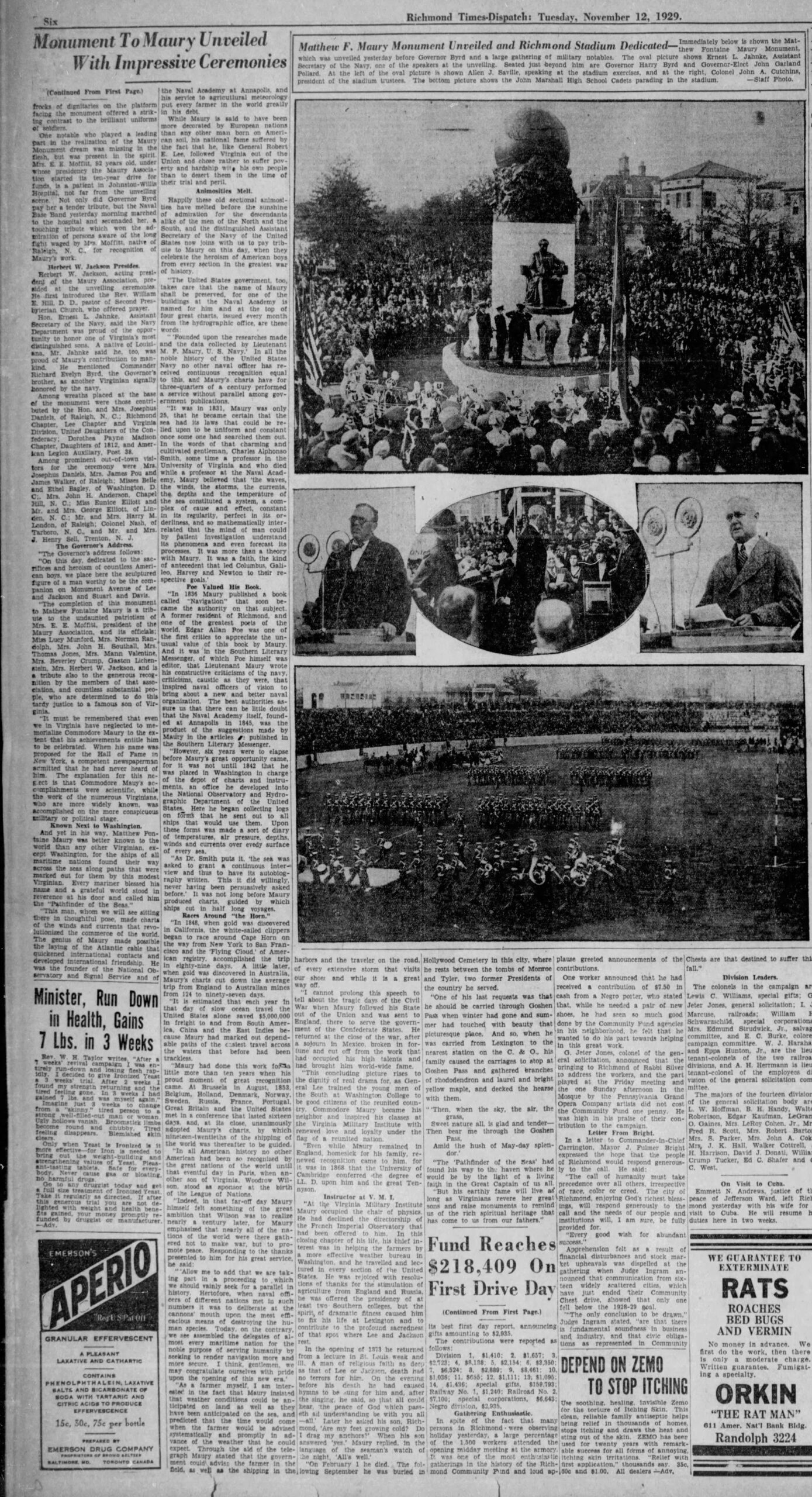
Matthew F. Maury Monument Unveiled and Richmond Stadium Dedicated —
Immediately below is shown the Matthew Fontaine Maury Monument, which was unveiled yesterday before Governor Byrd and a large gathering of military notables. The oval picture shows Ernest L. Jahnke, Assistant Secretary of the Navy, one of the speakers at the unveiling. Seated just beyond him are Governor Harry Byrd and Governor-Elect John Garland Pollard. At the left of the oval picture is shown Allen J. Saville, speaking at the stadium exercises, and at the right, Colonel John A. Cutchins, president of the stadium trustees. The bottom picture shows the John Marshall High School Cadets parading in the stadium — Staff Photo.