

Richmond Times-Dispatch · Jun 23, 1922
Richmond Times-Dispatch · Jun 23, 1922
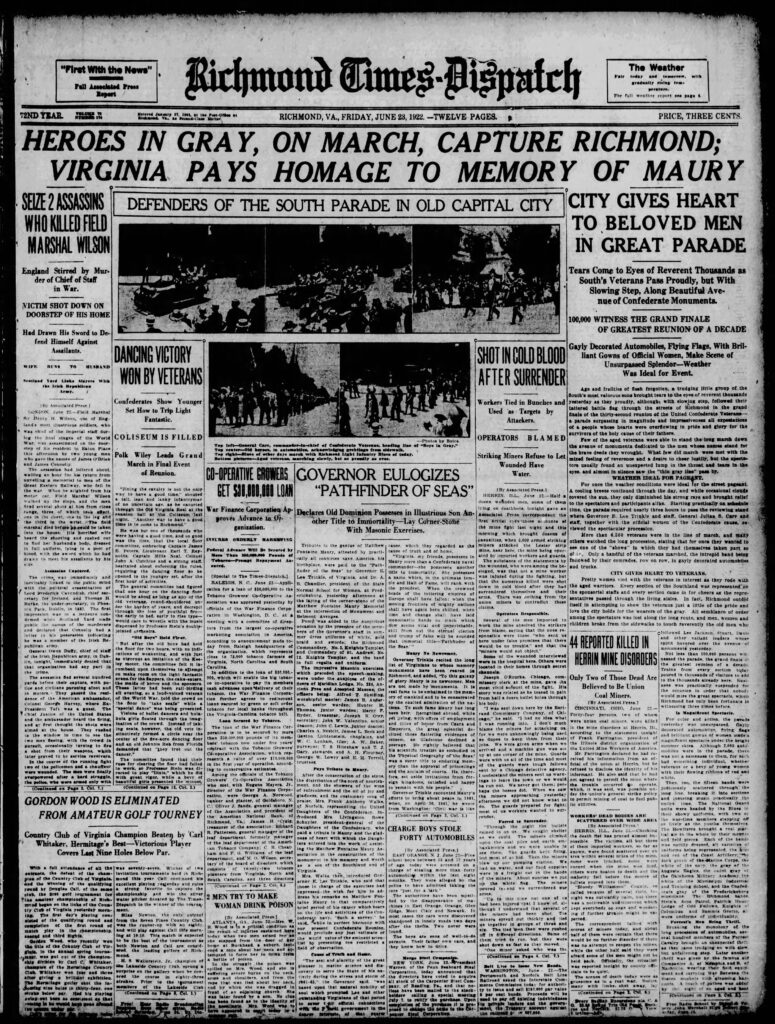
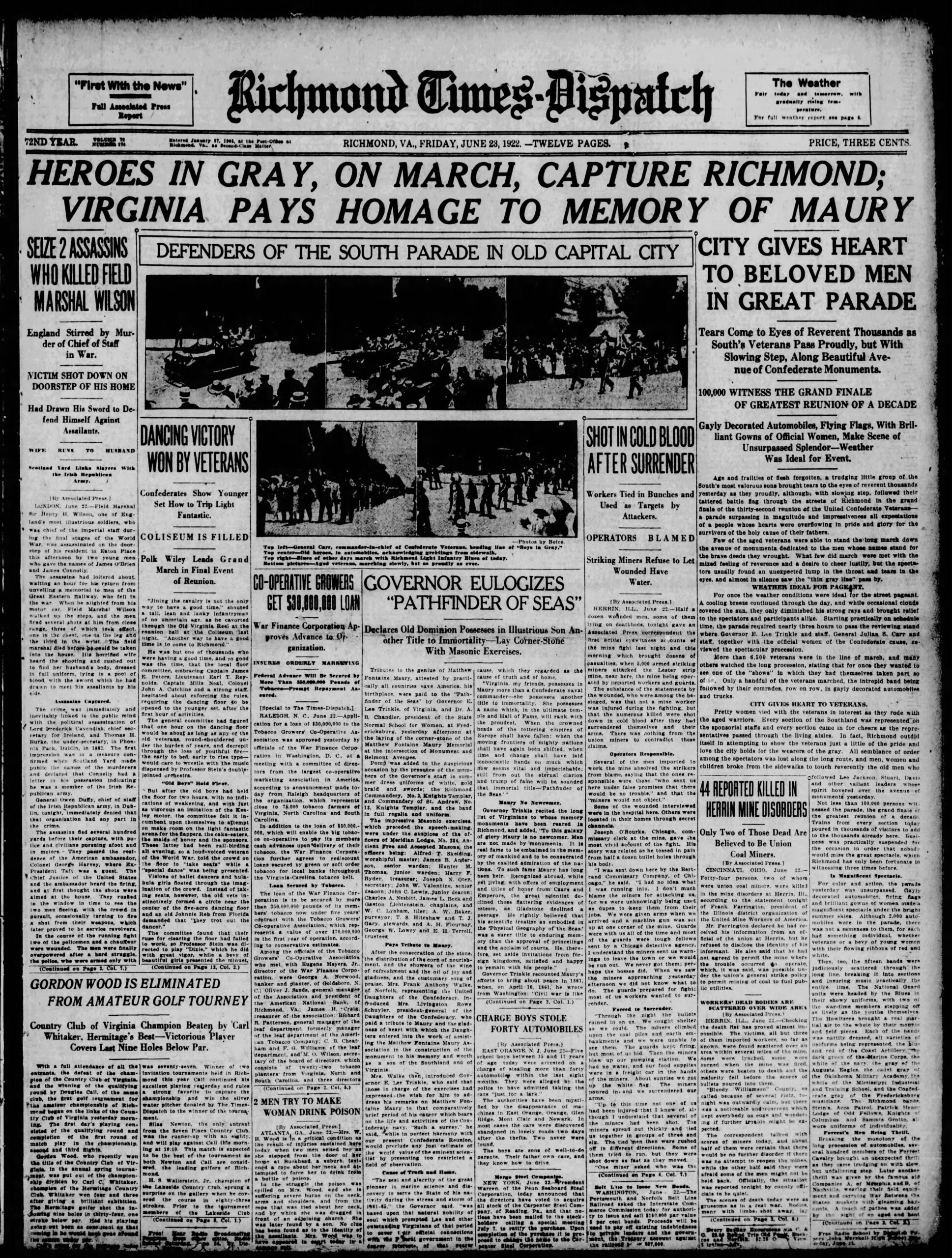
HEROES IN GRAY, ON MARCH, CAPTURE RICHMOND; VIRGINIA PAYS HOMAGE TO MEMORY OF MAURY
GOVERNOR EULOGIZES “PATHFINDER OF SEAS”
Declares Old Dominion Possesses in Illustrious Son Another Title to Immortality — Lay Corner-Stone With Masonic Exercises.
Tributes to the genius of Matthew Fontaine Maury, attested by practically all countries save America. his birthplace, were paid to the “Pathfinder of the Seas” by Governor E.
Leo Trinkle, of Virginia, and Dr. A. B. Chandler, president of the State Normal School for Women, at Fredericksburg, yesterday afternoon at the laying of the corner-stone of the Matthew Fontaine Maury Memorial at the intersection of Monument and Belmont Avenues.
Pomp was added to the auspicious occasion by the presence of the members of the Governor’s staff in summer dress uniforms of white, gold braid and swords; the Richmond Commandery, No. 2, Knights Templar, and Commandery of Bt. Andrew, No. 13, Knights Templar, and the band In full regalia and uniform.
The impressive Masonic exercises, which preceded the speech-making, were under the auspices of the officers of Meridian Lodge, No. 284, Ancient Free and Accepted Masons, the officers being: Alfred T. Skelding. worshipful master; James B. Anderson, senior warden; Hunter M. Thomas, junior warden; Harry F. Ryder, treasurer: Joseph N. Otey, secretary: John W. Valentine, senior deacon; John C. Lewis. junior deacon: Charles A. Nesbitt, James L, Beck and Gaston Lichtenstein, chaplains, and
W. C. Lynham, tiler; A. W. Baker, purveyor; T. S. Hiteshaw and T. J. Gary, stewards, and A. H. Flournoy, George W. Lowry and B. H. Terrell, trustees.
Pays Tribute to Maury.
After the consecration of the stone, the distribution of the corn of nourishment, and the showers of the wine of refreshment and the oil of joy and gladness, and the customary song of praise. Mrs. Frank Anthony Walke, of Norfolk, representing the United Daughters of the Confederacy, Introduced Mrs. Livingston Rowe Schuyler, president-general of the Daughters of the Confederacy, who paid a tribute to Maury and the gladness of heart with which the Daughters entered into the work of assisting the Matthew Fontaine Maury Association in the construction of the monument to his memory and worth as a son of the Southland and of Virginia.
Mrs. Walke then, introduced Governor E. Lee Trinkle, who said that those in charge of the exercises had expressed the wish for him to address his remarked on Matthew Fontaine Maury to that comparatively brief period of his career which bears on the life and activities of the Confederate navy. “Such & survey,” he said “while in perfect harmony with our present Confederate Reunion, would preclude any just estimate of the world value of the eminent scientist by presenting too restricted field of observation.
Cause of Truth and Home.
“The seal and alacrity of the great pioneer in marine science and discovery to serve the State of his nativity during the stress and storm of 1861-65,2 the Governor said “was based upon that natural nobility of soul which prompted Lee and other outstanding Virginians of that period to sever their official connections with the federal government in the () cause, which they regarded as the cause of truth and of home.
“Virginia, my friends, possesses in Maury more than a Confederate naval commander-she possesses another title to immortality. She possesses a name which, in the ultimate temple and Hell of Fame, will rank with the proudest. When the crowned heads of the tottering empires of Europe shall have fallen: when the moving frontiers of mighty nations shall have again been shifted; when time and change shall have laid iconoclastic hands on much which now seems vital and imperishable: still from out the eternal clarion and trump of fame will be sounded that immortal title—’Pathfinder of
the Seas.’”
Maury No Newcomer.
Governor Trinkle recited the long list of Virginians to whose memory monuments have been reared in Richmond, and added, “To this galaxy of glory Maury is no newcomer. Men are not made by monuments. It in real fame to be embalmed in the memory of mankind and to be consecrated by the exalted admiration of the nations. To such fame Maury has long been heir. Recognized abroad, while yet living, with offers of employment and titles of honor from Czars and Emperors, the great scientists declined those flattering evidences of esteem, as Gladstone declined a peerage. He rightly believed that his scientific treatise as embodied in the ‘Physical Geography of the Seas.’ was a surer title to enduring memory than the approval of princelings and the acclaim of courts. He, there-fore, set aside Invitations from foreign kingdoms, satisfied and happy to remain with his people.” Governor Trinkle recounted Maury’s efforts to bring about peace in 1861. when, on April 10, 1861, he wrote from Washington: “Civil war is like a conflagration. There is no telling when or where it will stop, as long as there is fuel to feed it.” Then on April 15 came the proclamation from President Lincoln calling on Virginia to furnish 75,000 troops, to which Virginia responded with an immediate ordinance of secession. On April 20, Maury answered the call of this State, resigned his commission in the United States Navy and repaired to Richmond.
“Retiring from the seclusion of the life of a scholar, Maury embarked upon one of tempestuous action. He began by applying in the practice of war theories perfected by him in the study and laboratory. The first great fruits of this labor was the introduction into the undeveloped water defenses of Richmond of the torpedo — but not such a torpedo as had ever before been employed in warfare… Having missed the James River, below Richmond, plans of this torpedo defense fell into the hands of the Federals. At this time, Northern officers as well as Southern officials were ignorant of electrical torpedo warfare. The result was that a panic seized upon the Federal fleet, paralyzing for a time its activity.”
Governor Trickle reviewed Maury’s trip to Great Britain to secure material for the manufacture of submarine explosives, and later, when he heard of the fall of the Confederate government, of him offering his services to Maximilian in an effort to form a colony of Virginians in Mexico.
Nothing we can say on this occasion will enhance the fame of one who is already gathered among the immortals,” said the Governor. “In erecting a memorial in bronze to the illustrious Virginian, we but honor ourselves in a tribute to greatness. Maury is not great because he was knighted by the Emperor of Russia, by the King of Denmark, by the King of Portugal, by the King of Belgium, by the Emperor of France; nor because he was decorated by the Pope by Austria, Prussia, Sweden, Holland, Sardinia, Bremen and Mexico. Such decoration was but a recognition of greatness a greatness founded on intelligence and on truth.
Maury’s Request Granited
It was the dying request of Commodore Maury that his body temporarily remain in Lexington until the spring of the year, after which it should be carried to Richmond. ‘And when you take me through the Goshen Pass,’ said he, ‘you must pluck the rhododendrons and the mountain ivy and lay them on me.’ The request was granted.
“There is something exquisitely and infinitely beautiful, my friends, in the simplicity of such a petition. This man, who had declined the royal favors of kinds, who had disdained the pomp of courts and disregarded the flattery of fame, reached now his hands in death for mountain flowers. And, in that final hour, when the great Maury paused for the moment on the brink of eternity, with God on one side and with death on the other, his heart became as a heart of a child. There was no solicitude on his part for a monument in bronze, no apprehension of the future; no fear for the past. Only the desire that, having fought the good fight, having kept the faith, he be ushered into the presence of the Master. That, like a little child, wearied with its joy and sorrows, he be admitted with rhododendrons and mountain ivy in his arms, into the () of the Father of all.”
Dr. Chandler was introduced by General Julian S. Carr commander-in-chief of the United Confederate Veterans, who was introduced by Mrs. E. E. Moffitt, president of the Maury Memorial Association. Dr. Chandler said, in part:
“How befitting is it that in this beautiful city, where his remains now sleep in yonder silent city of the dead, and on this spacious avenue, In calling distance of Davis and of Lee, of Stuart and of Jackson, this other immortal should also be portrayed in bronze that all the world may know we love him and appreciate his matchless contributions to the development of world civilization.
“How appropriate, too, that F. William Sievers, who designed Stonewall Jackson’s monument, should be chosen sculptor for this memorial-Jackson and Maury alike high servants of Virginia’s proud military institute and each attaining incomparable distinction in his respective sphere. It is no less appropriate that the Matthew Fontaine Maury Memorial Association and the United Daughters of the Confederacy should take the leadership. as they have done—God bless these splendid women of the South— in raising the funds of this statue.
Maury Matched by None.
“Impartial history warrants me in declaring to you that Matthew Fontaine Maury was not only the greatest scientist the South has yet produced, but one of the greatest of
the world in all ages, and, in his particular field of discovery, he is matched by none.
Not only so, but full examination of his record discloses the fact that his work was not local, but universal: not transient, but permanent: not benefiting a few, but all the earth. Nor is this all. In him I point you to the man who, in view of the character and value of his discoveries and the obstacles overcome, has received less recognition and reward from his fellow countrymen than any man who has ever lived amongst us.
“The ingratitude of this nation in in nothing more pointedly displayed than in its neglect or refusal thus tar to pay its incalculable debt to this constructive scientist by the
erection of a monument, the gift of a medal, or in any other appropriate way.
“The appearance of his name at the top of a pilot chart of the North Atlantic, prepared in April, 1922, by the hydrographic office of the national government, smacks of belated recognition of Maury as the nation’s pioneer hydrographer and offers suggestion that prejudice may not always control in withholding from this mighty son of the South that. measure of recognition which should be his.
Ingratitude In Accentuated.
“The unspeakable shamelessness of this ingratitude is accentuated by the studied and successful policy of petty politicians to suppress even mention of his name in the authoritative papers at the nation’s capital. His name is omitted at the Naval Observatory, which he founded; in the history of the Brussels conference, at which every civilized nation of the world did him distinction and unprecedented honor while he yet lived, the American historian, In his blinding prejudice, fails to record his name and in the beautiful Congressional Library at Washington the name of Maury does not appear either among the scientists or the naval officers of America.
“This unpardonable affront to truth and justice, thus exemplified, makes my blood boil, especially when searching for a motive. I find none, except the fact. that he was a Southerner and, in the War Between the States. he pinned his faith to the land of his fathers, following, like Lee, the dictates of his conscience, rather than the allurements of reward and honor.”
Reviews Life of Maury.
Dr. Chandler reviewed the life and activities of Maury, and closed, as follows:
“Born within ten miles of Fredericksburg. died at Lexington, buried In Richmond, with close and distinguished descendants now living within the borders of hie native State and throughout the Southland too modest, as was he, to seek notoriety, this silent scientist today receives at the hands of his Confederate contemporaries and the sons and daughters of his country the last loving recognition of his incomparable work.
How heartening it should be to our youth to come to this sacred shrine. to look upon his open and kindly face portrayed In bronze, to study his early boyhood life of struggle
and of disappointment, to learn from him the Value earnestness, of modesty, of perseverance, of industry, of self-abnegation and of Christian character. In these qualities, which were pre-eminently his, our posterity, though they may never startle the world, as did he, with useful discoveries or inventions, yet may imitate this great American, thus laying the surest foundation for independence and mastery, whatever
may be their mission in the world.”
The benediction was offered by Rev. S. L. Dumville, pastor of Fairmount Avenue Methodist Church