

POINT OF VIEW
Morality is never a clear-cut cause
BY ERIC MEDLIN
The debate over removing
Confederate statues has flared once again in recent days, with cities across the South either removing their monuments in the cover of night or offering plans for imminent removal. While no doubt prompted by the violence in Charlottesville over the weekend, these removals are rooted in long-standing campaigns against symbols of white supremacy across the country. Arguments for removing statues usually boil down to one simple desire: to prevent the state-sponsored admiration of white supremacy. But what happens when statues commemorate more complicated figures than Confederate Gen.
Robert E. Lee or Klan founder Nathan Bedford Forrest?
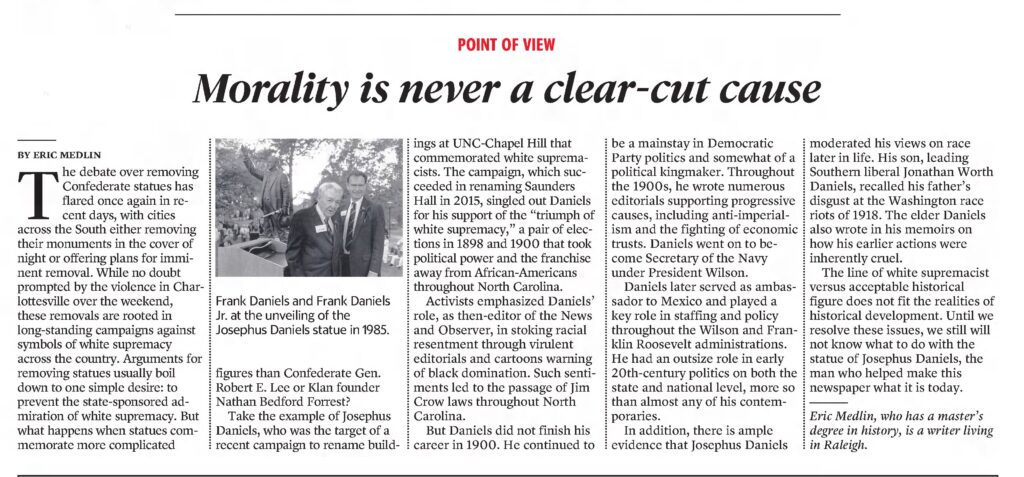
Frank Daniels and Frank Daniels Jr. at the unveiling of the Josephus Daniels statue in 1985.
Take the example of Josephus Daniels, who was the target of a recent campaign to rename buildings at UNC-Chapel Hill that commemorated white supremacists. The campaign, which succeeded in renaming Saunders Hall in 2015, singled out Daniels for his support of the “triumph of white supremacy,” a pair of elections in 1898 and 1900 that took political power and the franchise away from African-Americans throughout North Carolina.
Activists emphasized Daniels’ role, as then-editor of the News and Observer, in stoking racial resentment through virulent editorials and cartoons warning of black domination. Such sentiments led to the passage of Jim Crow laws throughout North Carolina.
But Daniels did not finish his career in 1900. He continued to be a mainstay in Democratic Party politics and somewhat of a political kingmaker. Throughout the 1900s, he wrote numerous editorials supporting progressive causes, including anti-imperial-ism and the fighting of economic trusts. Daniels went on to become Secretary of the Navy under President Wilson.
Daniels later served as ambassador to Mexico and played a key role in staffing and policy throughout the Wilson and Franklin Roosevelt administrations.
He had an outsize role in early 20th-century politics on both the state and national level, more so than almost any of his contemporaries.
In addition, there is ample evidence that Josephus Daniels moderated his views on race later in life. His son, leading Southern liberal Jonathan Worth Daniels, recalled his father’s disgust at the Washington race riots of 1918. The elder Daniels also wrote in his memoirs on how his earlier actions were inherently cruel.
The line of white supremacist versus acceptable historical figure does not fit the realities of historical development. Until we resolve these issues, we still will not know what to do with the statue of Josephus Daniels, the man who helped make this newspaper what it is today.
Eric Medlin, who has a master’s degree in history, is a writer living in Raleigh.