

The Baltimore Sun · Jan 23, 1989
The Baltimore Sun · Jan 23, 1989
Once again, Lee and Jackson draw nostalgic salutes
Baltimore tribute reflects romantic appeal of South
By Michael Olive
In the chill of a brilliant January morning, the Confederate gray once again marched under the shadow of Bobby Lee and Old Jack.
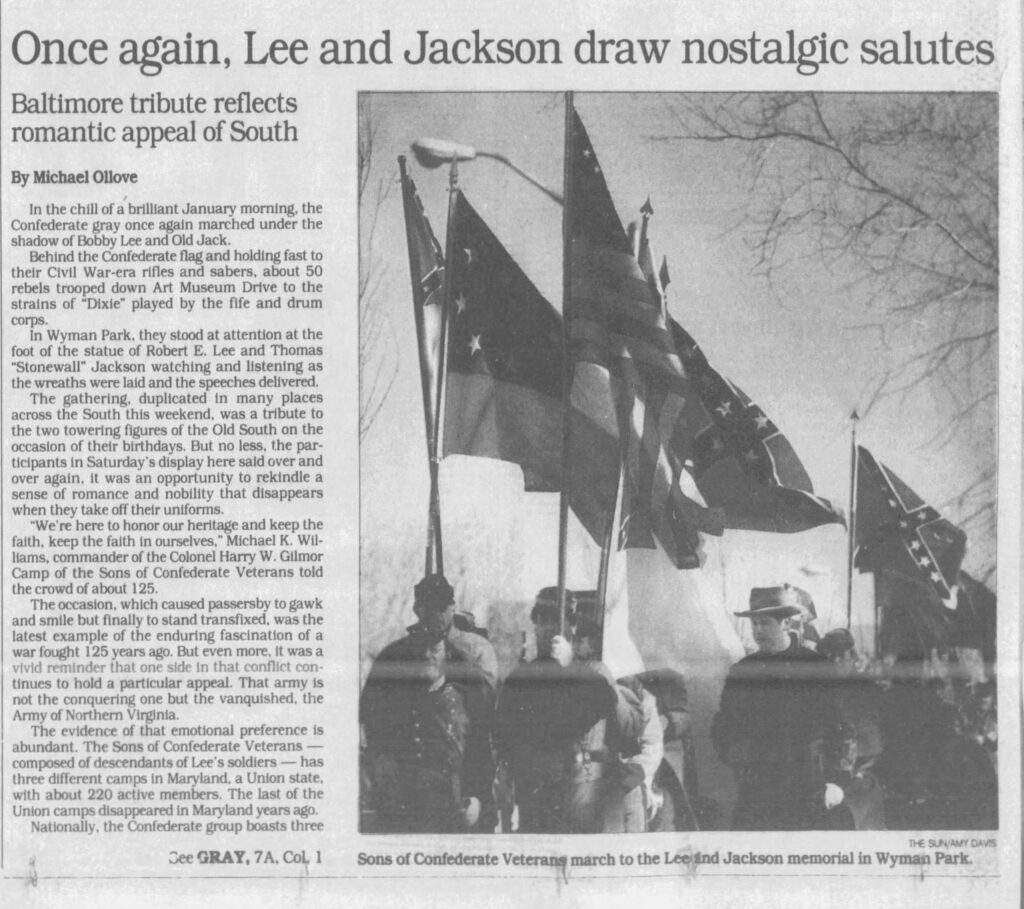
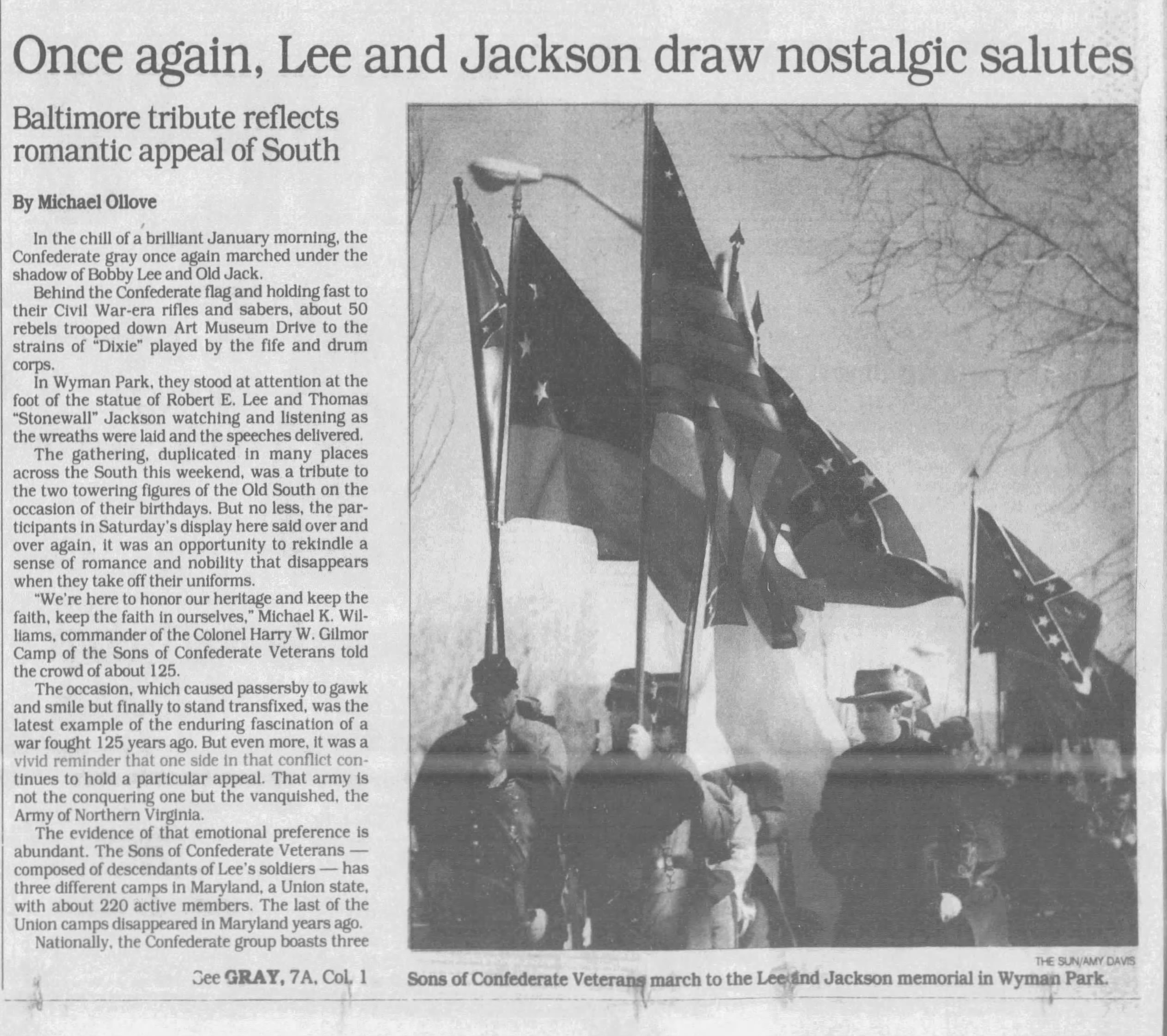
Behind the Confederate flag and holding fast to their Civil War-era rifles and sabers, about 50 rebels trooped down Art Museum Drive to the strains of “Dixie” played by the fife and drum corps.
In Wyman Park, they stood at attention at the foot of the statue of Robert E. Lee and Thomas “Stonewall” Jackson watching and listening as the wreaths were laid and the speeches delivered.
The gathering, duplicated in many places across the South this weekend, was a tribute to the two towering figures of the Old South on the occasion of their birthdays. But no less, the participants in Saturday’s display here said over and over again, it was an opportunity to rekindle a sense of romance and nobility that disappears when they take off their uniforms.
“We’re here to honor our heritage and keep the faith, keep the faith in ourselves,” Michael K. Williams, commander of the Colonel Harry W. Gilmor Camp of the Sons of Confederate Veterans told the crowd of about 125.
The occasion, which caused passersby to gawk and smile but finally to stand transfixed, was the latest example of the enduring fascination of a war fought 125 years ago. But even more, it was a vivid reminder that one side in that conflict continues to hold a particular appeal. That army is not the conquering one but the vanquished, the Army of Northern Virginia.
The evidence of that emotional preference is abundant. The Sons of Confederate Veterans composed of descendants of Lee’s soldiers – has three different camps in Maryland, a Union state, with about 220 active members. The last of the Union camps disappeared in Maryland years ago.
Nationally, the Confederate group boasts three times as many members as the Northern organization even though the Union Army outnumbered the South’s by nearly three to one.
Those who operate Civil War milItary parks say that Confederate memorabilia easily outsell Union merchandise. The product manager for Time-Life Inc.’s enormously successful Civil War volume said that books with a Southern focus, such as “Lee Takes Command” always do well. The company, though, has learned not to try to sell a book with a Northern focus.
“In the North, we find that they’re not as dedicated to the war as a Northern cause but in the war as a totality,” said Kathy Bloomfield.
And in Europe, where Civil War re-enactment groups are also active, new members are required to serve first in the Union Army because everyone wants to wear the Confederate gray.
The lure of the Confederacy seems to have nothing to do with politics – although certainly many in Confederate organizations de-emphasize the role of slavery as a cause of the Civil War – but instead is due to a romanticized view of the Southern army and the notions of idealism, chivalry and gallantry.
“Maybe losers simply have more reason to venerate the past than winners,” Richard Schlenker, onetime commander of the Sons of Union Veterans, said ruefully last week from his Rockville home.
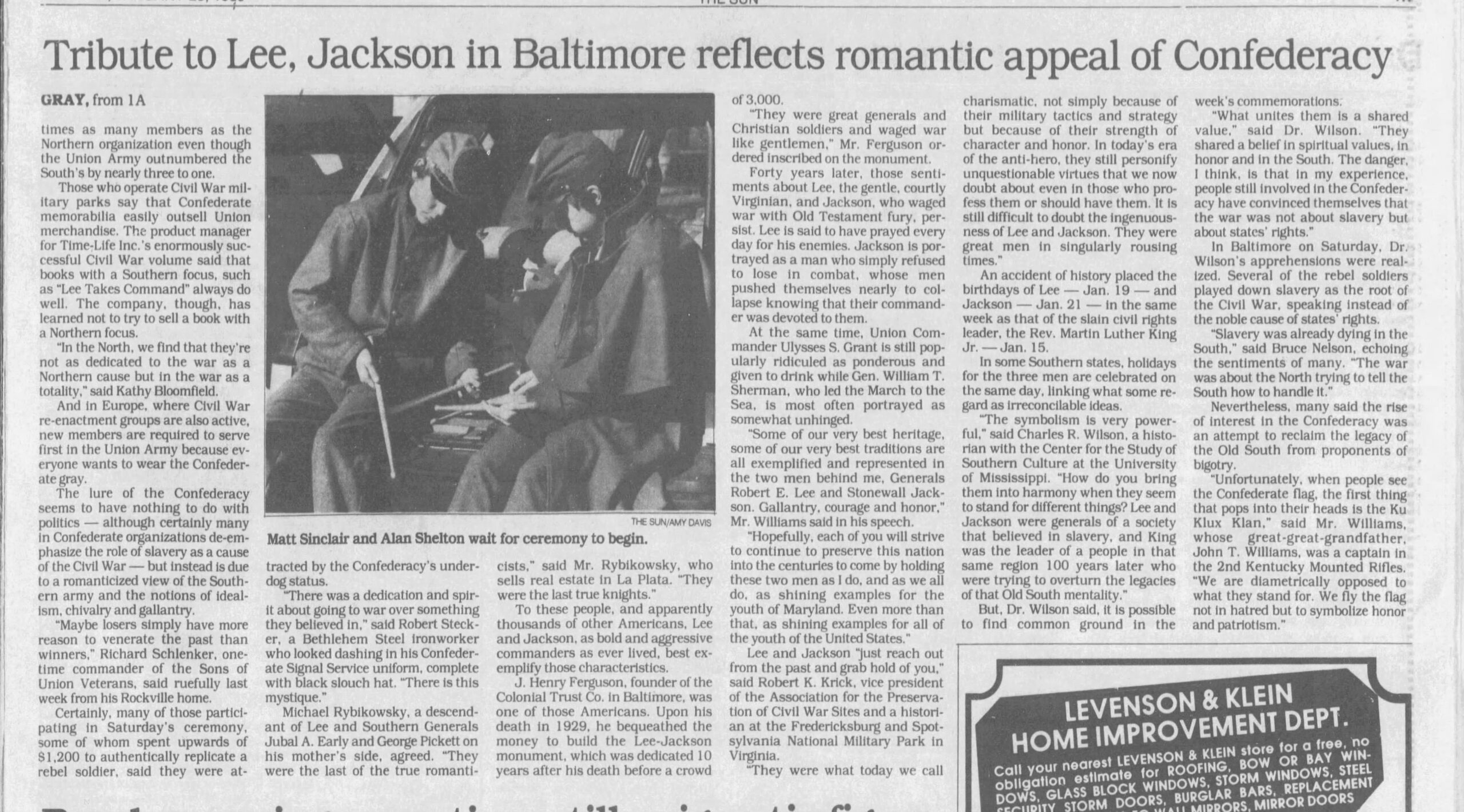
Certainly, many of those participating in Saturday’s ceremony, some of whom spent upwards of $1,200 to authentically replicate a rebel soldier, said they were attracted by the Confederacy’s underdog status.
“There was a dedication and spirit about going to war over something they believed in,” said Robert Stecker, a Bethlehem Steel ironworker who looked dashing in his Confederate Signal Service uniform, complete with black slouch hat. “There is this mystique.”
Michael Rybikowsky, a descendant of Lee and Southern Generals Jubal A. Early and George Pickett on his mother’s side, agreed. “They were the last of the true romanticists,” said Mr. Rybikowsky, who sells real estate in La Plata. “They were the last true knights.”
To these people, and apparently thousands of other Americans, Lee and Jackson, as bold and aggressive commanders as ever lived, best exemplify those characteristics.
J. Henry Ferguson, founder of the Colonial Trust Co. in Baltimore, was one of those Americans. Upon his death in 1929, he bequeathed the money to build the Lee-Jackson monument, which was dedicated 10 years after his death before a crowd of 3,000.
“They were great generals and Christian soldiers and waged war like gentlemen,” Mr. Ferguson ordered inscribed on the monument.
Forty years later, those sentiments about Lee, the gentle, courtly Virginian, and Jackson, who waged war with Old Testament fury, persist. Lee is said to have prayed every day for his enemies. Jackson is portrayed as a man who simply refused to lose in combat, whose men pushed themselves nearly to collapse knowing that their commander was devoted to them.
At the same time, Union Commander Ulysses S. Grant is still popularly ridiculed as ponderous and given to drink while Gen. William T.
Sherman, who led the March to the Sea, is most often portrayed as somewhat unhinged.
“Some of our very best heritage, some of our very best traditions are all exemplified and represented in the two men behind me, Generals Robert E. Lee and Stonewall Jack-son. Gallantry, courage and honor,” Mr. Williams said in his speech.
“Hopefully, each of you will strive to continue to preserve this nation into the centuries to come by holding these two men as I do, and as we all do, as shining examples for the youth of Maryland. Even more than that, as shining examples for all of the youth of the United States.”
Lee and Jackson “just reach out from the past and grab hold of you,” said Robert K. Krick, vice president of the Association for the Preservation of Civil War Sites and a historian at the Fredericksburg and Spotsylvania National Military Park in Virginia.
“They were what today we call charismatic, not simply because of their military tactics and strategy but because of their strength of character and honor. In today’s era of the anti-hero, they still personify unquestionable virtues that we now doubt about even in those who profess them or should have them. It is still difficult to doubt the ingenuousness of Lee and Jackson. They were great men in singularly rousing times.”
An accident of history placed the birthdays of Lee — Jan. 19 – and Jackson – Jan. 21 – in the same week as that of the slain civil rights leader, the Rev. Martin Luther King
Jr. – Jan. 15.
In some Southern states, holidays for the three men are celebrated on the same day, linking what some regard as irreconcilable ideas.
“The symbolism is very powerful,” said Charles R. Wilson, a historian with the Center for the Study of Southern Culture at the University of Mississippi. “How do you bring them into harmony when they seem to stand for different things? Lee and Jackson were generals of a society that believed in slavery, and King was the leader of a people in that same region 100 years later who were trying to overturn the legacies of that Old South mentality.”
But, Dr. Wilson said, it is possible to find common ground in the week’s commemorations.
“What unites them is a shared value,” said Dr. Wilson. “They shared a belief in spiritual values, in honor and in the South. The danger, I think, is that in my experience, people still involved in the Confederacy have convinced themselves that the war was not about slavery but about states’ rights.”
In Baltimore on Saturday. Dr. Wilson’s apprehensions were realized. Several of the rebel soldiers played down slavery as the root of the Civil War, speaking instead of the noble cause of states’ rights.
“Slavery was already dying in the South.” said Bruce Nelson, echoing the sentiments of many. “The war was about the North trying to tell the South how to handle it.”
Nevertheless, many said the rise of interest in the Confederacy was an attempt to reclaim the legacy of the Old South from proponents of bigotry.
“Unfortunately, when people see the Confederate flag, the first thing that pops into their heads is the Ku Klux Klan,” said Mr. Williams, whose great-great-grandfather, John T. Williams, was a captain in the 2nd Kentucky Mounted Rifles. “We are diametrically opposed to what they stand for. We fly the flag not in hatred but to symbolize honor and patriotism.”